A pair of dumbbells is all you need to build stronger, more defined calves at home or in the gym. Calf raises with dumbbells are simple to learn, joint friendly, and easy to fit into your current routine, yet they can noticeably improve your lower-leg strength, balance, and performance.
Below, you will learn exactly how to do calf raises with dumbbells, how to adjust them for your goals, and how to avoid the common mistakes that keep calves from growing.
Why calf raises with dumbbells work
Your calves are made up mainly of two muscles: the gastrocnemius (the big, visible muscle) and the soleus (deeper, underneath). Both help you point your toes, push off when you walk or run, and stabilize your ankles and knees.
Dumbbell calf raises directly train these muscles by asking them to lift your entire body plus the added weight. According to Edward R. Laskowski, M.D., the calf raise exercise with dumbbells strengthens the calf muscles at the back of your lower legs and helps protect your Achilles tendon from injury. That means you are not just training for appearance, you are also supporting daily movement and long-term joint health.
Because you can easily change weight, reps, and tempo, dumbbells make it simple to progress gradually without needing a full machine setup.
How to do standing calf raises with dumbbells
The standing dumbbell calf raise is your foundation. It mainly targets the gastrocnemius, which plays a big role in power and definition.
Step-by-step form
Nicole L. Campbell from the Mayo Clinic recommends this basic setup for calf raises with dumbbells:
- Stand upright with a dumbbell in each hand, arms relaxed at your sides.
- Place your feet shoulder-width apart, toes pointing straight ahead.
- Keep your back and knees straight but not locked.
- Rise smoothly onto the balls of your feet as high as you can.
- Pause briefly at the top and feel the contraction in your calves.
- Slowly lower your heels back to the starting position.
You should feel tension in the muscles at the back of your lower legs from the bottom to the top of each rep. Focus on smooth, controlled movements rather than bouncing.
If you struggle with balance, the Mayo Clinic suggests using a chair, wall, or pole for light support while you learn the movement.
Using an elevated surface for more range
You can perform calf raises with dumbbells flat-footed on the floor, and you will still get benefits. However, balancing the front of your foot on a low step or weight plate so your heel can drop below your toes changes the exercise in a useful way.
This heel-hanging setup, popularized in routines like the Frankoman dumbbell workout, lets your calves stretch more at the bottom and contract more fully at the top. That increased range of motion is believed to provide a stronger stimulus than flat-footed raises, especially for growth and mobility.
You do not need a tall platform. Community advice around this method suggests only a few inches in height is enough to work effectively. You can use a:
- Sturdy exercise step
- Thick weight plate
- Low, homemade wooden block or step
Plans for building small, affordable steps are easy to find online and can be a good option if you do not have commercial stands available.
When you use an elevated surface, think about:
- Keeping the ball of your foot solidly planted so you feel stable
- Lowering your heel as far as comfortable without pain
- Pushing up through the entire width of your forefoot, not just your big toe
Single leg vs double leg dumbbell calf raises
You can do calf raises with both legs at once or one leg at a time. Each version offers something slightly different.
Double leg standing dumbbell calf raise
This is the best starting point if you are new to calf training or returning after a break. It improves balance and lets you load both calves at the same time.
You simply follow the main standing instructions, but you focus on pushing evenly through both feet. This version works well when you are using heavier dumbbells that might be uncomfortable to hold on one side only.
Single leg standing dumbbell calf raise
The single leg version is more challenging and is very effective for building strength and evening out imbalances between sides. It also places more demand on your balance and coordination.
To do it:
- Stand on one leg with the ball of that foot on the floor or an elevated step.
- Hold a dumbbell in the hand on the same side as your working leg.
- Use your free hand lightly on a wall or chair if needed for balance.
- Keep your knee straight and your body tall.
- Lower your heel as far as you comfortably can.
- Push up strongly onto your toes, then lower slowly.
This variation targets both the gastrocnemius and the soleus, which are essential for ankle extension, foot stability, and even knee support. Because you are on one leg, the working calf has to handle more of the load on its own.
Seated calf raises with dumbbells
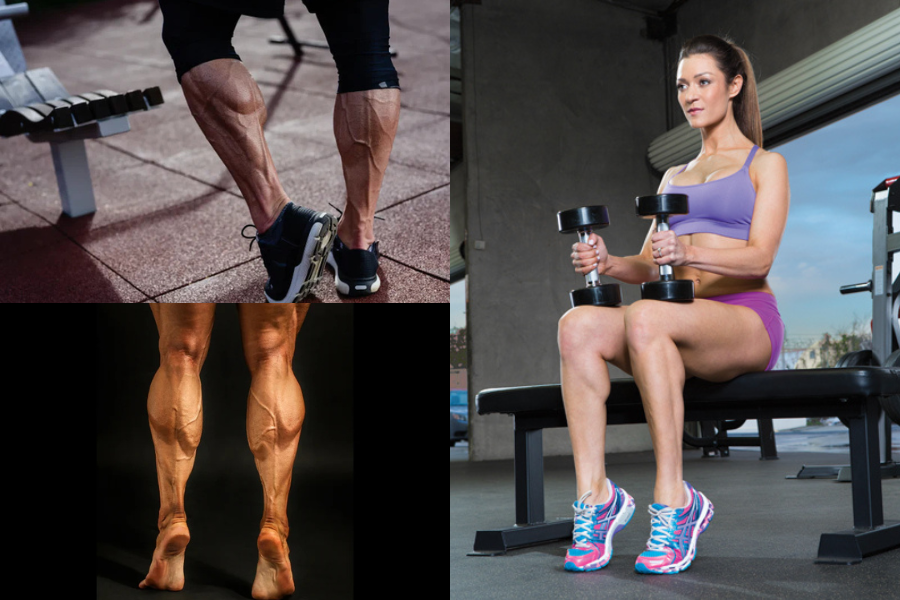
Standing calf raises put more emphasis on the gastrocnemius. If you want to better target the soleus, the deep muscle that is rich in slow-twitch fibers, seated calf raises with dumbbells are a smart addition.
To perform them:
- Sit on a bench with your feet flat on the floor, hip-width apart.
- Place a dumbbell across your thighs, close to your knees. If needed, use a towel or pad under the weight for comfort.
- Optional: place the balls of your feet on a low plate or step so your heels can drop.
- Keep your back supported and upright.
- Raise your heels as high as possible, lifting the dumbbell.
- Pause briefly at the top, then lower your heels slowly until you feel a stretch.
Good back support is important here to avoid straining your lower back. You can lean forward slightly as long as your spine remains neutral and you feel the work in your calves, not your low back.
Because the soleus responds well to higher repetitions, seated calf raises often work best with moderate weight and longer sets.
Reps, sets, and how much weight to use
The right weight for calf raises with dumbbells depends on your experience and goals, but you can use general strength standards as a rough reference.
In 2026, the average one-rep max (1RM) dumbbell calf raise for male lifters is about 85 lb, which is classified as an intermediate level and considered very impressive. For beginners, a 17 lb one-rep max is already strong relative to the general population. For female lifters, the average 1RM is around 48 lb at the intermediate level, and 16 lb is an impressive beginner one-rep max. These dumbbell calf raise strength standards help you compare your performance with others of similar bodyweight.
You do not need to test a true 1RM to benefit, but these numbers can guide your expectations. As a rule of thumb:
- If you are new or focusing on general fitness, start with a weight that lets you do 1 set of 12 to 15 reps in good form, as recommended by the Mayo Clinic.
- If you want more muscle growth, aim for 3 sets of 8 to 15 reps, adding weight over time when you can complete the high end of the range.
- For endurance and soleus development, especially in seated raises, you can use lighter weight for 15 to 20 controlled reps.
Always prioritize form over loading more plates. The goal is to feel your calves working throughout the whole range of motion, not just survive the heaviest possible set.
Common mistakes to avoid
Even simple movements can be done poorly if you rush through them. Here are key errors to watch for when you do calf raises with dumbbells:
Relying on speed or momentum
Performing reps too quickly or bouncing at the bottom shifts force away from your calf muscles and into your Achilles tendon. This not only reduces muscle activation, it can also increase strain on the tendon. Slow your reps down, especially at the bottom and top.
Cutting the range of motion short
Stopping halfway because the weight is too heavy means you miss the deep stretch and full contraction that make calf raises effective. Reduce the weight if you need to so you can lower your heel as much as possible and rise as high as you can without pain.
Letting your ankles roll inward or outward
If your feet collapse inward or roll out, you change how the stress is distributed through your calves and ankles. Focus on pressing through the entire width of your forefoot. Think about your big toe, little toe, and the area in between staying in contact with the step.
Losing posture
Rounding your back or bending your knees a lot takes focus away from the calves. Stand tall, keep your core lightly engaged, and let your ankles do the movement.
Trying advanced tricks before mastering basics
Single leg variations, elevated surfaces, and slow tempos are excellent tools, but they work best if you already own the basic standing motion. Spend a few sessions on flat ground if you feel wobbly at first.
Simple weekly calf routine with dumbbells
You do not need a long, complicated workout to see results. Two or three focused calf sessions per week can significantly improve strength and muscle over time.
Here is a straightforward routine you can plug into the end of your lower body or full-body workouts:
- Standing double leg dumbbell calf raise
- 3 sets of 10 to 15 reps
- Use an elevated surface if you have one
- Single leg standing dumbbell calf raise
- 2 sets of 8 to 12 reps per leg
- Hold a lighter dumbbell and use a wall or chair for support if needed
- Seated dumbbell calf raise
- 2 sets of 15 to 20 reps
- Focus on a slow tempo and deep stretch
Rest 45 to 90 seconds between sets. When all your sets feel challenging but controlled, and you can hit the top of your rep range without losing form, increase the dumbbell weight slightly.
Final tips for better results
To get the most out of calf raises with dumbbells, think consistency and quality over tricks and extremes. Train your calves regularly, use a full range of motion, and adjust variations to your level. If balance is a struggle, give yourself permission to hold onto something for stability instead of fighting to stay upright.
You can start today by adding just one or two sets of standing dumbbell calf raises to your normal workout. Over the next few weeks, slowly build volume and experiment with single leg and seated versions. With a little patience and attention to form, you will notice stronger, more responsive calves every time you climb stairs, walk, or sprint.
About the Author