A good calf workout does not require a gym or fancy machines. With a few smart bodyweight calf exercises, you can build strength, improve balance, and support healthier ankles and knees using just your own body weight and a bit of floor space.
Below, you will find simple moves you can do at home, in a hallway, or even on a stairwell. You will also learn how your calf muscles work so you can get more from every rep.
Understand your calf muscles
Before you start, it helps to know what you are actually training. Your calves are more than just one muscle on the back of your lower leg.
The calf area is mainly made up of two muscles, the gastrocnemius and the soleus. They run down the backs of your lower legs and attach into the Achilles tendon. You use them every time you walk, run, jump, or go up on your toes, so strong calves are key for everyday movement as well as sports performance.
Most bodyweight calf exercises target both muscles, but your position can emphasize one more than the other. Straight-leg variations tend to hit the gastrocnemius harder, while bent-knee positions bring the soleus into the spotlight. Keeping this in mind will help you choose the right variations for your goals.
Classic standing calf raises
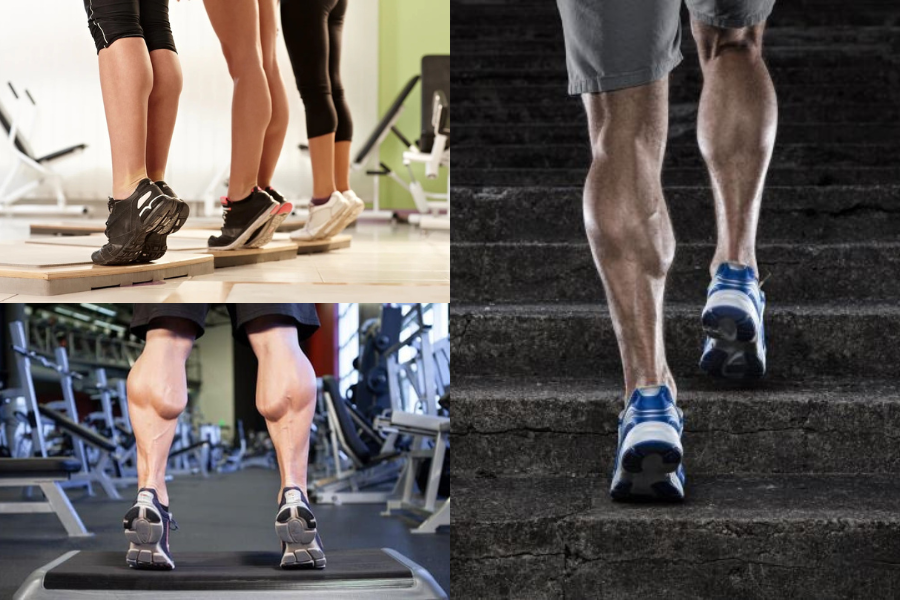
If you only did one calf exercise, the standing calf raise would be the best choice. It directly targets both major calf muscles and can be done anywhere without equipment.
To perform a bodyweight standing calf raise, stand with your feet about hip width apart and your toes facing forward. Engage your core, then slowly lift your heels off the ground until you are balanced on the balls of your feet. Pause briefly at the top, then lower your heels back to the floor with control.
Aim for 2 to 3 sets of 10 to 20 reps at first. Focus on smooth, controlled movement and avoid bouncing. You can place your hands lightly on a wall or counter for balance. Over time, you can progress by increasing repetitions, slowing the tempo, or moving to a single leg version.
Elevated and angled calf variations
Once the basic version feels easy, changing your foot position or using a small step makes the exercise more challenging and more effective.
You can perform calf raises on an elevated surface such as a stair, curb, or sturdy low step. Stand with the balls of your feet on the edge and your heels hanging off. This setup lets your heels drop slightly below the step, which creates a deeper stretch and larger range of motion. Lift your heels as high as you comfortably can, then lower until you feel a gentle stretch in the calves.
Rotating your toes can also change which parts of the muscle work hardest. Try three positions during your workout:
- Toes pointed forward
- Toes turned slightly outward
- Toes turned slightly inward
With your feet shoulder width apart and knees soft but not locked, slowly lift and lower your heels in each position. These subtle adjustments help recruit different fibers throughout the gastrocnemius and soleus.
Single leg calf raises for balance and strength
When you are ready for a step up in difficulty, single leg calf raises are one of the most effective bodyweight calf exercises you can do. Working one leg at a time effectively doubles the load on the working leg and challenges your balance at the same time.
Stand tall on one leg with the other foot slightly off the ground. You can use a wall or chair for light support. Slowly rise onto the ball of your standing foot, pause at the top, then lower your heel back down in a controlled way.
Single leg calf raises improve lower body strength, balance, and body control by targeting the muscles unilaterally and increasing the range of motion at the ankle joint. They are also important in rehabilitation settings, because being able to perform them comfortably is often considered a key step before you return to higher impact activities like running.
Start with 2 sets of 8 to 10 reps per side. As your control improves, let go of support for part of the set or move to an elevated surface for more range.
Dynamic calf moves you can add
You do not have to stick only to up and down heel raises. Several familiar bodyweight moves challenge your calves along with the rest of your lower body.
Lunge pulses are a variation of forward lunges that keep constant tension on the legs. From a long stance, sink into a lunge and then pulse up and down in a small range, keeping your front heel planted. You will feel your calf working to stabilize the ankle as you move.
Mountain climbers also involve the calves through repeated jumping or stepping in and out of a plank position. They are more explosive, so they build both strength and endurance in the lower legs while also providing a cardiovascular challenge.
Bodyweight squats on a slant board or with your heels slightly elevated can increase calf activation as well. If you do not have a board, placing your heels on a folded towel or small weight plate can create a similar angle.
Jump rope and tiptoe walking
If you like more rhythmic, cardio based training, jump rope is a simple way to strengthen your calves while raising your heart rate. Repeated small jumps on the balls of your feet build calf muscle strength and endurance and offer cardiovascular benefits at the same time.
You can start without an actual rope by performing small, quick jumps in place. Begin with 1 minute of continuous jumping, rest, then repeat. Over time, work up to 3 minutes at a time. Focus on landing softly and keeping your knees slightly bent to reduce impact.
On days when you do not feel like jumping, walking on tiptoes is a quieter alternative that still challenges your calves. Try walking on your toes for 30 seconds at a time, keeping your heels lifted and your core engaged. You can do this down a hallway or around your living room as an easy finisher after a workout.
Isometric and wall based options
If impact is a concern, or you want to add intensity without extra equipment, isometric holds and wall exercises are helpful tools.
Isometric calf raises use a pause at the top of the movement to increase muscle engagement. Perform a traditional calf raise, then hold the top position for a deep inhale and a count of 3 before you slowly lower your heels. This brief hold recruits more muscle fibers and can make a simple set feel significantly harder.
Wall sits are another lower body exercise that can indirectly challenge the calves, especially if you experiment with foot position. Slide your back down a wall until your knees are bent to about 90 degrees and hold. Variations such as wall sits with arms overhead increase the full body challenge. Pressing gently through the balls of your feet during the hold will recruit the calves along with your quads and glutes.
You can also finish a leg workout with tibialis and calf raises to fully train the muscles around the lower leg. For tibialis raises, lean your back against a wall with heels slightly away and lift your toes toward your shins. Pairing these with calf raises helps create more balanced lower leg strength.
How to structure a calf focused session
To build stronger, leaner legs, you do not need a long, complicated routine. A focused 10 to 15 minute calf session two or three times a week can make a noticeable difference in strength, ankle stability, and endurance.
Here is a simple sample structure you can follow:
| Step | Exercise | Sets x Reps / Time | Notes |
|---|---|---|---|
| 1 | Standing calf raises | 2 x 15 to 20 | Warm up, full range of motion |
| 2 | Single leg calf raises | 2 x 8 to 12 per side | Use support if needed |
| 3 | Elevated calf raises (toes in, out, forward) | 1 set of 10 each position | Slow tempo, controlled stretch |
| 4 | Jump rope or tiptoe walking | 2 x 1 to 2 minutes | Focus on soft, quiet landings |
| 5 | Isometric calf holds | 2 x 20 to 30 seconds | Hold at top of raise |
| 6 | Calf stretch | 3 x 30 seconds each leg, 2 positions | One with straight knee, one with bent knee |
You can insert this mini routine at the end of a leg day, or on a lighter day as a stand alone session. If you follow a more complete leg workout that already includes single leg squats, step ups, Bulgarian split squats, and walking backwards with a sled, finishing with tib and calf raises is an effective way to round out your training.
Stretch and care for your calves
Strong muscles are important, but so is flexibility. Tight calves can increase strain on your Achilles tendon and limit your ankle mobility, which can affect your running, squatting, and even your daily walking.
Regular calf stretches, held for 30 seconds and repeated three times, help lengthen the muscle tissue and reduce the risk of injury. To target both the gastrocnemius and the soleus, use two positions:
- Straight leg stretch, with your hands on a wall and your back leg straight and heel down
- Bent knee stretch, in the same stance but with your back knee slightly bent
You should feel a comfortable pull along the back of the lower leg but no sharp pain. Breathe steadily and do not bounce. Adding these stretches after your workouts, or at the end of the day, keeps your calves supple and ready for your next session.
Progress safely and stay consistent
Bodyweight calf exercises are accessible to all fitness levels, but you still want to progress gradually. Focus first on mastering your form and using a full range of motion, which means achieving a strong height at the top of each raise and a gentle stretch at the bottom.
When basic sets feel easy, increase repetitions, slow down the pace of each rep, add isometric holds, or move to single leg and elevated versions. You can later add external resistance, such as holding a backpack or dumbbells, but it is not required to see progress.
Working your calves 2 to 3 times per week is usually enough to see improvements in strength, posture, and running efficiency. Over time, you may notice less fatigue when you walk or climb stairs, better ankle stability, and more defined lower legs.
Start with one or two of the exercises above and weave them into your existing routine. As they become familiar, layer in new variations and small challenges. Your calves work for you all day. A few focused minutes of training is a worthwhile way to return the favor.
About the Author