A strong pair of quads powers everything from your squat to your sprint. Quad isolation exercises let you focus directly on this muscle group so you can build size, strength, and definition without being limited by your hips, glutes, or lower back.
Below, you will learn how quad isolation work fits into your training, how to structure quick but effective sessions, and the key moves that give you the most muscle for your effort.
Understand quad isolation exercises
Quad isolation exercises use a single joint movement so your quadriceps do almost all the work. Instead of relying on a heavy back squat to hit your quads indirectly, you use more controlled patterns that focus on straightening the knee.
Isolation work is especially useful when you:
- Want to bring up lagging quads for more balanced legs
- Need extra volume without overloading your whole body
- Are correcting imbalances between your left and right leg
- Care about definition and a strong “quad pump” at the end of a workout
Research from Gymshark explains that isolation exercises like the seated leg extension minimize help from muscles such as the glutes and hamstrings so you can drive more focused quad development.
Why quad isolation boosts muscle gain
If you already squat, lunge, and leg press, you might wonder why you need isolation work at all. The reason comes down to targeted tension and smart fatigue management.
Focused overload where you want it most
Compound lifts build overall strength very efficiently, but other muscles often take over when your quads get tired. In a back squat, for example, your hips and lower back can do more work as the weight climbs, which sometimes leaves your quads undertrained.
With isolation exercises like leg extensions or sissy squats, the quads stay in the hot seat the entire time. RP Strength notes that leg extensions are ideal for hitting parts of the quadriceps that squats may not stimulate as effectively, especially when you chase moderate to high rep ranges.
More volume with less overall stress
Because isolation exercises support the rest of your body, you can usually recover from them faster than from heavy compound lifts. Several guides highlight that leg extensions are easier to recover from and can be performed more often since the quads do all the work while your torso and hips stay supported by the machine.
This lets you:
- Add extra sets at the end of a leg day
- Train your quads twice a week without feeling completely wiped
- Use shorter rest periods to keep workouts quick and focused
RP Strength also points out that isolation moves cause less systemic fatigue, so your rest periods can be shorter, often under 30 seconds between sets on leg extensions in some programming styles.
How often to train your quads
You do not need to spend every day training legs to grow your quads. In fact, most lifters make good progress with 2 to 3 quad-focused sessions per week.
Weekly frequency and volume
Across different sources, you will see similar recommendations:
- Train quads 2 times per week for most goals
- Use at least 2 quad exercises per workout
- Aim for at least 5 working sets per session directed at the quads
Gymshark recommends a twice-weekly approach with a mix of heavy compound lifts and quad isolation exercises like leg extensions to keep progress steady without overloading your joints.
If your priority is strength, you will spend more time in the 70 to 85 percent of your one rep max range with lower reps. For muscle growth and definition, moderate intensity around 50 to 70 percent of your max with higher volume works very well.
Sequence your quad workouts
The order of your exercises matters. If you start with isolation moves when you are fresh, your heavy lifts will suffer. The fix is simple: place compound lifts first, then isolations.
Start with compound, finish with isolation
A useful structure for a quad-focused session looks like this:
- Compound strength work, such as front squats, hack squats, or leg presses
- Unilateral or stability work, like split squats or lunges
- Isolation finishers, such as leg extensions or sissy squats
Gymshark advises performing compound exercises first while your energy is highest, then adding isolation moves like leg extensions to specifically grow the quadriceps without extra help from secondary muscles. This pattern lets you move heavy weight safely and then completely fatigue the quads at the end.
Key machine-based quad isolation exercises
If you have access to a gym, machine and cable based quad isolation exercises are quick to set up and easy to load. They also support your body so your focus stays on your thighs.
Seated leg extension
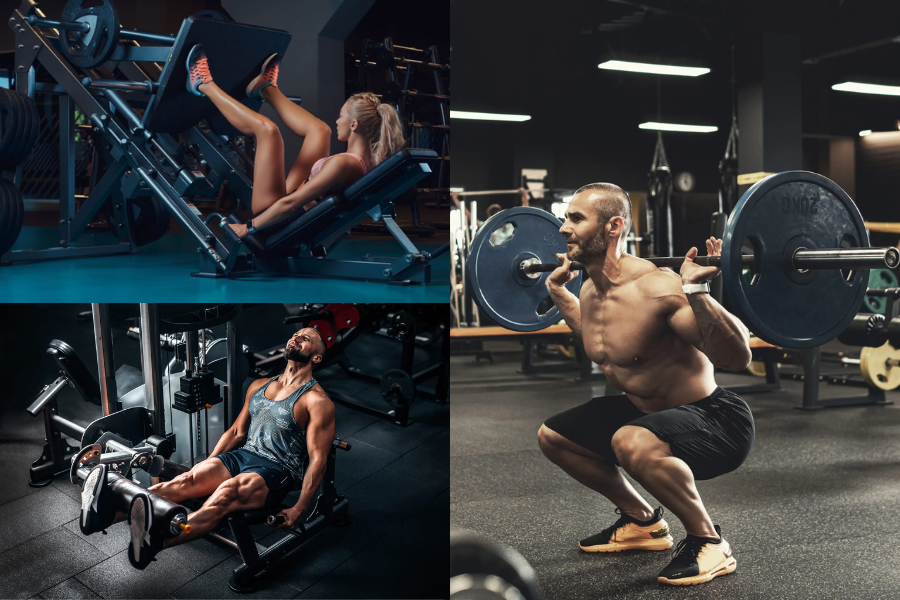
The leg extension is one of the purest quad isolation exercises you can perform. You sit with your hips and back supported while your quads straighten your knees against resistance.
Coaches consistently highlight leg extensions as a top choice for maximum quad growth. The quads handle the entire movement while the rest of your body is stabilized by the machine, which means you can accumulate more volume and recover faster between sessions.
For hypertrophy, RP Strength recommends staying in moderate to high rep ranges, roughly 10 to 30 reps per set, to reduce knee stress while keeping tension high across the quads.
Banded leg extension
If you do not have a machine, you can mimic the pattern with a resistance band anchored behind you. This version gives you progressive tension that increases as you straighten your leg, which keeps the peak of the movement challenging without putting extra load on your joints.
Guides recommend 3 to 4 sets of 12 to 20 reps with 45 to 60 seconds of rest. This structure builds both endurance and strong muscle engagement in a short amount of time.
Isometric leg extension holds
Isometric holds are simply pauses at the hardest part of the movement. With leg extensions, that means holding your legs locked out at the top of the rep.
Holding this fully extended position for 20 to 30 seconds keeps your quads under constant tension and improves muscular control and stability. These holds are especially useful in rehab settings or when you want to strengthen your quads without adding more joint motion.
You can plug isometric sets at the very end of your extension work, for example, one long hold after your last regular set.
Try this finisher: Perform one set of leg extensions to near failure, then lock out the weight and hold for as long as you can with solid form. This quick burnout gives you a strong quad pump without much extra time.
Effective bodyweight and free weight quad isolations
You can still isolate your quads without big machines. With a few smart tweaks to your stance and foot position, you can turn common exercises into highly quad focused movements.
Split squats and Bulgarian split squats
Split squats isolate each leg independently, which helps you correct strength imbalances and improve stability. To place more emphasis on your quads, keep your torso more upright and bring your feet a bit closer together so your knee tracks forward over your toes.
For Bulgarian split squats, a shorter stance and upright torso make the front quads work harder while your rear foot rests on a bench. Gymshark notes that these unilateral exercises correct imbalances and improve balance and core stability while ensuring each leg develops evenly.
You can use 3 to 4 sets of 8 to 12 reps per leg depending on whether your focus is strength or muscle size.
Lunges with elevated front foot
Lunges already demand a lot from your quads. Elevating your front foot a few inches on a plate or low step increases knee bend and reduces hip involvement, so your front quad has to drive the movement.
Unilateral exercises like these are an important part of balanced quad growth. They make it easy to spot if one side is weaker and to give that side a bit more focused work.
Sissy squat
The sissy squat is an advanced bodyweight quad isolation exercise. You rise onto your tiptoes, lean back, and drive your knees well over your toes while keeping your hips extended. This removes most hip involvement and puts extensive tension directly on your quads.
Because the pattern is demanding, you can start by holding a support like a rail or using a resistance band around a post for balance. Over time you can progress to full bodyweight or even a loaded version in a Smith machine.
Since the movement is intense, it works best with moderate reps and full control rather than chasing heavy resistance.
Use foot position to increase quad emphasis
Your foot placement is one of the easiest ways to turn a general leg exercise into a quad isolation move. Small adjustments in heel height and stance change how much your knees bend compared with your hips.
When you raise your heels on a plate or slant board during squats, goblet squats, or lunges, your knees travel further forward and your torso can stay more upright. This increases knee flexion and therefore quad involvement, while taking some work away from your glutes and hamstrings.
Guides from Gymshark emphasize that focusing on knee tracking over the toes and using heel elevation helps shift the workload to your quads in both squats and isolation exercises like leg extensions. Used carefully and with good control, these tweaks can make each rep feel much more targeted.
Sample quick quad isolation finisher
To see how this all fits together, here is one way you could finish your leg day with 10 to 15 minutes of quad focused work:
- Seated leg extensions, 3 sets of 12 to 20 reps, 45 to 60 seconds rest
- Single leg extensions, 2 sets of 10 to 15 reps per side
- Top position isometric hold, 1 long set of 20 to 30 seconds
You would start this finisher after your main compound lifts, such as front squats, hack squats, or leg presses. The isolation work will fully exhaust your quads and create a strong pump while staying relatively easy to recover from between sessions.
Put it all together
To get the most out of quad isolation exercises, keep a few principles in mind:
- Train your quads 2 times per week
- Open sessions with heavy compound lifts, then add isolation work
- Include unilateral exercises to keep both legs equally strong
- Use leg extensions and similar moves in higher rep ranges for safe, targeted fatigue
- Adjust foot position to shift more load to the quads when needed
With a smart mix of heavy compounds and quick isolation finishers, you can build stronger, fuller quads without spending endless hours in the gym. Start by adding just one or two of these exercises to your next leg workout and pay attention to how your quads feel during and after the session.
About the Author