A strong, defined chest does more than fill out a T-shirt. The right chest workouts help you push, pull, carry, and stabilize your upper body in everyday life. They also support better posture and can prevent neck and back strain by keeping your shoulders in a healthier position, as trainer Elise Young noted in a 2024 feature for Women’s Health Magazine.
Below, you will find clear guidance on chest exercises, form tips, and sample workouts you can use at home or in the gym, whether you are just starting or ready to build serious strength.
Understand your chest muscles
Your chest is built around two key muscles: the pectoralis major and the pectoralis minor. The pectoralis major is the large fan-shaped muscle you see on the front of your torso. It moves your arms across your body, helps you push objects away from you, and stabilizes the shoulder joint. Underneath it sits the smaller pectoralis minor, which assists with shoulder positioning and stability.
When you train your chest, you also involve several supporting muscles. Chest presses and pushups engage your shoulders, triceps, lats, upper back, and core, so effective chest workouts naturally become full upper body sessions. This is one reason they are so efficient for building overall strength and improving daily tasks like lifting groceries, pushing a stroller, or getting up from the floor.
Why chest workouts matter
Strong chest muscles do more than look impressive. They support how you move, how you feel, and even your long-term health.
Chest workouts can help you:
- Improve posture by balancing the muscles that pull your shoulders forward with those that stabilize them
- Make pushing, pulling, and carrying objects easier
- Reduce your risk of neck and back injuries by strengthening the front of your torso
- Build overall upper body muscle, which supports your metabolism and bone health
You do not need to be a bodybuilder to benefit from chest training. Women gain just as much from building chest strength as men, and the best chest exercises are the same for both, as highlighted in a 2024 article by UPPPER Fitness Gear.
Start with pushups as your foundation
If you are looking for one movement to anchor your chest workouts, start with the pushup. In 2026, fitness expert Simon King identified the pushup as the best starting chest exercise for beginners because it builds a strong foundation, requires no equipment, and is easy to adjust to your current strength level.
A standard pushup already provides significant resistance. Research with young men experienced in resistance training has shown that a regular pushup requires you to lift roughly 64 percent of your body weight. That is enough load to build muscle size and strength in a way that is comparable to the bench press.
What pushups work
Pushups primarily target the pectoralis major, but they also recruit the pectoralis minor, triceps, anterior deltoids, and core muscles. This combination makes them a true whole body movement. They even support heart health by increasing overall muscle strength and cardiovascular demand and they help maintain bone density due to the weight-bearing nature of the exercise.
Pushup variations to try
Different pushup variations let you emphasize different fibers of the chest or challenge your body in new ways:
- Decline pushups, with your feet elevated, place more emphasis on your upper chest and front shoulders
- Incline pushups, with your hands on a bench or step, are easier on your shoulders and are ideal if you are still building strength
- Wide pushups increase the involvement of the serratus anterior and challenge your chest in a stretched position
- Diamond pushups bring your hands closer together to target the triceps more strongly
- Plyometric pushups, where your hands briefly leave the floor, train your muscles to produce force quickly and can improve endurance, speed, and power
You can also experiment with one-leg pushups, offset pushups, typewriter pushups, and band-resisted pushups to keep progressing at home without any machines. Several studies have found that, for trained individuals, pushups can produce similar muscle activation and strength gains as the bench press, provided you work close to fatigue.
Progress to pressing with weights
Once regular and advanced pushup variations feel manageable, you can move to loaded pressing exercises. The barbell bench press and dumbbell bench press are classics for a reason.
Barbell bench press
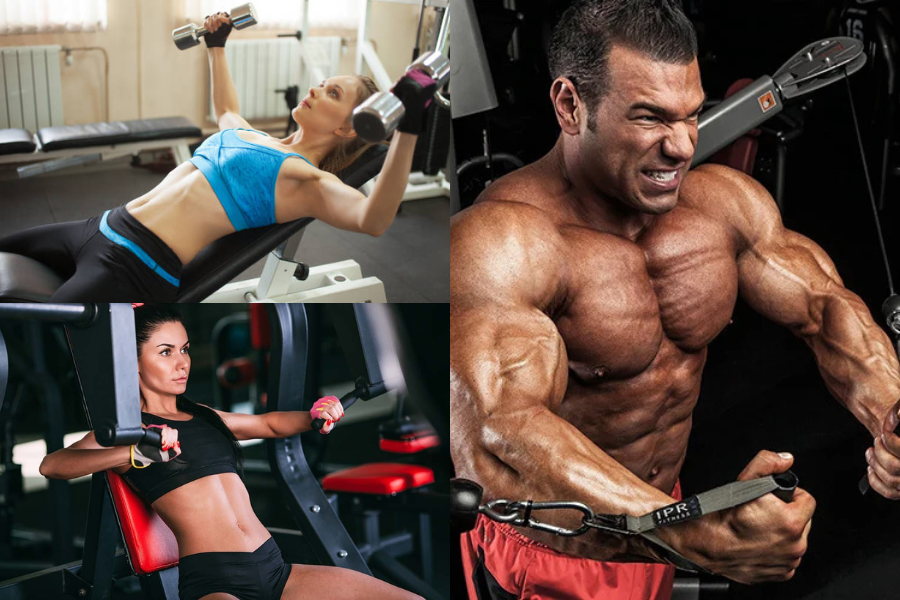
The barbell bench press is a key progression once you have mastered pushups. It activates your chest, shoulders, triceps, lats, glutes, and core, so your whole upper body learns to work together. Because you can add weight in small increments, it is one of the best ways to build size and strength.
If you are new to the bench press, focus on form over load. Fitness experts recommend starting with dumbbells before heavy barbell work and using wrist wraps for extra support when the weight gets challenging.
Dumbbell bench press
Dumbbell presses offer several advantages over the barbell:
- Each arm works independently, which helps correct strength imbalances
- You can adjust your grip, for example turning the palms slightly inward, to find a position that feels better on your shoulders
- The increased need for control promotes stability and better muscle engagement
Because dumbbells allow a slightly deeper range of motion, you will often feel a stronger stretch in your pecs at the bottom of the movement, which can support muscle growth when controlled.
Add flyes and cables for definition
Pressing builds mass and strength. Fly variations and cable work help you add shape and detail.
Decline dumbbell flyes
Decline dumbbell flyes are especially effective for sculpting your lower and mid chest. They apply a strong stretch to your pecs followed by a hard contraction as you bring the weights together. This “stretch and contract” principle under load is a powerful trigger for muscle growth through fatigue.
Begin with light weights and move slowly. The goal is not to lift heavy here, but to feel the chest working through the full arc of motion, while keeping the elbows slightly bent and the shoulders supported by the bench.
Cable crossovers
Cable crossovers provide constant tension across the entire movement, and they also let you work each side of your chest independently. This makes them useful for correcting small imbalances, since you cannot unconsciously let your stronger side take over.
By changing the pulley height, you can emphasize different parts of the chest. Higher pulleys target the lower chest more as you bring your hands down and across, while lower pulleys emphasize the upper chest as you lift and cross the cables upward.
Warm up properly before chest day
Skipping a warm up is one of the fastest ways to limit your progress. Not warming up the chest muscles properly increases your risk of sprains, strains, or tears and reduces your range of motion, which means you cannot perform your main lifts as effectively.
Aim to spend 5 to 10 minutes on:
- A general warm up like brisk walking, light cycling, or arm circles
- Dynamic shoulder and chest movements such as band pull aparts, scapular pushups, and arm swings
- A few light sets of your first chest exercise using very low weight or a simpler variation
You should feel warmer, looser, and more coordinated before you touch your working sets. If you still feel stiff or unstable, add another light set or two.
Use form that targets your chest, not your shoulders
Your technique has a bigger impact on your results than any single exercise choice. Two areas matter especially: shoulder position and elbow angle.
Scapula position on presses
If you bench press with your shoulders rounded forward, also known as scapular protraction, your shoulder muscles will take over much of the work. This reduces stimulation to your pecs and can increase strain on the shoulder joint.
Instead, gently retract your shoulder blades by pinching them together and tucking them down toward your back pockets before you start each set. Maintain this position on the bench while you press. This approach helps you better engage the outer, upper, and inner chest and creates a more stable base for your shoulders.
Safe elbow angles
Beginner chest workouts often fall apart because of flared elbows. Pressing with your upper arms at a 90 degree angle to your torso places a lot of stress on your shoulder joints and can lead to pain, as Men’s Health fitness director Ebenezer Samuel explained in 2026.
A better guide is to keep your upper arms at roughly a 45 degree angle relative to your torso. This angle is safer for your shoulders and also lets your lats assist in the movement, which can improve both chest size and your ability to perform more reps.
For incline presses, another common error is pressing at the same steep angle as the bench, which is often close to 90 degrees. This tends to hammer your shoulders without fully activating the upper chest. Ebenezer Samuel recommends focusing instead on keeping your forearms perpendicular to the floor at the bottom of each rep, regardless of bench angle. This adjustment helps you hit multiple chest fibers more effectively.
Balance chest workouts with back training
Chest exercises naturally pull your shoulders forward. If you train your chest without also strengthening your back, you can develop rounded shoulders and discomfort over time.
To avoid this, include pulling movements such as barbell rows, dumbbell rows, or seated rows in the same session or the same week as your pressing work. According to insights shared by Men’s Health fitness director Ebenezer Samuel in 2026, pairing chest and back training improves posture, maintains shoulder health, and even helps your chest look better by giving it a stable frame.
You do not need a complicated routine. Alternating sets of bench presses with sets of rows is a simple way to maintain balance, especially if you are short on time.
Use smart intensity techniques, not ego lifting
Progressive overload, adding more challenge over time, is essential for muscle growth. However, loading the bar recklessly is not the answer.
Ego lifting, or trying to move more weight than you can control, often leads to poor form. Once that happens, secondary muscles like the shoulders and triceps take over and your chest gets less of the training effect. Your risk of injury also climbs.
Instead of chasing numbers at any cost, you can increase intensity in smarter ways:
- Drop sets, where you reduce the weight after reaching fatigue and continue the set
- Half or quarter reps at the end of a set to extend the time under tension
- Pauses during the lowering or contracting phase to force your muscles to work harder under control
Used occasionally, these methods can stimulate extra growth beyond traditional 8 to 12 rep sets, without needing to push past your technical limits.
Sample chest workouts you can follow
You can build an effective chest plan with very little equipment or with a full gym. Use these templates as a starting point and adjust the sets, reps, or exercise choices to match your current fitness level.
At home, no equipment
Perform 3 rounds. Rest 30 to 45 seconds between exercises and 1 to 2 minutes between rounds.
- Incline pushups on a bench or counter, 10 to 15 reps
- Regular pushups, 8 to 12 reps
- Wide pushups, 8 to 12 reps
- Decline pushups with feet elevated, 6 to 10 reps
- Hands elevated pushups for a controlled cool down, 10 to 15 reps
If you are more advanced, you can include typewriter pushups and band-resisted pushups to increase difficulty. Several programs have shown that you can build a very effective chest routine at home using these variations alone.
Gym based strength and size session
Perform 3 to 4 sets for each exercise. Rest 60 to 90 seconds between sets.
- Barbell bench press, 6 to 8 reps
- Incline dumbbell chest press, 8 to 12 reps
- Decline dumbbell flyes, 10 to 15 reps
- Cable crossovers, 12 to 15 reps
- Barbell or dumbbell rows, 8 to 12 reps
If you want to follow a structured short term plan, some coaches recommend a 28 day approach that alternates between two main sessions. One focuses on 10 sets of 6 reps on the barbell bench press with 60 seconds of rest to build strength and size. The other emphasizes fascial stretching and targets both the pectoralis major and minor with movements like a 45 degree incline dumbbell press and dips, typically performed for 4 sets of 12 reps with 60 seconds of rest.
Whichever structure you use, aim to train your chest one to two times per week. If you are a beginner, start with one chest focused session and see how your body responds before adding more. Leave at least two days of rest between heavy chest workouts to allow for recovery and growth.
Putting it all together
Effective chest workouts are less about fancy exercises and more about consistent, well executed basics. When you warm up thoroughly, use form that keeps the tension on your chest, and balance pushing with pulling, you set yourself up for steady progress without unnecessary wear and tear.
Choose a simple routine from this guide to try in your next workout, even if it is just swapping your current pushups for a variation that challenges you differently. As your strength builds, so will your confidence in everything you do with your upper body.
About the Author