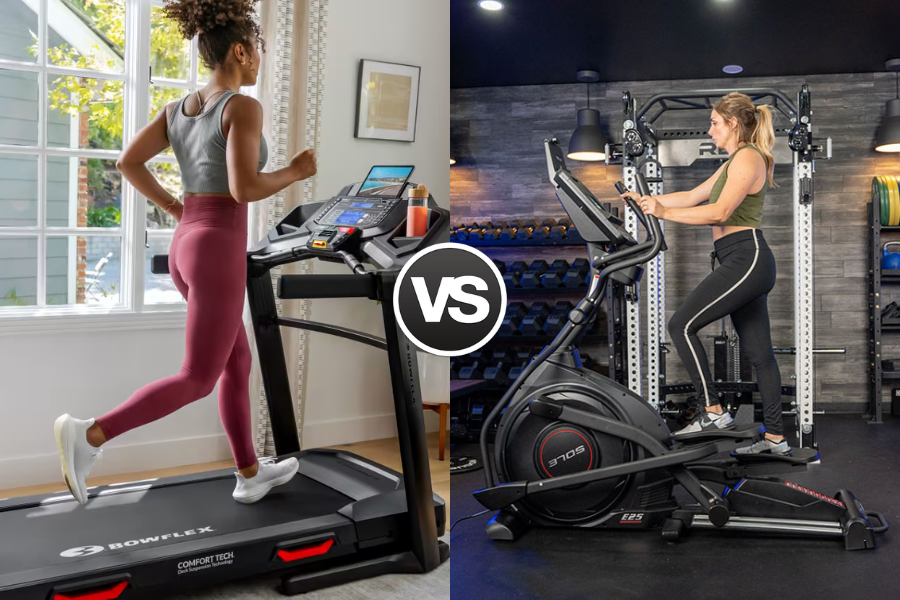
Elliptical vs treadmill cardio is one of those friendly gym debates that never seems to end. Both machines help you burn calories, strengthen your heart, and support weight loss. The real question is not which one is “best” in general, but which one fits your body, goals, and preferences.
Below, you will learn how each machine affects calorie burn, joint health, muscle engagement, and long term results, so you can feel confident choosing the cardio that actually works for you.
Understand calorie burn on each machine
If you are focused on weight loss, you probably want to know which burns more calories, the elliptical or the treadmill.
A 2010 study found that calories burned, oxygen consumption, and heart rate were nearly identical when comparing elliptical vs treadmill cardio at similar effort levels, which means the elliptical is an acceptable alternative to the treadmill for cardio exercise (Healthline). In other words, if you work equally hard, you can burn a similar amount of calories on either machine.
Harvard Health data shared in a comparison found that, for a 155 pound person, 30 minutes on an elliptical burns about 335 calories, while running on a treadmill at a 10 minute mile pace burns around 372 calories in the same time (Livefit). That is a modest difference, not a deal breaker.
So why do the numbers on the machines sometimes look so different? One gym user reported that their LifeFitness elliptical showed 1200 to 1400 calories per hour, while the treadmill estimated about 700 calories per hour, even though the treadmill felt harder and produced a higher heart rate (Reddit). This kind of mismatch helps you see that machine readouts are only rough estimates.
What matters most for your calorie burn is your:
- Effort level
- Workout duration
- Body weight
- Use of incline or resistance
Both treadmills and ellipticals let you adjust speed, incline, or elevation, which can significantly increase workout intensity and total calories burned (Livefit).
Protect your joints and prevent injuries
If you have ever felt your knees or shins complain after a run, joint impact is probably top of mind. Here is how the two machines compare for joint friendliness.
How a treadmill stresses your joints
Treadmill exercise is a weight bearing, high impact activity that closely mimics outdoor walking and running. This has real benefits for bone density and lower body strength, but it also means more stress on your joints.
Running or jogging on a treadmill can put more stress on bones and joints than using an elliptical. That extra impact may increase your risk of common issues like shin splints, knee pain, and stress fractures (Healthline). If you already deal with low back pain, knee or hip pain, or conditions like arthritis or osteoporosis, you may find a treadmill uncomfortable or risky at higher intensities.
How an elliptical supports joint health
The elliptical machine keeps your feet in constant contact with the pedals, so your body glides in a smooth circular motion instead of pounding into the deck. This low impact pattern puts less stress on your knees, hips, and ankles and is safer for people with musculoskeletal conditions such as low back pain, arthritis, or osteoporosis (Healthline).
Updated guidance notes that ellipticals are ideal for beginners, older adults, or anyone easing back into fitness, because the motion is joint friendly and more forgiving when you are rebuilding strength and stamina (NordicTrack). Nike’s 2025 comparison also highlights that the elliptical helps you avoid the joint stress and impact loading that comes with treadmill running, which makes it a smart choice for injury prevention (Nike).
One 2024 study did note that elliptical machines can create higher peak forces at the knee and ankle than stationary bikes, especially at higher speeds, because of the fixed pedal design and joint angles involved (Medicina via PMC). The takeaway for you is simple: even on a low impact machine, you still want to choose a comfortable speed and resistance, and avoid suddenly cranking things up to the max.
If you live with joint issues, or you want to reduce injury risk while still doing effective cardio, the elliptical gives you a clear advantage.
Compare muscle engagement and body focus
Elliptical vs treadmill cardio is not only about your heart and lungs. Each machine trains your muscles a little differently.
What muscles you work on a treadmill
On a treadmill, you primarily work the major muscles of your lower body. That includes your:
- Quadriceps
- Hamstrings
- Glutes
- Calves
Walking or running on a flat treadmill mainly targets the front and back of your thighs and your calves. When you add incline, you bring your glutes and hamstrings into the spotlight and mimic uphill walking or running. Treadmills with good incline options are especially useful if you are training for outdoor runs or races, because they closely simulate real world terrain and build lower body strength and endurance (NordicTrack).
What muscles you work on an elliptical
Ellipticals are designed to give you a more complete, total body workout. As you push and pull the handles, you recruit muscles in your:
- Arms and shoulders
- Chest and upper back
- Core
At the same time, your lower body works hard, including your glutes, quads, hamstrings, hip flexors, and calves. Switching directions, for example pedaling backward, lets you shift more emphasis to different muscle groups, such as your glutes and hamstrings (Healthline).
Because you are engaging both upper and lower body at once, elliptical workouts can feel more efficient and balanced. NordicTrack points out that this dual action can make the elliptical more effective than a treadmill for a time pressed, total body cardio session (NordicTrack).
If you want to strengthen your legs for running or hiking, a treadmill might be your main tool. If you want to involve your upper body and core while you do cardio, the elliptical has the edge.
Use each machine for different fitness goals
Once you understand how each machine feels and what it works, you can match elliptical vs treadmill cardio to your specific goals instead of guessing.
If your goal is weight loss
Both ellipticals and treadmills can effectively support weight loss when you use them consistently and combine them with sensible nutrition. Your total calorie burn will depend on your:
- Speed or resistance
- Incline or elevation
- Workout duration
- Effort level
Increasing treadmill speed and incline can boost calorie expenditure quickly (NordicTrack). On the elliptical, increasing resistance and pace has a similar effect.
Treadmill workouts tend to burn slightly more calories because they engage larger muscle groups, like the quads and glutes, at higher impact loads and they offer a wide range of speeds and inclines (Nike). However, that advantage only helps you if your joints can handle it and you can stay consistent.
If joint pain would cause you to skip workouts, choosing the lower impact elliptical is often better for long term fat loss, because it lets you show up more regularly.
If your goal is cardio fitness and stamina
A 2010 comparison and Nike’s 2025 overview both found that treadmill and elliptical workouts can produce similar improvements in calories burned, heart rate, and oxygen consumption when effort is matched (Healthline, Nike). In practical terms, that means both are excellent tools for building cardiovascular fitness.
If you are training for outdoor walking, jogging, or running, using a treadmill will translate more directly to your sport. It helps you get comfortable with pacing, impact, and terrain that feels close to the real thing.
If your goal is simply to strengthen your heart and lungs, improve your health markers, and feel less winded during your day, the elliptical can deliver those benefits while being easier on your joints.
If your goal is intervals and performance
High intensity interval training, or HIIT, is one of the most efficient ways to burn calories, reduce body fat, and improve cardiovascular fitness in less time. Treadmills are especially well suited for HIIT, because you can precisely adjust speed and incline for your work and rest intervals (Healthline).
Ellipticals also allow you to do interval training by changing resistance or ramp height and speeding up or slowing down your stride. Incorporating HIIT on either machine can greatly increase your total calorie burn and keep your workouts engaging (Livefit).
If you enjoy fast, powerful intervals, the treadmill might feel more natural. If you want low impact intervals that are kinder to your joints and spine, the elliptical is a better match.
Mix both machines for the best of both worlds
You do not have to choose one machine forever. Alternating elliptical vs treadmill cardio can actually help you get better results with less risk.
NordicTrack recommends varying your workouts between elliptical and treadmill to prevent boredom, engage different muscle groups, and reduce the risk of overuse injuries (NordicTrack). This variety also makes your routine feel fresher and more sustainable.
You might:
- Use the treadmill for one or two interval or incline sessions per week
- Use the elliptical for low impact, longer steady state sessions on other days
- Switch to the elliptical when your joints feel tired, instead of skipping cardio completely
As Nike’s summary points out, both machines can deliver similar improvements in key fitness markers, so your decision should come down to what feels good on your joints, fits your age and injury history, and keeps you consistent (Nike).
A machine you enjoy and can use regularly will always beat the “perfect” machine you dread or avoid.
Simple way to choose your next workout
When you walk into the gym or look at your home setup, use these quick questions to decide between elliptical vs treadmill cardio for that day:
- Do your knees, shins, or back feel sensitive today?
Choose the elliptical for low impact support. - Are you training for an outdoor race or want to improve your running pace?
Choose the treadmill and play with speed and incline. - Do you want to involve your upper body and core more?
Choose the elliptical and use the handles actively. - Are you craving a tough HIIT session?
Start with the treadmill, or use the elliptical if you prefer less impact.
If you are not sure where to begin, try this simple plan for your next week of workouts:
- 2 days: 25 to 35 minutes on the elliptical at a steady, moderate pace
- 1 day: 20 to 30 minutes of intervals on the treadmill
- Optional 1 day: gentle elliptical session if you feel good
Pay attention to how your body feels after each workout. If you notice less joint soreness, more energy, and a routine that feels doable, you have found a mix that works.
You do not need to pick sides in the elliptical vs treadmill cardio debate. Use the strengths of each machine to support your weight loss, protect your joints, and build a sustainable cardio habit that fits your life.
About the Author