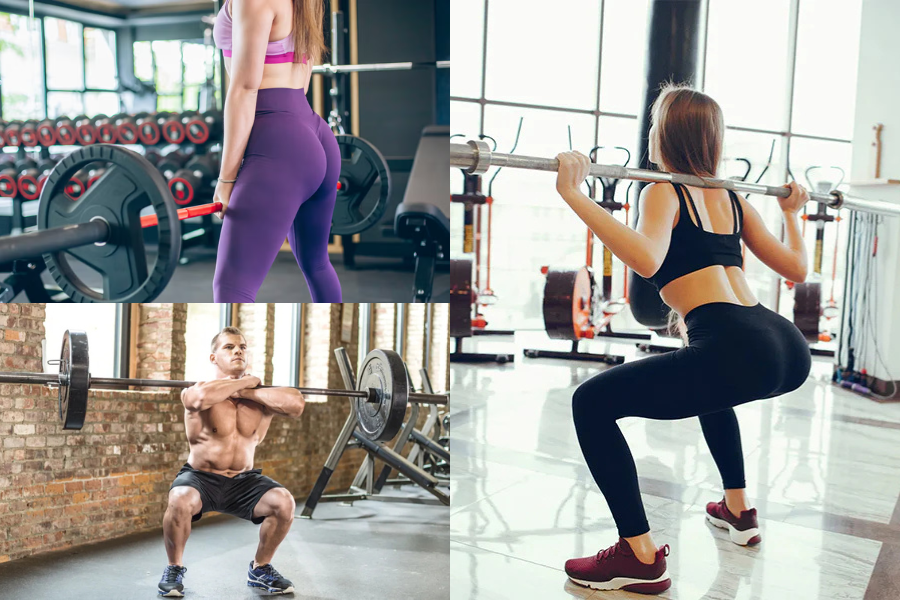
A strong, well-shaped backside does much more than fill out your jeans. When you master the best glute exercises, you support your lower back, improve posture, move better in daily life, and lift heavier in almost every lower body workout.
This guide walks you through how your glutes work, which exercises actually deserve a spot in your routine, and how to put them together for great results.
Understand your glute muscles
Before you load up a barbell, it helps to know what you are trying to train. Your “glutes” are a team of three muscles that work together anytime you walk, climb, or stand up from a chair.
- Gluteus maximus: The largest muscle in your backside. It handles hip extension, like when you stand up from a squat or drive your hips up in a bridge. It is the main muscle that adds size and power.
- Gluteus medius: Sits higher and more to the side of your hip. It helps move your leg out to the side and keeps your pelvis stable when you are on one leg, for example during walking, running, or step ups.
- Gluteus minimus: The smallest and deepest muscle. It assists with hip rotation and pelvic balance.
Together these muscles support posture, boost athletic performance, and reduce injury risk in your knees, hips, and lower back, as described by Planet Fitness. When you focus on exercises that hit all three, you build a backside that looks strong and actually functions that way.
Why glute strength matters
If you sit for long stretches, your glutes often switch off while your hip flexors tighten. Over time this can lead to weak, under-activated glutes, poor mobility, and a higher risk of lower body injuries according to the International Sports Sciences Association (ISSA).
Stronger glutes help you:
- Maintain better posture and a more upright torso
- Protect your knees by improving hip stability
- Support your lower back during lifting and everyday tasks
- Run, jump, and change direction more efficiently
Corrective glute work, such as single-leg deadlifts, split squats, and side lunges, has been linked to fewer ACL and knee injuries, hamstring strains, ankle sprains, and lower back pain in ISSA guidance.
In short, glute training is not just about looks. It is one of the best investments you can make for long-term joint health and performance.
Key principles for glute growth
To get visible and measurable results from the best glute exercises, you need more than a random mix of moves. A few training principles make a big difference.
Train often enough
Most people get great results training glutes two to three times per week, with at least one day of rest between hard sessions. This gives you enough stimulus to grow without cutting into recovery, a balance recommended in guides from Planet Fitness.
You can dedicate full sessions to glutes or pair them with legs or lower body days.
Use the right rep ranges
For hypertrophy, you want to challenge the muscles in different ways. Research-based guides, including those from Gymshark and PureGym, recommend a mix of:
- Moderate reps, 8 to 12, at about 60 to 80 percent of your 1RM for pure muscle growth
- Low reps, 4 to 8, with heavier weights to build strength and recruit more muscle fibers
- Higher reps, 12 to 15, with lighter loads for endurance and a strong “burn”
Whatever rep range you choose, you should finish most sets close to muscular failure while still maintaining good form.
Prioritize form and full range
Glute exercises work best when you move through a full, controlled range of motion and actually feel your glutes working:
- Drive through your heels or mid-foot, not just your toes
- Keep your core braced so your lower back does not take over
- Squeeze your glutes at the top of each rep rather than rushing
According to PureGym trainer Hannah Kerridge, resistance training that creates those tiny muscle tears is what prompts your body to rebuild the glutes larger and stronger over time.
Best compound glute exercises
Compound moves involve multiple joints and muscle groups at once. They are the foundation of any effective glute program because they let you lift heavier and stimulate serious growth.
Squats and their variations
Squats heavily involve the gluteus maximus, especially when you sit back and stand up with control.
- Back squat: A 2017 study referenced by Gymshark reports significantly increased glute engagement when squats are performed with heavier loads, around 90 to 100 percent of your 1RM. A wider stance and sitting deeper can further increase glute activation, as noted in a 2020 systematic review on gluteus maximus activity.
- Sumo squat: A wider stance with toes turned slightly out shifts more emphasis to the glutes and inner thighs.
- Goblet squat: Holding a single dumbbell or kettlebell at your chest is friendly for beginners and still challenges your glutes when you sit low.
Think “sit between your hips, then drive the floor away” rather than letting your knees shoot forward without hip movement.
Romanian deadlifts (RDLs)
Romanian deadlifts load your hamstrings and glutes through a strong hip hinge. Keep a soft bend in your knees, push your hips back, and let the weight travel along your thighs until you feel a big stretch in your hamstrings. Then drive your hips forward and squeeze your glutes at the top.
RDLs are one of the best ways to build the backside of your body and improve hip power for sports and daily life.
Bulgarian split squats
Bulgarian split squats are a favorite for glute growth and single-leg stability. With your back foot elevated on a bench, drop your rear knee toward the floor while leaning your torso slightly forward over your front leg. Drive back up through the heel of your front foot.
Guides from Gymshark highlight Bulgarian split squats as:
- Excellent for unilateral glute training
- Helpful for addressing right and left side imbalances
- Often more knee friendly than heavy back squats because they use a lighter load
You can hold dumbbells at your sides or a barbell on your back once bodyweight versions feel comfortable.
Step ups
Step ups are more than a simple bodyweight exercise. A 2020 systematic review found that step ups and their variations elicited very high gluteus maximus activation, averaging about 125 percent of maximal voluntary isometric contraction, especially when external load is added.
To perform them well:
- Place one foot on a stable box or bench
- Lean slightly forward from your hips
- Drive through the entire foot on the box to stand tall, then lower with control
You can adjust the height to target your glutes more, generally a bench where your hip and knee are at or just above 90 degrees when your foot is planted.
Best isolation glute exercises
Isolation moves focus tension more directly on your glutes, especially the maximus, and help you feel those muscles working. They are perfect after heavy compound lifts.
Hip thrusts and glute bridges
If you had to pick only one isolation move, the hip thrust would be a strong contender. Multiple sources, including Gymshark, ATHLEAN-X, and a 2020 systematic review, highlight the barbell hip thrust as one of the best exercises for activating the gluteus maximus.
- In an elevated hip thrust, your upper back rests on a bench, feet are flat on the floor, and you thrust your hips up while squeezing your glutes.
- In a glute bridge, your shoulders stay on the floor. This is a great place to start if you are a beginner.
To get more upper glute emphasis, you can widen your stance slightly and add a resistance band around your knees to encourage you to push out.
Glute kickbacks and resistance band work
Glute kickbacks and banded exercises keep constant tension on the muscles, which is great for hypertrophy.
Useful options include:
- Cable or banded glute kickbacks: Focus on driving your heel back and slightly up, keeping your core steady and your lower back still. Resistance band kickbacks are often recommended for building a larger gluteus maximus because they emphasize hip extension with continuous tension.
- Banded lateral walks and clamshells: These target your gluteus medius and minimus, the smaller stabilizers on the side of your hip. A 2024 Peloton guide notes that lateral band walks and clamshells significantly activate these muscles without heavy weights.
These moves are especially helpful if you struggle to “feel” your glutes in big compound exercises.
Curtsy lunges and side lunges
Side-to-side and crossover movements challenge your hip stabilizers in a way that traditional squats do not.
- Curtsy lunge: Step one leg diagonally back behind the other, lowering into a lunge while keeping your hips facing forward. ATHLEAN-X highlights curtsy lunges as uniquely effective for the gluteus medius and minimus due to the crossover motion.
- Side lunge: Step out to the side, sit back into your hip, and keep the other leg straight. Push the floor away to return to center.
These patterns help prevent knee collapse, improve hip stability, and round out the shape of your glutes.
Warm up with glute activation
If you sit a lot or feel your quads and lower back working more than your glutes, adding a short activation warm up before you lift can make a big difference.
Peloton instructors and physical therapists recommend doing glute activation before activities like running, cycling, or lower body strength work to enhance performance and reduce injury risk.
You can pick two or three of these and perform 1 to 2 light sets:
- Bodyweight glute bridges
- Banded clamshells
- Banded lateral walks
- Donkey kicks or fire hydrants
- Toe down hip lifts or stability ball hip drops and lifts, both used in activation protocols
The goal here is not to burn out your muscles. You simply want to “wake them up” so your main sets hit harder.
A simple rule of thumb: if you do not feel your glutes working in the first warm up set, they will not magically wake up when the bar gets heavy.
Sample beginner glute workout
If you are unsure how to put the best glute exercises together, use this as a starting template. Perform it two or three times per week with at least one rest day in between.
- Warm up and activation
- 5 minutes of light cardio
- 1 set of 12 to 15 glute bridges
- 1 set of 12 to 15 banded lateral walks each way
- Strength and hypertrophy work
- Bulgarian split squats, 3 sets of 8 to 10 reps per leg
- Romanian deadlifts, 3 sets of 8 to 10 reps
- Hip thrusts, 3 sets of 10 to 12 reps
- Finisher and stability
- Curtsy lunges, 2 sets of 12 reps per leg
- Banded glute kickbacks, 2 sets of 15 reps per leg
Rest 60 to 90 seconds between most sets. When all your sets feel comfortable and you can maintain good form, gradually increase the weight or add reps to apply progressive overload, as recommended by Planet Fitness and ISSA.
Progress safely and stay consistent
You do not need to overhaul your entire routine to see results. Start by adding one or two of the best glute exercises into your next lower body session and focus on doing them well.
Over the next few weeks, aim to:
- Train glutes at least two times per week
- Mix compound lifts with isolation moves
- Use a variety of rep ranges, from 4 to 15
- Increase weight, reps, or sets slowly as exercises become easier
If you feel unsure about form or have a history of pain or injury, consider working with a qualified trainer. As Planet Fitness notes, guidance from a professional plus steady progressive overload is one of the most reliable ways to keep improving while staying safe.
Pick one exercise from this guide to try in your next workout, such as hip thrusts or Bulgarian split squats, and pay attention to how your glutes feel the day after. That soreness is a sign that your new routine is starting to work.
About the Author