Elliptical workouts for beginners are one of the easiest ways to start improving your cardio fitness without beating up your joints. You stay in place, your feet never leave the pedals, and you still get a low impact, full body workout that can help you lose weight and build endurance over time (Cleveland Clinic).
If you are new to the gym, returning after a break, or looking for a gentle alternative to running, this guide walks you through exactly how to start.
Why the elliptical is great for beginners
Elliptical training is beginner friendly because it combines cardio and strength in one low impact movement. Your feet stay planted on the pedals so there is less pounding on your knees, hips, ankles, and back compared with a treadmill or outdoor running (Lose It!).
You also work more muscles at once. When you use the moving handles, you engage your arms, chest, back, and core along with your legs, which increases calorie burn and builds muscle endurance (Lose It!). This is helpful when your goal is fat loss or overall fitness and you do not want to spend hours in the gym.
Because the motion is smooth and supported, the elliptical is often recommended if you are recovering from injury or dealing with joint discomfort. It can improve range of motion while keeping stress on your joints low (Cleveland Clinic).
How often and how long to work out
When you are just getting started, your main job is to build a habit without overdoing it. You can think of your first few weeks as a “practice period” where you teach your body the movement.
Beginner guidelines suggest you:
- Aim for 15 to 30 minute sessions
- Work out 2 to 3 times per week
- Keep resistance under level 5 with a low to moderate incline at first
This approach helps you avoid burnout and injury while your muscles, lungs, and joints adapt (Garage Gym Reviews).
If 15 minutes feels long right now, you can start with 10 minutes and add 2 to 3 minutes every few workouts. Over a few weeks, you can work toward 30 minute sessions that meet daily exercise guidelines for moderate to vigorous activity (Verywell Fit).
Get your form right from day one
Good form makes elliptical workouts safer and more effective. The machine will move either way, but how you position your body determines which muscles are working and how your joints feel.
Basic posture and alignment
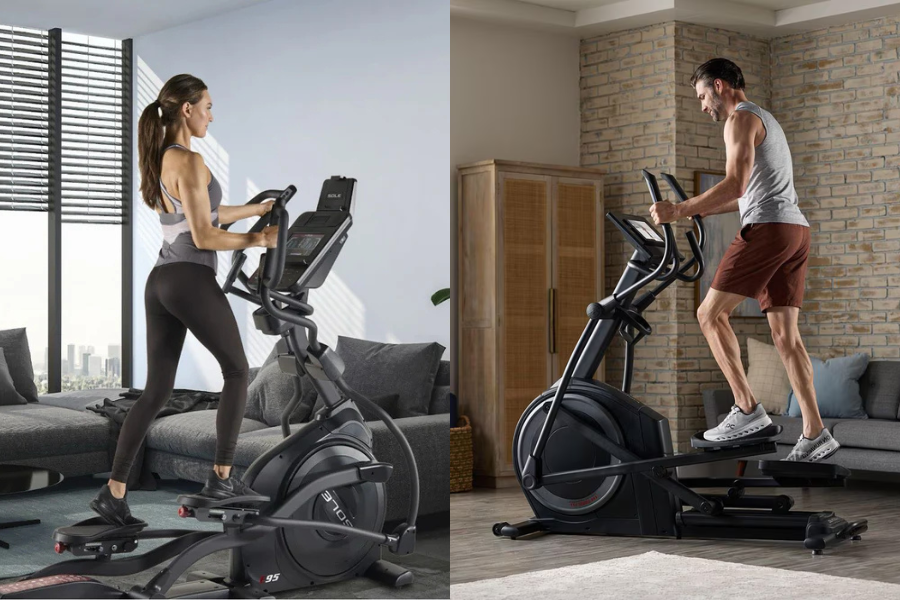
Stand tall on the pedals instead of hunching over the console. Keep your shoulders back and down, your chest open, and your gaze forward. Avoid leaning your weight onto the handles because that takes effort away from your legs and core and can strain your back (ProForm).
Engage your abdominal muscles lightly, as if you are bracing before a small sneeze. This helps stabilize your spine and allows your arms and legs to move more smoothly.
Leg and foot mechanics
Instead of letting the pedals carry you, you want to actively push and pull through the entire stride. Press your feet down and back as the pedal moves away, then pull up and forward as it returns. This pattern engages your quadriceps and other leg muscles effectively (Hospital for Special Surgery).
If you tend to get numbness in your feet, try sitting your weight slightly back into your heels rather than pressing through your toes. This cues larger muscle groups to do more of the work and can make longer workouts more comfortable (Prevention).
Using the handles the smart way
Most elliptical machines have moving handles for your arms and sometimes a center set for balance. As a beginner, it often helps to master the leg motion first, then add coordinated arm movement once you feel steady. You can also use the center handles if coordinating arms and legs feels awkward at first (Hospital for Special Surgery).
When you are ready, start actively pushing and pulling the moving handles instead of letting them swing. This turns your elliptical workout into a true upper and lower body session, which raises calorie burn and improves overall conditioning (ProForm).
You can also occasionally let go of the handles during warm up, cool down, or short rest intervals. This forces your core and balance muscles to work a bit harder, but keep the resistance low while you practice no hands segments (Lose It!).
Warm up and cool down every time
Skipping your warm up and cool down can make you feel stiff and sore later, especially if you are new to exercise. A few minutes at easy intensity helps your body transition into and out of the workout.
Beginner friendly guidelines suggest using the elliptical itself for both:
- Warm up for 5 to 10 minutes at very low resistance, around level 3 or below
- Keep your pace conversational so your breathing gradually increases, not spikes
- Finish your session with a similar 5 minute easy cooldown at low resistance
This simple habit prepares your muscles and joints for work and then helps them relax afterward, which reduces soreness and lowers injury risk (Garage Gym Reviews).
Three beginner elliptical workouts to try
Once you are comfortable getting on and off the machine and maintaining basic form, you can start using simple workout structures. These give you a clear plan, so you spend less time guessing and more time moving.
Intensity in the workouts below is based on a 1 to 10 scale of perceived exertion, where 1 feels like sitting on the couch and 10 feels like an all out sprint. For beginner elliptical workouts, you usually want to stay between 4 (easy warm up) and 6 (just out of your comfort zone), especially at the beginning (Verywell Fit).
Tip: During moderate intensity portions, you should still be able to speak in full sentences. If you can only get out a few words at a time, ease off until your breathing settles.
1. 20 minute steady state starter
This is your go to session for building a base of cardio fitness.
- Warm up: 5 minutes at level 3 to 4, easy pace
- Main block: 10 minutes at a steady pace at level 4 to 5
- Cooldown: 5 minutes back at level 3, gradually slowing your stride
A structured 20 minute workout like this can be increased by a few minutes each week until you comfortably reach 30 minutes of steady activity, which aligns with daily exercise guidelines (Verywell Fit).
2. Gentle interval workout for variety
Intervals simply alternate slightly harder efforts with easier ones. They can make time go by faster and improve fitness without requiring long workouts.
Try this 20 minute beginner interval session:
- Warm up: 5 minutes, easy pace, level 3
- Intervals:
- 1 minute at level 5, a bit out of your comfort zone
- 2 minutes at level 3 to 4, easy recovery
- Repeat this 3 minute pattern 4 times
- Cooldown: 5 minutes at level 3
This style of progressive intervals is similar to beginner protocols that vary one minute efforts to keep your body guessing without overwhelming you (Garage Gym Reviews).
3. Short HIIT style session when you are short on time
High intensity interval training, or HIIT, uses short bursts of harder work followed by equal or slightly longer recovery. On the elliptical, this might mean 20 to 30 seconds of strong effort and then 40 to 60 seconds easy.
A basic 15 minute session might look like:
- Warm up: 4 minutes easy
- Work block:
- 20 seconds at level 6 to 7, strong but still controlled
- 40 seconds at level 3, very easy
- Repeat this 1 minute cycle 8 to 10 times
- Cooldown: 3 to 4 minutes easy
Even a short HIIT workout like this can increase calorie burn during and shortly after the session, which makes it a time efficient option when you do not have a full half hour (ProForm). As a beginner, keep your total HIIT time short until you feel confident with the movement and your recovery.
Adjust resistance, incline, and direction wisely
Elliptical machines let you change more than just speed. When you learn how to use resistance, incline, and direction, you can target different muscles and keep your workouts interesting.
Start with moderate resistance that feels challenging but controllable. You should be actively pushing and pulling through the stride. If your feet are gliding without effort or you are bouncing and losing form, adjust the resistance downward. Very high resistance before you are ready can compromise your technique and increase injury risk (Hospital for Special Surgery).
You can also:
- Raise the incline slightly to emphasize your calves and hamstrings
- Lower the incline for a flatter, more quad focused effort
- Occasionally pedal in reverse to shift emphasis to your hamstrings and glutes and to fight boredom (Prevention)
Changing direction, resistance, and incline from time to time helps you avoid plateaus and keeps your body challenged without needing a completely new workout every visit (ProForm).
Elliptical workouts and weight loss
If weight loss is one of your goals, elliptical workouts for beginners can play a major role. The machine engages a large amount of muscle, especially if you actively use the handles, which raises your calorie burn compared with smaller movements (Lose It!).
Estimates vary, but one source notes that a 150 pound person can burn about 170 calories in 30 minutes of moderate intensity elliptical training (Cleveland Clinic). Another report highlights that a 155 pound person can burn about 335 calories in 30 minutes at a stronger intensity (ProForm). Your personal numbers will depend on your weight, fitness level, effort, and machine settings.
For fat loss, you will get the best results when you pair consistent workouts with nutrition habits that support a modest calorie deficit. You might:
- Use the elliptical 3 to 5 times per week for 20 to 40 minutes
- Mix steady state days with interval based days
- Enter your personal stats into the machine for a more accurate calorie estimate and aim for about 100 calories burned per 10 minutes as a rough benchmark (Prevention)
Even if the numbers are not perfect, tracking them gives you something to measure against as your fitness improves.
Safety tips and when to talk to your doctor
Before starting any new exercise program, especially if you have medical conditions, injuries, or take medication that affects your heart rate, it is a good idea to check in with your doctor. This is especially important if you are recovering from surgery, managing heart issues, or have been sedentary for a long time (Verywell Fit).
Once you are cleared to exercise, keep these safety tips in mind:
- Increase time, resistance, and incline gradually instead of all at once
- Use shoes with good support and cushioning so your feet and joints stay comfortable (Lose It!)
- Stay hydrated before, during, and after your workout to support joints, temperature regulation, and overall performance (ProForm)
- Stop if you feel sharp pain, dizziness, or unusual shortness of breath
You can also use the elliptical on recovery days between harder workouts like heavy strength training or running. This lets you keep your heart and lungs working while giving your joints a bit of a break (Hospital for Special Surgery).
Putting it all together
When you focus on simple, consistent elliptical workouts for beginners, you give yourself a sustainable way to improve your health. You get low impact cardio, full body engagement, and flexible options that can match whatever time and energy you have on a given day.
You might start with just 10 to 15 minutes at easy intensity, practicing good posture and form. Over the next few weeks, you can add intervals, play with incline and direction, and build toward 30 minute sessions that support weight loss and better fitness.
Choose one of the beginner workouts from this guide for your next gym visit, set a realistic time goal, and notice how much better you feel as moving becomes part of your routine.
About the Author