Treadmill HIIT workouts can turn your usual steady jog into a fast, focused session that burns more calories in less time. By alternating short bursts of effort with easier recovery periods, you challenge your heart, lungs, and muscles in a way regular walking or running cannot match. If you are trying to lose weight, improve your health, or just keep cardio from getting boring, this style of training can fit into a busy week.
In this guide, you will learn how treadmill HIIT workouts work, what the benefits are, and exactly how to put together beginner, intermediate, and advanced routines. You will also see how to adjust speed and incline for your fitness level and how to stay safe while you push yourself.
Understand how treadmill HIIT works
High intensity interval training, or HIIT, is a pattern of hard work followed by easier work. On a treadmill, that usually means running or fast walking for a short time, then slowing down to catch your breath.
Instead of holding one pace for 30 minutes, you move between two levels of effort. Your high intervals feel challenging, usually around a 9 or 10 on a 1 to 10 effort scale, and your recovery intervals feel like a 3 or 4. Verywell Fit notes that HIIT treadmill workouts typically keep your hard intervals at about 80 to 95 percent of your maximum heart rate, with lower intensity rest periods in between (Verywell Fit).
The total workout is usually shorter, often 10 to 30 minutes. During that time, you tap into both your aerobic system, which uses oxygen for longer efforts, and your anaerobic system, which helps you handle that hard, breathless feeling in the sprints (Verywell Fit). This mix is part of what makes HIIT so efficient.
Learn the benefits for fat loss and health
You might be interested in treadmill HIIT workouts for weight loss, but the benefits go beyond the scale. Several sources highlight how HIIT affects your heart, metabolism, and even long term health.
Research summarized by NordicTrack reports that a 2019 Sports Med New Zealand study found HIIT gave greater cardiorespiratory benefits and was more time efficient than moderate continuous training (NordicTrack). In practical terms, you can gain similar or better fitness improvements in less total workout time.
For fat loss, HIIT shines as well. A 2010 University of New South Wales study, shared by NordicTrack, found that women doing high intensity intermittent exercise lost significantly more subcutaneous fat than those following steady state aerobic programs (NordicTrack). HIIT also creates an “afterburn” effect, or excess post exercise oxygen consumption, where you keep burning more calories for an hour or more after your session (Verywell Fit).
Other benefits you can expect include:
- Better cardiovascular function and VO2 max
- Improved blood pressure and insulin sensitivity
- Stronger endurance in your calves, quads, hamstrings, and glutes, thanks to the repeated hard efforts (PureGym)
HIIT has also been linked to healthy aging. Mayo Clinic researchers found that high intensity intervals helped reverse age related muscle deterioration in adults over 65 by improving cellular energy and muscle growth, according to NordicTrack’s summary (NordicTrack).
Decide if treadmill HIIT is right for you
Before you jump into treadmill HIIT workouts, it helps to know where you are starting from. These sessions are intense by design, so they are not ideal if you have never done regular cardio.
Verywell Fit points out that HIIT treadmill training is not recommended for complete beginners with no cardio base, since the high effort intervals can feel uncomfortable and raise the risk of injury or overtraining (Verywell Fit). If you are new to exercise, building a foundation with walking or gentle jogging a few days a week first is a smart move.
You are likely ready for HIIT if you can:
- Walk briskly or jog for 20 to 30 minutes without stopping
- Recover your breath within a minute or two after climbing stairs
- Handle light strength training without lingering joint pain
If you have heart conditions, high blood pressure, or other medical concerns, talk with your doctor before you start any high intensity program. Once you are cleared and have a modest base, you can introduce short intervals and build from there.
Set up your treadmill safely
A good treadmill setup makes HIIT more effective and safer. You want easy access to controls so you can switch speeds smoothly, and enough space to feel comfortable when you are moving fast.
Start with a short warm up of 5 to 10 minutes. TRUE Fitness recommends light jogging and dynamic stretches such as leg swings before treadmill intervals (TRUE Fitness). This prepares your joints, muscles, and nervous system for the sudden changes in speed.
During the workout, focus on:
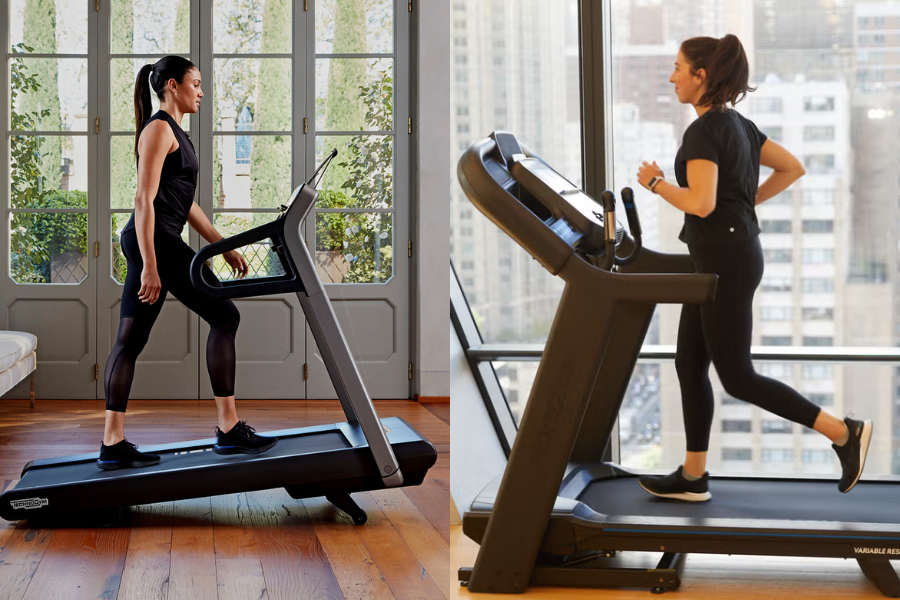
- Posture: keep your chest lifted, eyes forward, and shoulders relaxed
- Foot strike: land gently under your body, not on your heels far in front
- Hand placement: avoid gripping the rails during hard intervals so your body can move naturally
For the cool down, slow to an easy walk for 5 minutes and then stretch your calves, hamstrings, and hips. TRUE Fitness emphasizes that cooling down and stretching help reduce injury risk and improve recovery (TRUE Fitness).
Use speed and incline the smart way
One big advantage of treadmill HIIT workouts is how easily you can adjust difficulty. You have two main knobs to turn: speed and incline.
Speed controls how fast your legs need to move. For beginners, TRUE Fitness suggests starting with jog intervals around 4 miles per hour on a flat or slight incline up to 2 percent, then gradually increasing speed as you adapt (TRUE Fitness). Intermediate users might sprint at 6 to 7 miles per hour with a 2 to 4 percent incline, while advanced users can reach 8 to 9 miles per hour and up to a 6 percent incline (TRUE Fitness).
Incline increases the challenge without requiring as much speed. Walking at a high incline can raise your heart rate and work your glutes and hamstrings without the impact of running. Some lifters on Reddit report walking at 12 to 15 percent incline at 3.5 to 4.5 miles per hour for about 30 minutes after lifting as a solid fat loss routine (Reddit).
Many people also like to keep some steady incline walking in Zone 2 heart rate, roughly 128 to 138 beats per minute for many adults, to support fat loss and endurance (Reddit). You can alternate these easier incline days with true HIIT days to avoid burnout.
Start with beginner treadmill HIIT workouts
If you are new to intervals, your goal is to get comfortable with the pattern of speeding up and slowing down. Keep your total time short at first and choose speeds that feel tough but controlled.
Fitbod shares a simple beginner protocol from running expert David Dack: after a 5 minute power walk, alternate 1 minute runs at a challenging pace with 1 to 2 minutes of walking, repeated for about 8 rounds (Fitbod). That gives you around 20 to 25 minutes including the warm up and cool down.
Here is a basic beginner treadmill HIIT template you can adapt:
- Warm up: 5 minutes brisk walk at 0 to 1 percent incline
- Interval 1: 30 to 60 seconds jog at 4 miles per hour, 0 to 2 percent incline
- Recovery: 60 to 90 seconds walk at 2.5 to 3 miles per hour
- Repeat intervals and recoveries 6 to 8 times
- Cool down: 5 minutes easy walking
Fitbod also suggests 20 minute workouts that alternate 60 second jogs with 90 second walks, or even shorter 10 minute sessions of 10 second sprints followed by 50 seconds of rest for a quick start (Fitbod). Aim for 2 or 3 HIIT days per week with at least one rest or easy day in between, especially when you are just getting used to the impact on your joints (Fitbod).
Progress to intermediate and advanced routines
Once you can handle beginner intervals without feeling wiped out, you can slowly move into more intense treadmill HIIT workouts. You might increase your speed, your incline, or the length of your hard intervals, while keeping recovery periods long enough that your form stays solid.
TRUE Fitness recommends for intermediate users:
- Sprints at 6 to 7 miles per hour
- Incline between 2 and 4 percent
- Intense intervals of about 30 seconds
- Active recovery of about 60 seconds at a brisk walking pace (TRUE Fitness)
Advanced users can push to:
- Sprints at 8 to 9 miles per hour
- Inclines up to 6 percent
- Hard efforts lasting up to 90 seconds
- Around 2 minutes of active recovery walking at about 3.5 miles per hour
- Total workout time of 20 to 30 minutes to avoid excessive fatigue and injury risk (TRUE Fitness)
PureGym offers example protocols as well, such as eight 20 second all out sprints with one minute of rest, or five 15 second sprints where you increase the incline by 1 percent each round (PureGym). However you structure it, keep your high intervals short enough that you can maintain strong technique.
Balance HIIT with steady state cardio
Even if you enjoy the challenge of HIIT, you do not need every workout to be all out. Steady state treadmill sessions at a moderate pace still improve your health and can match HIIT in some outcomes.
An 8 week study in untrained college aged adults compared two HIIT protocols with steady state training. All groups increased aerobic capacity by about 18 percent and improved anaerobic performance, with no one protocol clearly superior (NCBI PMC). The most intense Tabata style HIIT, which used 20 seconds of work at 170 percent of VO2 max and 10 seconds rest, was actually the least enjoyable and required longer recovery (NCBI PMC).
Enjoyment matters for sticking with exercise over months and years. If you feel drained or start dreading your intervals, you can:
- Swap one HIIT day for a 30 minute incline walk in Zone 2
- Shorten your hard intervals slightly and extend recovery
- Limit HIIT to 2 or 3 sessions per week and fill other days with easier movement
This balance lets you get the benefits of high intensity training without overwhelming your body or motivation.
Think of HIIT as a powerful seasoning for your workout week, not the whole meal.
Make your cardio fun and sustainable
One reason people like treadmill HIIT workouts is that they feel more engaging than a steady slog. You are always a minute away from a change, which helps the time pass faster. You can lean into that variety to keep things enjoyable.
A few ways to keep your sessions interesting:
- Vary speed and incline across intervals instead of repeating the same pattern every time, a tip echoed by treadmill users on Reddit to avoid monotony and support effectiveness (Reddit)
- Use music with clear beats and match your sprints to the chorus, then walk the verses
- Try “ladder” workouts where intervals gradually get longer, then shorter again
- Track your distances or speeds so you can see real progress over weeks
NordicTrack suggests warming up with dynamic stretches and keeping your heart rate in about 70 to 85 percent of max during high intensity intervals for safe, effective training (NordicTrack). A simple heart rate monitor or smartwatch can make this easy and add another layer of feedback.
Finally, consistency is more powerful than any perfect plan. Reddit users who focus on 30 to 60 minute treadmill sessions 3 to 5 times per week, whether incline walks or interval runs, tend to see steady fat loss and conditioning gains over time (Reddit). Your own best routine will be the one you can repeat most weeks without dread.
Try adding one short interval session to your week, pay attention to how your body responds, and adjust from there. With a bit of structure and some experimentation, your treadmill can become a surprisingly effective and even enjoyable tool for getting fitter and leaner.
About the Author