A strong set of quadriceps does much more than shape your thighs. The right quadriceps strengthening exercises help you walk, run, climb stairs, and get up from a chair with less effort and less pain. They also protect your knees and support your overall mobility as you age.
Below, you will learn what your quads do, how to train them safely, and a range of beginner friendly and more advanced exercises you can do at home or in the gym.
Understand your quadriceps
Your quadriceps femoris is a group of four muscles on the front of your thigh. Together they straighten your knee and help you flex your hip, so you use them with almost every step.
Those four muscles are:
- Rectus femoris
- Vastus lateralis
- Vastus intermedius
- Vastus medialis
The vastus medialis, especially the teardrop shaped part near your inner knee, helps stabilize your kneecap as you move, according to a 2024 patient guide from Frank Gilroy Physiotherapy in Glasgow.
When these muscles are strong and well coordinated, you are able to:
- Support your body weight without straining your joints
- Walk faster and run more efficiently
- Keep your kneecap tracking smoothly so it is less likely to feel sore or unstable
Weak or tight quads, on the other hand, can make simple movements like standing up, climbing stairs, or getting out of a car feel harder than they should.
Why quadriceps strength matters for everyday life
Quadriceps strengthening exercises are not just for athletes. They play a big role in how you move through daily life at any age.
Research summarized in a Frank Gilroy Physiotherapy guide notes that resistance strength training performed 3 to 5 times per week leads to clear gains in muscle strength in adults. Other studies by Bolton et al, Basat et al, and Stolzenberg et al found that resistive training that targets the quads significantly increases strength and the number of repetitions you can perform.
For you, that strength translates into:
- Easier stair climbing and hill walking
- More stable knees when you step off a curb or change direction
- Better balance and fewer stumbles
- Less stress on your knee joint during activities you already do
One eight week program focused on quadriceps strengthening, performed twice per week, significantly reduced pain and improved function and quality of life in adults with knee osteoarthritis, as reported in a study from São Paulo, Brazil. Participants who exercised had less pain and moved more easily than those who only received education without exercise, and the differences were statistically significant (p < 0.0001).
In short, doing the right exercises can directly improve how you feel and move every day.
Start safely if you are recovering from injury
If you have had a recent quadriceps strain or knee injury, your first goal is to calm things down before you worry about getting stronger.
According to Frank Gilroy Physiotherapy, the first 0 to 48 hours after a quad injury should focus on the PRICE protocol:
- Protection
- Rest
- Ice (usually about 20 minutes at a time)
- Compression with an elastic bandage
- Elevation to reduce swelling
Once pain and swelling start to settle, you can begin very gentle quadriceps strengthening exercises that avoid deep bending or heavy loads. Many rehab programs start with straight leg raises in long sitting, then progress to using a light resistance band (Theraband) and finally small ankle weights around 2 kilograms, performed 4 times per day, 5 days per week.
If you have arthritis, your therapist might also start you with simple movements like seated knee extensions, short arcs, or assisted squats to build strength without overloading your joints, as recommended in patient guides and knee conditioning programs from sources such as Frank Gilroy Physiotherapy and the American Academy of Orthopaedic Surgeons (AAOS).
If you are under medical care, always check with your doctor or physical therapist before starting a new routine.
Easy quadriceps strengthening exercises at home
You do not need a gym membership or special machines to work your quads. Many of the most effective quadriceps strengthening exercises can be done in your living room using only your body weight, a chair, or a step.
Start with 2 sets of 10 to 12 repetitions per exercise. As you get stronger and the movements feel easier, you can add a third set or increase the reps.
Seated knee extension
This is a simple way to activate your quads with good control.
- Sit tall on a firm chair with both feet flat on the floor.
- Tighten the muscles on the front of your thigh.
- Slowly straighten one knee until your leg is as straight as you can comfortably make it.
- Hold for about 5 seconds, then lower slowly.
- Repeat on the other side.
A variation uses an elastic band for extra resistance, as described in some physiotherapy protocols. Wrap the band around your ankle and attach the other end to a stable point behind you so your quads work harder as you straighten your knee.
Inner range quads over roll
This exercise lets you work the quads with very little knee movement, which is helpful if your knee is sore.
- Lie on your back with a rolled towel under your knee.
- Gently press the back of your knee into the towel as you straighten your leg.
- Tighten your quad and lift your heel slightly off the ground.
- Hold for 5 seconds, then lower with control.
- Repeat for your set, then switch sides.
Fitness trainer Kieran Knight notes that similar short arc movements are highly effective for building quad strength while keeping pain low.
Sit to stand
This is one of the most functional quadriceps strengthening exercises you can do because it mirrors a movement you perform all day.
- Sit on a firm chair with your feet under your knees, about hip width apart.
- Cross your arms or keep them in front of you so you do not push off with your hands.
- Lean your torso slightly forward and press through your heels to stand up.
- Pause, then slowly lower back down with control.
Try to keep your knees aligned with your toes rather than letting them collapse inward. This exercise is frequently recommended for people with arthritis and can be progressed by using a lower chair or holding a light weight.
Partial wall squat
Partial wall squats let you work your quads without putting as much stress on your knees as a deep squat.
- Stand with your back against a wall.
- Walk your feet about 30 centimeters away from the wall, hip width apart.
- Slide down the wall until your knees bend to a comfortable, pain free angle.
- Keep your knees over your feet and your heels on the ground.
- Hold for about 5 seconds, then slide back up slowly.
Patient guides often include this exercise as a way to strengthen the quadriceps gradually while protecting the knee.
Weighted step up
Once the easier variations feel comfortable, a step up is a great way to challenge your quads in a controlled way.
- Stand facing a step or low platform.
- Place one foot on the step, keeping your knee aligned with your second toe.
- Press through your front heel to step up, then lightly tap your back foot onto the step.
- Step down with control, leading with the same leg.
- Switch legs after your repetitions.
Some arthritis programs suggest holding 2 kilogram weights to increase resistance once you can do the movement smoothly.
Beginner friendly bodyweight quad exercises
As your confidence grows, you can move into more demanding compound moves. These work not only your quads but also your hips and core, which helps with overall stability.
Bodyweight squat
- Stand with your feet about shoulder width apart.
- Brace your core and keep your chest lifted.
- Sit your hips back slightly and bend your knees as if you are sitting into a chair.
- Go only as low as you can while staying pain free and keeping your heels grounded.
- Push through your feet to return to standing.
Bodyweight squats are a staple in knee conditioning programs, including those discussed by the AAOS, because they strengthen the front of the thigh and support the knee joint.
Walking lunge
- Stand tall with feet hip width apart.
- Step one foot forward, lowering your back knee toward the floor.
- Both knees should bend to about 90 degrees, and your front knee should stay over your ankle, not far past your toes.
- Push through your front heel to bring your back leg forward into the next step.
Lunges are excellent for your quadriceps and also improve hip and knee stability and balance. You can modify your step length if your knees are sensitive.
Split squat
A split squat is like a static lunge and is easier to balance for many people.
- Stand with one foot in front of the other as if you are about to take a step.
- Keep most of your weight on your front leg.
- Bend both knees and lower your back knee toward the floor.
- Push through your front heel to return to the starting position.
You can hold the back of a chair or place a hand on a wall if you need extra support. This exercise works your front leg quads, glutes, and hamstrings, and stretches the quads and hip flexors of your back leg.
More advanced quadriceps strengthening for the gym
If you already have a base of strength and no significant knee pain, you can use gym equipment and more challenging variations to keep progressing. Insights shared in a June 2024 Gymshark training guide highlight several quad focused moves.
Quad focused squats
Squat variations that keep your torso more upright and your knees tracking forward tend to increase quad activation. Examples include:
- Barbell front squats
- Heel elevated goblet squats
- Hack squats
- Sissy squats
Gymshark notes that these exercises change joint angles so your quads take on more of the load. Aim for the hypertrophy rep range of about 8 to 12 reps per set and try to complete around 10 sets per week of quad work if your goal is muscle growth.
The barbell front squat, for example, targets the quads, hamstrings, and glutes, while typically placing less stress on the lower back compared with a traditional back squat. Because it is a technical movement, it is safest to learn it with a coach, especially if you are returning from an injury.
Unilateral quad work
Working one leg at a time helps fix side to side imbalances and challenges your balance.
Good choices include:
- Lunges with the front foot elevated
- Bulgarian split squats with a shorter stance and, for extra focus, an elevated front heel
The Gymshark article explains that these tweaks can enhance quad engagement and also demand more from your core and hip stabilizers.
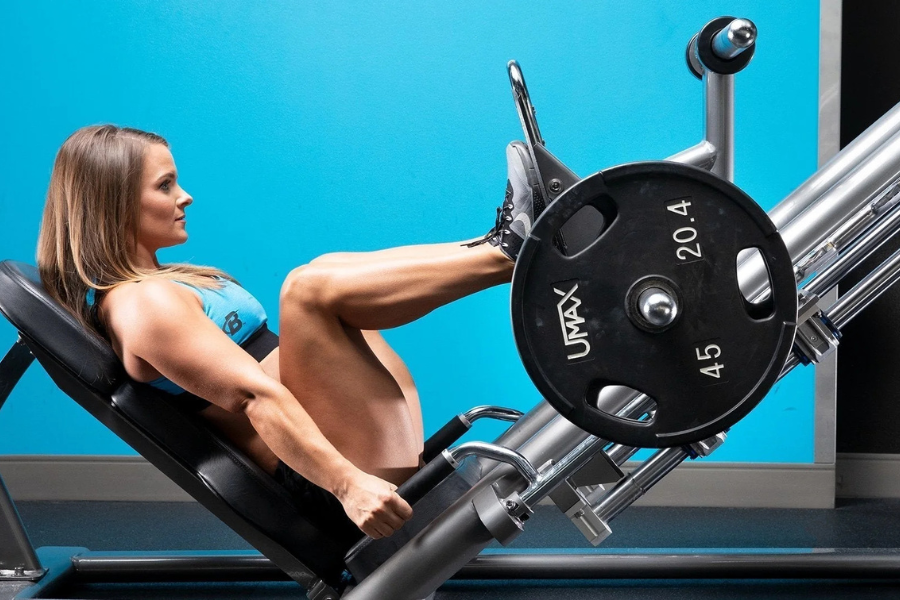
Leg extensions and machine work
Seated leg extensions isolate the quadriceps and are relatively easy on the rest of your body, which is why they often show up in rehab programs as well as strength plans. Patient guides recommend:
- Using a controlled tempo, not swinging the weight
- Avoiding very heavy loads that cause knee pain
- Performing sets of roughly 12 to 15 repetitions, several times per week
AAOS protocols suggest starting with around 3 sets of 10 repetitions, 4 to 5 days per week, and gradually increasing from 5 pound weights up to around 10 pounds as you tolerate it.
Banded Spanish squats are another option if you have access to resistance bands. The band helps stabilize your knees and prevents them from drifting too far forward, which can make squatting more comfortable if you experience knee pain.
How often to train your quads
Your quadriceps respond well to consistent, moderate work rather than occasional hard efforts.
Here is a simple way to structure your week:
Aim to work your quads 2 to 3 times per week, choosing 2 or 3 exercises each session and performing 2 to 3 sets of 8 to 15 reps per exercise.
Research summarized by Frank Gilroy Physiotherapy suggests that resistance training 3 to 5 times per week is effective for strength gains. The Gymshark quad guide recommends at least 10 sets of quad exercises per week in the 8 to 12 rep range to drive muscle growth.
If you are new to exercise or focusing on rehab:
- Start with 2 sets of 10 to 12 reps
- Train every other day at most so your muscles can recover
- Increase sets or resistance only when movements feel controlled and pain free
Always listen to your body. Mild muscle fatigue is expected. Sharp or increasing joint pain is a sign to ease off or speak to a professional.
Long term benefits of strong quadriceps
Keeping your quads strong pays off far beyond your next workout.
Stronger quadriceps help:
- Reduce stress on your knees by absorbing more load
- Improve the stability of your kneecaps
- Support everyday actions like standing up, walking, running, and climbing stairs
- Maintain your independence as you age
Observational reports note that older adults who regularly walk and cycle tend to have stronger, more flexible quads and often continue these activities without knee pain well into later life. On the other hand, if your quads weaken significantly, it can become difficult to climb stairs or even walk without discomfort, and in severe cases it may contribute to loss of mobility.
By adding a few quadriceps strengthening exercises into your weekly routine now, you give yourself a better chance of staying active, steady on your feet, and confident in your movements for years to come.
About the Author