A glute workout for women does more than shape your butt. Strong glutes support your hips, protect your lower back, and help you walk, run, and climb stairs with less effort. The routine below is designed to feel approachable and friendly, whether you are just getting started or you already lift regularly.
You will move through three levels, but you can stay at whichever one feels right for you and mix and match exercises you enjoy.
Why glute strength matters for women
Your glutes are some of the most hard‑working muscles in your body. The gluteus maximus is actually the largest muscle you have, and it works together with the gluteus medius and gluteus minimus to stabilize your hips and pelvis during everyday movement. These muscles help you stand up, sit down, walk, and even maintain good posture.
When your glutes are weak, other areas pick up the slack. This can lead to tight hip flexors, cranky knees, and a lower back that feels stiff or sore after long days of sitting. Trainers often describe the glutes as the “gateway of the spine and lower legs” because they connect your upper body to your legs and influence how you move from head to toe.
Glute strength is especially important if you are pregnant or planning to be. Strong, active glutes can support your pelvic floor and may reduce the risk of back pain as your body changes throughout pregnancy.
How to know if your glutes are underactive
You might assume your glutes are working every time you squat or climb stairs, but that is not always the case. Some common signs they are not pulling their weight include:
- You feel squats and lunges mostly in your quads or lower back
- Your knees tend to cave inward when you lower into a squat
- Balancing on one leg feels very wobbly
- Your hip flexors, quads, or hamstrings always feel tight, even if you stretch often
- You sit for long periods and frequently notice low back discomfort
If a few of these sound familiar, you likely have underactive glutes. The good news is that you can wake them up fairly quickly with specific activation work before your main workout.
How often to do a glute workout for women
Most trainers recommend working your glutes 2 to 3 times per week, leaving at least 24 to 48 hours between strength sessions for recovery. This gives your muscles time to rebuild and grow stronger.
You do not need to spend hours in the gym either. A focused 30 to 45 minute glute workout that includes activation, mobility, and strengthening moves can be enough. Consistency beats intensity, so pick a schedule that feels realistic for you and stick to it.
If you are very new to strength training, start with 2 sessions per week. As you feel more comfortable, you can add a third glute day if you enjoy the training and recover well. Recovery can include light walking, stretching, foam rolling, hydration, and quality sleep.
Always start with glute activation
Before you lift heavier weights, you want to teach your body to actually use your glutes. That is where activation comes in. This is simply the practice of consciously squeezing and engaging the muscles so they fire properly during your workout.
One of the most effective activation moves is the basic glute bridge:
- Lie on your back with your knees bent and feet flat on the floor, hip‑width apart.
- Press your lower back gently into the floor so your core is engaged.
- Push through your heels and squeeze your glutes to lift your hips until your body forms a straight line from shoulders to knees.
- Hold for 1 to 2 seconds at the top, then lower with control.
Focus on feeling the work in your glutes, not your lower back. If your hamstrings cramp, scoot your feet a little closer to your hips.
You can also add simple moves like lateral band walks or banded clamshells to wake up the smaller glute muscles around your hips. Trainers often combine this activation work with gentle hip mobility drills to loosen tight areas and improve your range of motion before you start heavier sets.
Try 5 to 10 minutes of activation before each glute workout. It can make every rep more effective and reduce your risk of overusing your lower back.
Beginner glute workout for women
If you are new to strength training, you can build strong glutes at home using just your bodyweight. The goal at this level is to learn solid form, build confidence, and practice that mind‑muscle connection with your glutes.
Aim to do this workout 2 times per week for 4 to 6 weeks.
Circuit 1: Foundations
Perform each exercise for 10 to 12 repetitions. Move through the circuit 2 or 3 times with 45 to 60 seconds of rest between exercises.
-
Air squat
Stand with your feet slightly wider than hip‑width apart. Sit your hips back as if you are lowering into a chair, keep your chest lifted, then push through your heels to stand. Focus on squeezing your glutes at the top. -
Glute bridge
Use the activation bridge described earlier, but now think of it as a strength exercise. You can pause for 2 to 3 seconds at the top of each rep to increase time under tension. -
Split squat
Take a long step forward with one foot and keep your torso upright. Lower your back knee toward the floor, then push through the front heel to stand. Keep your front knee tracking over your middle toes. Switch sides after each set. -
Curtsy lunge
From standing, step your right leg diagonally back behind your left, then bend both knees. You should feel your left glute working hard to control the movement. Return to standing and repeat on the other side.
Circuit 2: Balance and stability
Again, perform 10 to 12 reps per side and repeat the circuit 2 times.
-
Single‑leg Romanian deadlift (bodyweight)
Stand on your right leg and keep a soft bend in the knee. Hinge at the hips, send your left leg back behind you, and lower your torso until it is roughly parallel to the floor. Squeeze your right glute to return to standing. Use a wall or chair for balance if needed. -
Crab walk
Lower into a shallow squat and take small side steps to the right, then to the left. Keep your hips low and your chest lifted. This move hits the sides of your glutes and will make them burn in a good way.
If you are consistent, you can start to notice strength and shape changes in roughly 4 to 8 weeks, with bigger changes over 3 to 6 months. Time frames vary based on your training frequency, nutrition, and genetics.
Intermediate glute workout with dumbbells
Once bodyweight exercises feel comfortable, you can move into an intermediate glute workout for women that uses dumbbells or a kettlebell. This helps you apply progressive overload by increasing resistance over time.
Plan to do this routine 2 or 3 times per week. Rest 60 to 90 seconds between sets.
Main lifts
-
Dumbbell squat
Hold a dumbbell at your chest or two dumbbells at your sides. Sit your hips back and down, then drive through your heels to stand. Perform 3 sets of 8 to 10 reps. -
Reverse lunge
Hold dumbbells by your sides. Step one foot back into a lunge and push through the front heel to return to standing. Reverse lunges are often easier on the knees than forward lunges and they load the glutes well. Do 3 sets of 8 to 10 reps per leg. -
Single‑leg Romanian deadlift with dumbbells
Hold a dumbbell in the opposite hand of the standing leg. Hinge at the hip and lower the weight toward the floor while lifting your back leg. Squeeze the standing leg glute to rise. Do 3 sets of 8 to 10 reps per side.
Finisher
- Glute bridge march
Hold the top of a glute bridge. While keeping your hips high, alternate lifting one knee toward your chest, then the other. This challenges your glutes and core together. Aim for 20 total marches.
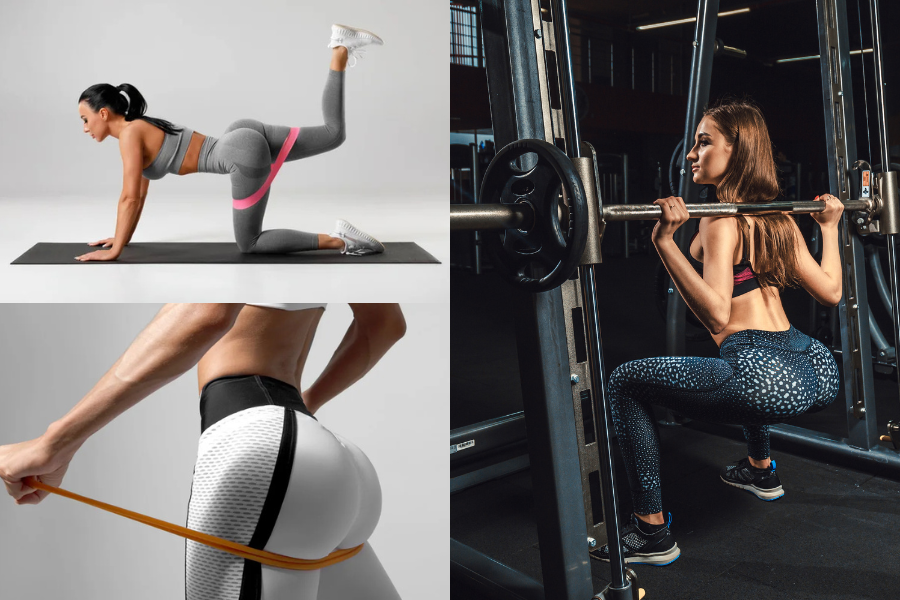
You can also add lateral band walks or banded hip abductions between sets to increase the work for your outer glutes, which help create that rounded, lifted look and also support hip stability.
Advanced glute workout with barbells and bench
If you are comfortable with the intermediate moves and have access to more equipment, you can level up with barbell work. A progressive program for a more advanced glute workout for women often includes hip thrusts, squats, deadlifts, and single‑leg exercises.
Trainer Sandy Brockman, who created the 6‑week Glute Gains Challenge, favors three strength‑training workouts per week that use barbells, dumbbells, and benches to apply progressive overload. Her program focuses heavily on glute activation, mobility, and steadily increasing weights and reps over several weeks to drive noticeable growth.
Here is a sample advanced day:
-
Barbell hip thrust
Sit with your upper back against a bench and a barbell resting across your hips. Plant your feet flat on the floor and lift your hips by driving through your heels and squeezing your glutes hard at the top. Lower with control. Perform 4 sets of 6 to 8 reps. -
Deadlift
With a barbell on the floor, hinge at your hips, grip the bar just outside your legs, and keep your spine neutral. Push through your feet and drive your hips forward to stand tall. You should feel strong engagement in your glutes and hamstrings. Do 3 sets of 5 to 8 reps. -
Bulgarian split squat
Stand a few feet in front of a bench. Rest the top of one foot on the bench behind you. Lower your back knee toward the floor, keeping your front knee aligned over the toes. Push through the front heel to stand. This move hits your glutes, quads, and improves balance. Do 3 sets of 8 to 10 reps per leg.
If your gym has a Smith machine, you can also use it for glute exercises. Contrary to what some trainers say, glute specialist Bret Contreras has found that many excellent glute movements can be done on a Smith machine, based on extensive work at his Glute Lab facilities.
Focusing on the upper glutes
If your goal is a lifted, “top shelf” shape, you want to pay special attention to the upper glutes, mainly the gluteus medius and minimus. These muscles control hip abduction, or moving the leg away from the midline, and they help keep your pelvis stable.
Effective upper glute exercises include:
- Lateral band walks
- Side plank with hip abduction
- Cable hip abduction
- Dumbbell walking lunges
- Single‑leg Romanian deadlifts
Most women see good results by training the glutes at least twice per week, and up to three times when recovery is managed well. With consistent training and smart progression, you can usually see some visible change in upper glute shape within 4 to 8 weeks, with more noticeable development over 3 to 6 months.
Tips for safe and effective glute training
A few simple habits will help you get more from every glute workout for women and stay pain‑free:
- Move slowly and with control, especially at home, to avoid shifting work into your lower back
- Keep your core gently engaged to support your spine during squats, deadlifts, and bridges
- Gradually increase your challenge by adding reps, shortening rest, adding isometric holds at the top of a movement, or using resistance bands or weights
- Allow 48 to 72 hours between hard glute sessions so muscles can recover and grow
- Support your training with good nutrition, hydration, stretching, and sleep
Certified strength and conditioning specialists frequently remind women that strong glutes do much more than change how jeans fit. They stabilize your pelvis, support your spine, and help prevent pain as you move through your day, which is especially important if you spend long hours sitting or if you are active in sports or activities like running and yoga.
Start with one level of this routine, choose 4 to 6 exercises you enjoy, and repeat them consistently for several weeks. As you feel stronger, adjust the weights or progressions. Over time, you will not only see changes in your glutes, you will also feel steadier, more powerful, and more comfortable in your own movement.
About the Author