A smart calf workout does more than add size to your lower legs. Effective calf workouts also help you run faster, jump higher, and protect your ankles and knees from injury. With a few strategic tweaks, you can turn “throwaway” calf raises at the end of your session into a focused routine that builds real strength and visible muscle.
Below, you will learn how your calves actually work, which exercises matter most, and how to structure calf workouts that finally deliver bigger gains.
Understand your calf muscles first
Before you overhaul your calf workouts, it helps to know what you are training.
Your calf is not just one muscle. It is mainly two:
- Gastrocnemius. The larger, more visible muscle that gives your calf its shape. It crosses both the knee and ankle. It works hardest when your leg is straight and it helps with explosive actions like sprinting and jumping.
- Soleus. A flatter, deeper muscle that sits under the gastrocnemius. It is more active when your knee is bent. It is crucial for posture, walking, and steady support when you stand for long periods.
Both muscles drive plantar flexion, which is the movement of pointing your toes away from your shin. This motion is essential for walking, running, and jumping, as described by the International Sports Sciences Association (ISSA) in May 2023.
If you only rely on basic standing calf raises, you mainly work the gastrocnemius. To build fuller, stronger calves, you need to target the soleus as well and train the entire lower leg, including the tibialis anterior on the front of your shin, which helps control and balance that motion.
Fix common calf training mistakes
Many people feel like they train calves regularly but never see a difference. Often, the issue is not effort, it is strategy. Several common mistakes can hold your calf workouts back.
One of the biggest problems is using too little weight and a tiny range of motion. Your calves already handle thousands of low intensity steps every day. If your reps look like quick, short bounces, you are repeating what they already tolerate. ISSA notes that growth requires unfamiliar, higher intensity work with a greater range of motion, not more of the same light stimulus.
Another mistake is only doing long, full range reps and never loading the bottom half of the movement. Sports rehab specialist David Grey explained on the Coach Em Up podcast that always using a full range for every rep can create active insufficiency. Most strength building happens in the bottom half of the calf raise, where the muscle is stretched but still able to produce a lot of force.
It is also easy to overcomplicate exercise selection. Grey points out that too much variety, especially an overreliance on seated calf raises, can water down your results. Standing calf raises with enough load should be your foundation, with other variations added intentionally, not randomly.
Finally, many lifters train calves too frequently but too lightly. They tack on a few sets at the end of most workouts without progressive overload. This pattern makes the muscles tired but not challenged enough to grow. A more focused plan with real loading and progression works better than constant low effort reps.
Choose the most effective calf exercises
To amp up your calf workouts, you do not need dozens of exercises. You just need a small group that hits both major muscles and supports real strength.
Fitness experts Ebenezer Samuel and Don Saladino recommend several key moves for well rounded calf development, as highlighted by Men’s Health in 2024:
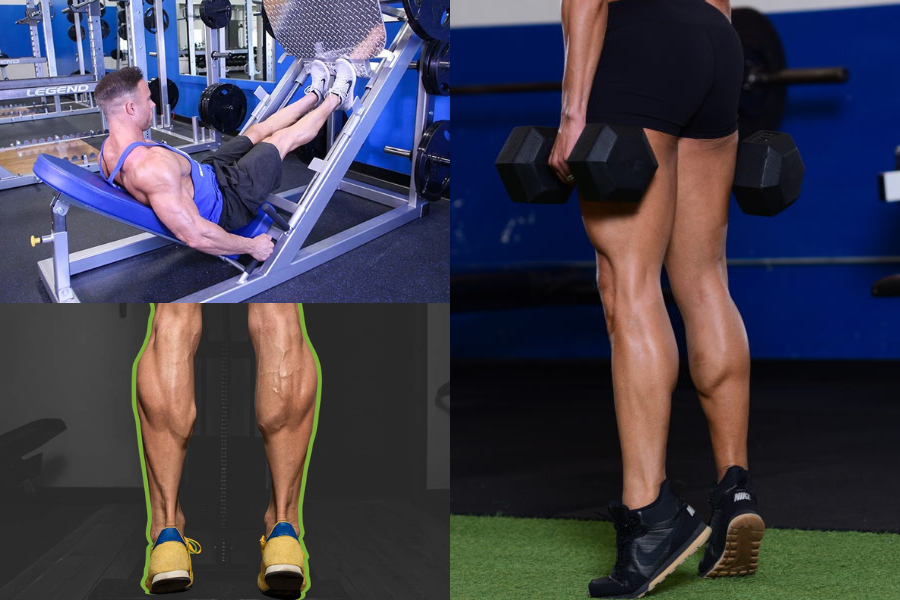
- Single leg calf raises on the leg press. Do 3 sets of 12 to 20 reps each leg. The machine lets you load heavily while controlling the range of motion.
- Jump rope intervals. Perform 3 to 4 rounds of 30 seconds on and 30 seconds off. This adds explosive, plyometric work that complements your strength sets.
- Seated calf raises. Aim for 3 sets of 8 to 15 reps. Because your knees are bent, these focus more on the soleus.
- Safety squat bar squat raises. Complete 3 sets of 10 to 15 reps. You perform a squat, then a calf raise at the top, which builds strength and coordination.
- Standing calf raises. Do 3 to 4 sets of 20 to 25 reps. This staple exercise provides the bulk of your volume for the gastrocnemius.
Research and coaching insights also emphasize the value of plyometric and explosive exercises like box jumps, jump squats, and single leg jumping to support calf muscle hypertrophy and power. These moves teach your calves to contract quickly and forcefully, which improves athletic performance and can stimulate growth when paired with resistance training.
For at home training, you can rotate through options like single leg calf raises, raised heel squats, downward dog holds, tiptoe walks, and calf rocks. These still follow the same principles, you adjust load and range of motion to challenge the muscles rather than racing through easy reps.
Adjust your form for better results
Small changes in how you perform calf exercises can make a big difference in what you get from them.
For straight leg exercises, keep your knees softly locked but not hyperextended. Push through the ball of your foot and big toe, not just the outer edge. Imagine reaching tall through the crown of your head as you rise, then lowering your heels with control until you feel a strong stretch in the muscle.
For bent knee variations like seated or bent knee calf raises, maintain a roughly 90 degree angle at your knees. This position shifts more work to your soleus. Move slowly and avoid bouncing at the bottom so the muscle, not momentum, does the work.
You can also change foot position to slightly bias different parts of the calf:
- Toes pointed slightly outward
- Toes pointed straight ahead
- Toes pointed slightly inward
Expert programming often uses these small variations across sets to hit the muscle from multiple angles. Effective calf training should also alternate between higher rep “volume” days in the 15 to 25 range and lower rep “strength” days in the 10 to 12 range for a complete stimulus.
Remember that according to David Grey, spending extra time in the bottom half of the movement, where the heel is lower and the muscle is most stretched, can have a big payoff for strength. You can use pauses or half reps in this zone to load it more heavily, as long as your ankles tolerate the position.
Use smart programming and progression
If you want bigger and stronger calves, treat them like any other major muscle group. You would not grow your back or legs with a few random sets once in a while, and your calves are no different.
ISSA recommends 6 to 12 reps for 4 to 5 sets twice a week for muscle growth. You can adapt this guideline to your fitness level, for example:
- One heavier day with 4 to 5 sets of 6 to 10 reps
- One higher rep day with 3 to 4 sets of 12 to 20 reps
The key is progressive overload. Over time, you should gradually increase the weight, the total number of quality reps, the range of motion, or the time under tension. ISSA also highlights volume, tempo, range of motion, and rest periods as variables you can manipulate to continue driving adaptation.
Because the gastrocnemius has a near equal mix of slow and fast twitch fibers, calves respond well to varied rep ranges and workloads. If you always stay in the same range, they adapt and stop changing. Rotate between heavier, slower sets and lighter, faster sets to keep the stimulus fresh.
Grey and other coaches also caution against doing frequent, light calf raises every single day. While Arsenal Strength notes that calf raises can be performed daily for some people, they advise aiming for 2 to 3 times per week for general strength and growth, and up to 4 to 5 times per week only if you manage recovery carefully. If your calves stay sore or your performance drops, scale back the frequency or volume.
Adequate sleep and recovery are part of the program too. ISSA points out that enough rest is crucial for hormone regulation, muscle repair, and protein synthesis. Without it, even the best designed calf workouts will underperform.
Quick rule of thumb: if you can do the same sets and reps with the same weight every week without effort, your calves are not getting a growth signal. Increase the challenge in at least one way.
Add power and mobility work
Muscle size and strength are not the only benefits you can target with calf training. You also want calves that are elastic, mobile, and responsive.
Plyometric moves like box jumps, jump squats, jump rope, and single leg hops improve calf muscle function and explosiveness. These exercises teach your muscles and tendons to store and release energy quickly, which boosts running speed, jump height, and overall athleticism. Research suggests they can also support hypertrophy when used alongside traditional resistance training.
Regular calf training also improves ankle mobility and lower body fluidity, which are essential for cutting, changing direction, and landing from jumps. Strengthening the muscles, tendons, and ligaments around your ankle joint can lower your risk of sprains and common overuse injuries, as noted by Arsenal Strength in 2025.
Do not overlook the front of your lower leg either. Targeting the tibialis anterior with shin raises or controlled dorsiflexion helps balance your calves and can reduce issues like shin splints. Effective calf workouts should train all lower leg muscles, not just the big ones on the back.
Finally, integrate stretching between sets and after workouts. Research cited by ISSA suggests that thorough calf stretching enhances mobility, encourages fascia expansion, improves the muscle pump, and supports recovery. Hold stretches for 20 to 30 seconds, avoiding sharp pain, and focus on both straight leg and bent knee positions to reach gastrocnemius and soleus.
Respect your limits and your genetics
If your calves feel stubborn, you are not alone. Greg Merritt explained in Flex Magazine in 2008 that calf size is largely influenced by genetics, especially the structure of the gastrocnemius. Some people have longer muscle bellies and shorter tendons that naturally look fuller. Others have shorter muscle bellies and longer tendons, which can make it harder to grow visually large calves even with serious training.
Genetics do not mean you should give up, they just mean your maximum potential look may be different from someone else’s. What you can always improve is strength, endurance, explosiveness, and resilience.
Pay attention as well to any signs of overuse or injury. Calf pain often stems from strains caused by running or jumping without a proper warm up, or from repetitive overuse that leads to cramps. If you notice severe pain, swelling, or trouble bearing weight, rest and consult a medical professional before jumping back into hard training.
Over time, properly loaded calf raises help strengthen the Achilles tendon, which reduces your risk of strains and supports recovery from Achilles tendinopathy. They also improve circulation in your lower legs, which can ease swelling for people who sit or stand for long periods.
Putting it all together
You do not need marathon sessions to build better calves. Start by picking a small number of effective exercises and training them with intent.
For example, you might structure a simple week like this:
- Day 1 (strength focus): Standing calf raises and single leg leg press calf raises in the 6 to 12 rep range
- Day 2 (power and endurance): Jump rope intervals, box jumps or jump squats, and higher rep standing or seated calf raises
Add progressive overload, vary your rep ranges, and take recovery seriously. Over the next few weeks, you should feel your calves getting stronger and more responsive. With consistent, focused calf workouts, bigger gains in size, strength, and performance are all within reach.
About the Author