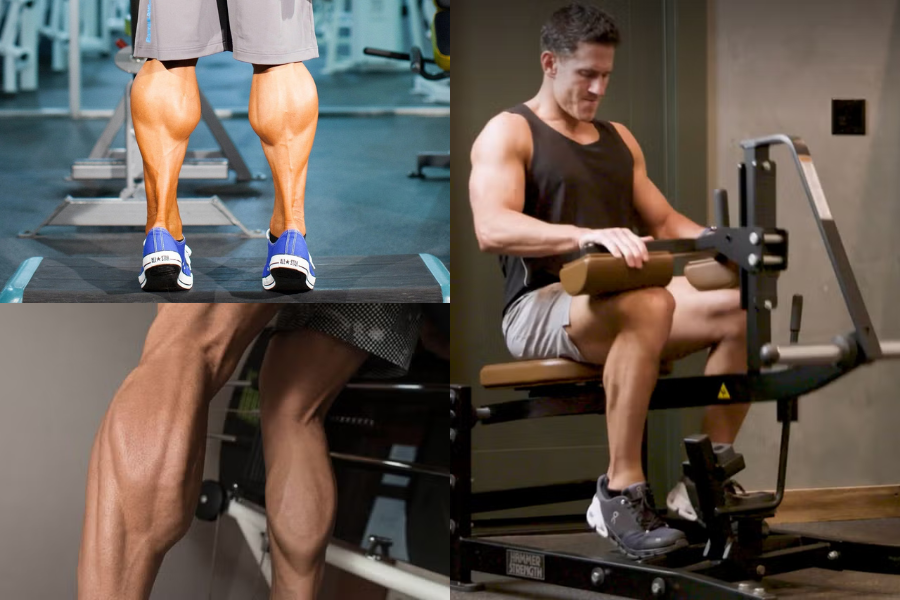
A pair of strong, defined calves does more than look good. When you understand how to build calf muscles with the right exercises, volume, and nutrition, you support better balance, stronger jumps, smoother runs, and more stable ankles. With a focused plan, you can turn stubborn calves into a real lower body strength asset.
Understand your calf muscles
Before you decide how to train your calves, it helps to know what you are actually working.
Your calves are mainly made up of two muscles:
- Gastrocnemius. This is the larger, more visible muscle that gives your calves their diamond shape. It crosses both your knee and ankle joints, contributes to plantar flexion (pressing your toes down) and helps with knee flexion.
- Soleus. This sits underneath the gastrocnemius and is less visible, but it plays a key role in stabilizing your foot and ankle, and in plantar flexion, especially when your knee is bent.
You also have the tibialis anterior, the muscle along your shin that pulls your toes up. Training it supports ankle health and calf shape and can help prevent shin splints.
Your calves are used all day when you walk or climb stairs, which means they are very accustomed to low intensity work over a short range of motion. To make them grow, you need to challenge them with higher intensity and longer ranges of motion that they are not getting from daily activity.
Set realistic expectations and goals
Calf training responds best to consistency and patience. Genetics do play a role in how easily you add size. Factors such as muscle insertion points, tendon length, and fiber type distribution vary from person to person and across ethnic backgrounds. For example, people with higher tendon ratios and more fast twitch dominance, which is common in some individuals of West African heritage, may find that their calves rely heavily on elastic recoil. Pausing for 2 to 3 seconds during each repetition can help reduce this recoil and shift more work to the muscles themselves.
You cannot change your bone structure or tendon length, but you can improve:
- Strength
- Endurance
- Shape and definition
- Overall lower body power and stability
A helpful way to approach calf training is to set clear goals:
- Short term, aim to add 2 to 3 dedicated calf sessions per week and hit them consistently for at least 8 weeks.
- Medium term, track strength increases such as using more weight or more reps at the same weight.
- Long term, measure ankle mobility, jump height, or running comfort as signs your calves are doing their job.
Fuel your calves with the right nutrition
You cannot build calf muscles effectively without supporting them with good nutrition. Muscle growth relies on enough protein, total calories, and nutrients that support recovery and performance.
Key muscle building foods
Several everyday foods are especially useful:
- Eggs. Each egg supplies about 7 grams of high quality protein, plus vitamins and minerals that support muscle building and recovery. This makes eggs an easy way to help fuel calf muscle development and overall strength.
- Wild salmon. A 100 gram serving contains about 20 grams of protein and a strong dose of omega 3 fatty acids, which support muscle health and recovery. This combination is especially useful if your calf training volume is going up and soreness is more frequent.
- Chicken. Skinless chicken provides around 31 grams of protein and only 4 grams of fat per 100 grams, so it is a staple option when you want to hit your protein targets without adding a lot of extra calories.
- Spinach. Spinach supplies iron and nitrates that help support cell metabolism and muscle growth. Including spinach in your meals can be an easy way to add nutrients that help your calves and other muscles recover from tough workouts.
You do not have to eat these specific foods every day, but including plenty of protein rich options and leafy greens in your regular meals makes it easier to support growth in any muscle group, including your calves.
Use full range of motion
One of the most important parts of learning how to build calf muscles is using the full range of motion at your ankle in each exercise.
Your ankle can typically move through about:
- Up to 20 degrees of dorsiflexion (toes up toward your shin)
- Up to 50 degrees of plantarflexion (pressing your toes down and lifting your heel)
On calf raises, many people only move through the top half of this motion. To grow your calves, you want:
- A deep stretch at the bottom, with your heel lowered below the level of your toes on a step or block.
- A strong contraction at the top, fully pressing up on your toes.
Slowing your reps and pausing briefly at both the bottom and top reduces bouncing and uses muscle strength rather than momentum. This is especially important if you usually walk a lot, since your calves are already used to shallow, repetitive motion.
Target both gastrocnemius and soleus
Because the gastrocnemius and soleus respond best to slightly different training styles, you will see better results if you train both on purpose.
Straight knee exercises for gastrocnemius
The gastrocnemius works harder when your knees are relatively straight. Good options include:
- Standing calf raises
- Leg press calf raises
- Tip toe farmer’s carries
- Squats that rise into a calf raise at the top
Heavier loads and moderate repetitions are ideal here. The gastrocnemius has more fast twitch fibers, so it tends to respond well to 8 to 12 reps with challenging weight and a strong focus on controlled movement.
Bent knee exercises for soleus
The soleus is most active when your knees are bent. Bent knee movements include:
- Seated calf raises
- Calf raises in a squat or lunge position
- Seated eccentric calf raises
The soleus contains roughly 80 percent slow twitch fibers, so it responds well to higher repetitions such as 15 to 30 reps with moderate loads and more time under tension.
A 2014 study by Suzuki and colleagues showed that knee angle affects calf muscle activation. This means you really do need both straight leg and bent leg movements if you want to fully develop your calves.
Vary your foot position
You can change which parts of the gastrocnemius you emphasize by rotating your feet slightly:
- Toes out. Targets the inner or medial head more.
- Toes in. Shifts more work to the outer or lateral head.
- Toes forward. Hits both heads fairly evenly.
A 2020 study by Nunes and colleagues recommends performing sets with different foot positions to maximize hypertrophy. In practice, you can alternate foot angles from set to set on standing calf raises. This lets you cover all regions of the muscle without needing many extra exercises.
Plan your calf training frequency and volume
Calves are used to daily activity, so they usually need more dedicated volume than other muscle groups to grow.
A practical structure is:
- Frequency. Train calves at least twice per week. Many people do best with 2 to 4 sessions, split between gastrocnemius focused days and soleus focused days.
- Exercises per session. Choose 2 to 3 calf exercises per workout. For example, one standing, one seated, and one single leg variation.
- Sets and reps for hypertrophy. Aim for 4 to 5 sets per exercise, with 6 to 12+ reps for heavier work and 15 to 30 reps on lighter variations. A common pattern is heavy standing raises in the 8 to 12 rep range, followed by high rep seated raises.
Because your calves have a mix of slow and fast twitch fibers, varying your rep ranges and loads across the week helps you avoid plateaus and keeps progress moving.
Learn the best calf exercises
You do not need a long list of movements. Focus on a few effective options and do them well.
Standing calf raises
Standing calf raises are a classic for a reason. They load the gastrocnemius directly, especially with straight knees and a solid stretch at the bottom.
- Stand with the balls of your feet on a raised surface and your heels hanging off. Hold a rail or wall for balance if needed.
- Lower your heels slowly until you feel a strong stretch in your calves.
- Press through your toes to lift your heels as high as you can.
- Pause briefly at the top, then return with control.
For endurance style growth, you can work up to 4 sets of 25 to 30 reps using your body weight or light weights. For strength and size, load the movement heavier and use 8 to 12 reps with a slower tempo.
Seated calf raises
Seated calf raises target the soleus by putting your knees in a flexed position.
- Sit with your knees bent about 90 degrees and the balls of your feet on a block.
- Place weight on your knees, such as dumbbells or a specific seated calf machine.
- Drop your heels slowly, pause in the stretched position, then drive up onto your toes.
- Hold the top for 1 to 2 seconds to make the muscle work, then lower again.
Because the soleus is highly endurance oriented, higher rep ranges such as 15 to 30 reps for 4 sets can be particularly effective.
Eccentric calf raises
Eccentric training uses the lowering phase of the movement to drive growth.
- Start standing with both feet on a step and rise onto your toes with both legs.
- Shift your weight onto one leg, then slowly lower your heel for 3 to 5 seconds.
- Place the other foot back on the step and repeat.
This variation is useful if one calf is weaker or if you are coming back from a mild injury and want to increase strength and tissue tolerance gradually.
Tip toe farmer’s carries
This exercise challenges both your calves and your balance.
- Hold a pair of dumbbells at your sides.
- Rise onto your toes and walk slowly forward while staying tall.
- Keep your core engaged and your shoulders down.
Start with short distances and lighter weights, then gradually increase either the weight or the distance as you build endurance.
Squats into calf raises
Combining a squat and a calf raise trains your calves along with your quads and glutes.
- Perform a bodyweight or light weighted squat.
- As you stand up, continue into a calf raise at the top.
- Lower back into the squat and repeat.
This option works well in home workouts when you have limited equipment and want to get more out of each movement.
Add plyometrics for power and definition
Once you have a base of strength and your ankles feel stable, you can add plyometric work to build power and improve calf definition.
Good choices include:
- Lunge jumps. From a lunge position, drive up powerfully and switch legs in the air, then land softly.
- Jump rope. Focus on quick, rhythmic toe off and light, controlled landings.
Plyometrics emphasize the explosive side of your calf function. Keep the volume moderate and focus on good technique to avoid overloading your Achilles tendon.
Train the tibialis for balance and injury prevention
The tibialis anterior on the front of your shin is often overlooked, yet it plays a big role in ankle stability and helps shape the lower leg from multiple angles.
Simple options include:
- Toe raises while standing with your heels on the ground
- Walking on your heels for short distances
- Controlled dorsiflexion against a resistance band
Balancing calf and shin strength can reduce your risk of shin splints and improve how your legs feel during running or jumping sports.
Use smart technique and intensity methods
To get the most from your calf training, focus on quality reps and strategic intensity rather than just piling on weight.
- Avoid bouncing or jerking. Use a steady tempo, with controlled lowering and deliberate pressing.
- Use partial reps at the end of a set once you reach full range failure. This lets you push the muscle a bit further without compromising form early in the set.
- Try rest pause on your final set. Stop 2 to 3 reps short of failure, rest 15 to 20 seconds, then perform more reps. This increases total effective reps for growth.
- Stretch between sets. Holding a calf stretch between sets can increase the feeling of the muscle pump and may help with fascia expansion and mobility, which many lifters find useful for calf growth.
Sample weekly calf routine
Here is a simple structure you can adapt to your own schedule. Perform this twice per week on non consecutive days.
Focus on controlled form and full range of motion, not rushing through the reps.
Workout A (gastrocnemius emphasis)
- Standing calf raises, 4 sets of 8 to 12 reps, heavy, varying foot angle each set
- Eccentric single leg calf raises, 3 sets of 10 reps per leg
- Tip toe farmer’s carries, 3 sets of 20 to 30 seconds
Workout B (soleus and tibialis emphasis)
- Seated calf raises, 4 sets of 15 to 25 reps
- Squats into calf raises, 3 sets of 12 to 15 reps
- Toe raises or heel walks, 3 sets of 15 to 20 reps
If your calves are a major priority, you can add a lighter third session that focuses on high rep bodyweight calf raises and stretching.
Put it all together
Learning how to build calf muscles is less about finding a secret exercise and more about doing the basics very well, very consistently. When you:
- Eat enough protein and nutrient rich foods
- Train both the gastrocnemius and soleus through a full range of motion
- Use a mix of straight and bent knee exercises
- Adjust foot positions to hit different muscle regions
- Combine higher rep endurance work with moderate rep strength work
- Sprinkle in plyometrics and tibialis training for balance
you give your calves every reason to grow stronger and more defined.
Start with one or two of the strategies above this week, whether that is adding standing calf raises at the end of your leg workout or planning two focused calf sessions. Over time, those small, deliberate changes can turn your calves into one of your lower body strengths.
About the Author