A well planned elliptical workout for muscle toning can do more than help you “get your steps in.” With the right settings and form, you can tighten and define your legs, glutes, arms, and core while protecting your joints and improving your cardiovascular health at the same time.
Below, you will learn how the elliptical tones muscle, which muscles it actually works, and how to structure your workouts so you see real changes in the mirror, not just on the calorie counter.
Understand how the elliptical tones muscle
Ellipticals are often labeled as pure cardio, but they also provide enough resistance to challenge your muscles.
When you push and pull through each stride, your muscles contract repeatedly against resistance. Over time, this helps you build lean muscle and muscular endurance, especially in your lower body. Experts note that elliptical training can be used for strengthening muscles as well as cardiovascular conditioning, so it is beneficial for both muscle toning and overall fitness (Hospital for Special Surgery).
You will not get bodybuilder size from the elliptical alone. Compared with heavy strength training, it is better at shaping and firming than at adding large amounts of mass. That is ideal if your goal is a lean, athletic look.
Learn which muscles the elliptical works
Knowing which muscles you are targeting helps you adjust your workout for better results.
Elliptical machines work multiple muscle groups at the same time, which is part of what makes them so efficient (Tousains).
Lower body: Your main drivers
Most of the work on an elliptical comes from your legs and hips. Research shows that you primarily train:
- Glutes
- Hamstrings
- Quadriceps
- Calves
Every stride includes a push down and back and then a pull up and forward. If you think about driving through your heels and finishing each stroke, you will feel your quads, hamstrings, and glutes working in sync (Hospital for Special Surgery).
Increasing the incline can dramatically increase muscle activation. One analysis found that a nine degree incline produced up to a 635 percent increase in hamstring activation and a 345 percent increase in glute contraction compared with flat settings (Hone Health).
Upper body: Handles that actually help
If your elliptical has moving handles, you can turn your cardio session into a true upper body assist.
When you push and pull the handles with intention, you engage your:
- Chest
- Back muscles such as the lats and rhomboids
- Shoulders
- Biceps and triceps
Used correctly, the handlebars help you strengthen upper body muscles and make the elliptical a full body workout option for muscle toning (Hospital for Special Surgery).
Core: Built in stability training
You might not feel your abs “burning” the whole time, but your core is working to keep you upright and stable.
Your rectus abdominis, obliques, and deep transverse abdominals all work isometrically to stabilize your torso and transfer power between your upper and lower body (Garage Gym Reviews). Using the elliptical without holding the handles occasionally can further engage your core muscles and improve balance (Healthline).
Adjust settings to target different muscles
Small changes to resistance, incline, and stride can shift which muscles do the most work. This is where you can really turn a basic sweat session into an elliptical workout for muscle toning.
Use resistance to challenge your muscles
Resistance is your best friend for definition. Increasing resistance significantly enhances muscle building by forcing your legs, glutes, and core to work harder against each pedal stroke (Mr. Treadmill).
Set resistance to a level that:
- Feels difficult but controllable
- Lets you maintain good posture and smooth strides
- Allows you to speak in short sentences but not carry on an easy conversation
Most machines offer multiple resistance levels. Experts recommend starting at a moderate level that challenges your muscles while still allowing proper technique, instead of jumping straight to the highest setting (Hospital for Special Surgery). As you get stronger, you can increase resistance gradually.
Use incline and stride to shape your legs and glutes
Incline and stride length change how your legs work.
- A higher incline places more emphasis on your glutes and hamstrings (Planet Fitness).
- Shorter strides tend to emphasize your quadriceps and calves.
- Longer strides more strongly activate your hamstrings and glutes (ACE Fitness Equipment Blog).
If your main goal is firmer glutes and hamstrings, use a moderate incline and a slightly longer stride. If you want to feel your quads and calves more, lower the incline and shorten your stride a bit.
Try forward and reverse pedaling
Most of the time you probably move forward. Try pedaling backward for intervals too.
Reverse pedaling puts more load on your hamstrings and calves, which helps balance out your leg development and can reduce overuse strain on your quads (Mr. Treadmill). Start with 30 to 60 seconds at a time so you can get used to the motion.
As you rotate through resistance, incline, stride length, and direction, you give your muscles new challenges and avoid plateaus.
Use proper form to maximize toning
Good form is non negotiable if you want stronger muscles without sore joints.
Experts suggest a few key technique points (ACE Fitness Equipment Blog):
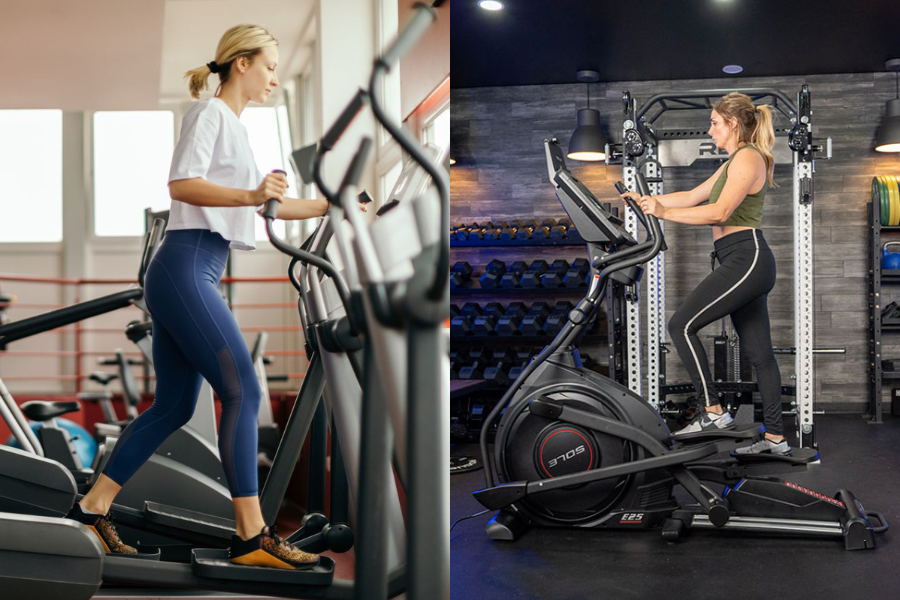
- Stand tall with your shoulders back, not hunched over the console.
- Keep your feet flat on the pedals, do not ride up onto your toes the whole time.
- Engage your core and avoid leaning heavily on the handles.
- Use a full range of motion, let your legs complete the circle instead of taking tiny, fast steps.
- Avoid bouncing or letting the machine carry you. You should feel that you are driving the movement.
Proper elliptical technique also involves pushing your legs down and back and then pulling them up and forward in a smooth, cyclical pattern. This keeps your quadriceps active and prevents you from “coasting” through your workout (Hospital for Special Surgery).
Structure an elliptical workout for muscle toning
You do not need marathon sessions to see results. Consistency and smart intervals matter more.
Here is a simple 35 minute routine that balances cardio and toning. You can adapt the resistance and incline to your fitness level.
-
Warm up, 5 minutes
Low resistance, low incline. Focus on posture, full range of motion, and deep breathing. -
Strength focused intervals, 16 minutes total
Alternate:
-
2 minutes at moderate to high resistance, moderate incline, using the handles
-
2 minutes at moderate resistance, slightly lower incline, hands off handles to engage your core
Repeat this 4 times. You should feel your legs and glutes working hard during the high resistance periods and your core working more during the hands free segments.
- Reverse pedaling block, 6 minutes
Keep resistance moderate and incline low or moderate.
-
1 minute pedaling backward
-
1 minute pedaling forward
Repeat 3 times. Adjust if backward pedaling feels too awkward at first.
- HIIT finisher, 4 minutes
High intensity interval training on the elliptical is an efficient way to increase muscle engagement and calorie burn (Healthline). Try:
-
30 seconds fast and powerful strides at higher resistance
-
60 seconds very easy recovery
Repeat 3 times, then finish with 30 seconds easy.
- Cool down, 4 minutes
Gradually lower resistance and incline. Let your heart rate come down and finish with gentle stretching off the machine.
Beginners can start with a shorter 20 to 30 minute plan that uses a similar pattern of warm up, intervals, and cool down, then increase length and intensity as fitness improves (Planet Fitness).
Combine elliptical training with fat loss and strength
If your goal is visible muscle definition, you will get the best results when you pair elliptical workouts with a few other habits.
Elliptical sessions help you burn calories and can assist with belly fat loss as part of an overall fat loss regimen, especially when combined with a calorie deficit, adequate protein, and some resistance training (Garage Gym Reviews). At the same time, they mainly engage slow twitch muscle fibers that are great for endurance and fat burning, but less effective for maximum muscle size (Garage Gym Reviews).
You will see faster changes if you:
- Strength train 2 to 3 days a week with basic movements like squats, lunges, pushups, and rows.
- Eat enough protein to support recovery and muscle repair.
- Stay hydrated and get adequate sleep, which both affect performance and muscle tone.
Combining elliptical training with other strength exercises such as squats and core work can accelerate muscle toning and growth results (Tousains).
Keep your joints happy while you tone
One of the biggest advantages of choosing an elliptical workout for muscle toning is how friendly it is to your joints.
Elliptical workouts are low impact and reduce joint stress while still effectively toning muscles, which makes them a strong option if you have knee, hip, or ankle concerns (Planet Fitness). Since the movement is weight bearing, you also support bone health and the strength of your skeletal system (Hospital for Special Surgery).
That combination of low impact, resistance, and full body engagement is rare. With thoughtful settings and consistent effort, you can use the elliptical to reshape your legs, lift your glutes, tighten your core, and build stamina, all while taking care of your joints.
Start with one or two focused sessions this week and pay attention to how your body feels. As you dial in your resistance, incline, and form, you will notice that the elliptical is much more than “just cardio.” It is a versatile tool that can help transform both how you look and how you move.
About the Author