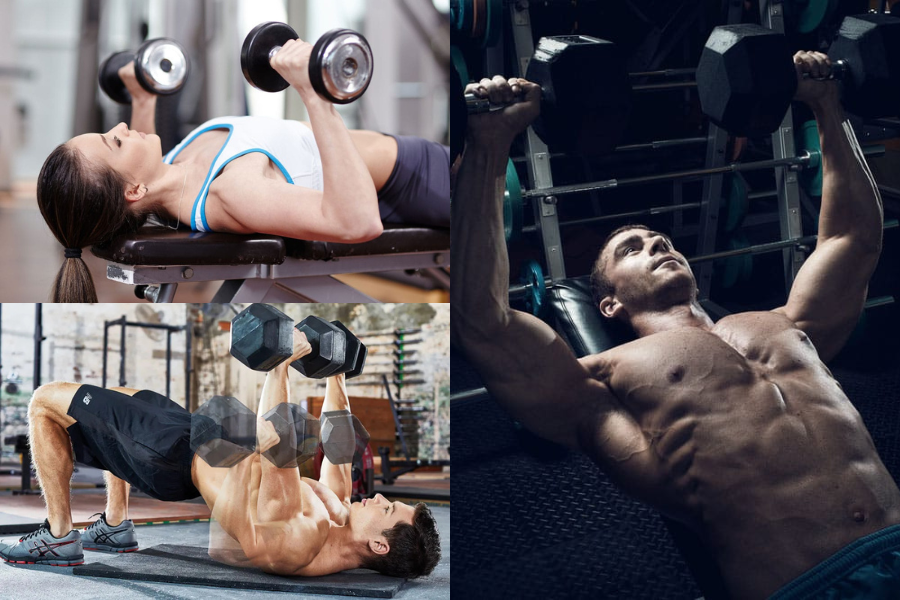
A focused chest workout with dumbbells lets you build strength and size quickly without needing a full gym. With just a bench and a pair of weights, you can target every part of your chest, protect your joints, and see progress in a matter of weeks.
Below, you will learn how your chest muscles work, the best dumbbell exercises to train them from all angles, and simple routines you can follow based on your fitness level.
Understand your chest muscles
When you know what you are training, it is easier to pick the right exercises and use good form.
Your chest is not just one flat muscle. It is a group of muscles that work together to move your arms and stabilize your upper body:
- Pectoralis major is the big, fan-shaped muscle you usually think of as your chest. It moves and rotates your upper arm, like when you push a weight away from you or hug a heavy box.
- Pectoralis minor sits underneath the pec major and helps keep your shoulder blade stable while you press or push.
- Serratus anterior is along your ribs and helps raise your arm overhead by rotating the shoulder blade.
No single exercise hits all areas of the chest equally. That is why a good chest workout with dumbbells uses different angles and movement patterns to target the upper, middle, and lower portions effectively.
Why choose a chest workout with dumbbells
Dumbbells are one of the most effective tools for chest training, and they offer several advantages over machines and barbells.
Dumbbells allow your hands and wrists to rotate naturally, so your elbows and shoulders can move in a comfortable path. This increased freedom gives you a larger range of motion, a deeper stretch at the bottom of each rep, and more tension on the pecs instead of the joints. Over time, that extra stretch and squeeze can lead to greater muscle growth.
Because each arm works on its own, a chest workout with dumbbells also helps correct left and right strength imbalances that are often hidden during barbell presses. Your body cannot let the stronger side do all the work, so you build more balanced muscle and strength.
Dumbbell exercises demand more stabilization too. Your shoulders, triceps, and core have to keep the weights under control, which improves coordination, balance, and functional strength you can use in daily life. This added stability work also makes dumbbells a joint friendly and scalable option that you can progress by adding weight, reps, or sets over time.
Finally, dumbbells are convenient. Most gyms have them, and you can keep a set at home or even in a small space so you do not have to skip your chest session when you cannot get to a full gym.
Best dumbbell exercises for chest
To build a strong, defined chest, focus most of your time on a few key compound exercises and then add a couple of isolation moves for detail work. Below are some of the most effective dumbbell chest exercises and how to use them.
Dumbbell bench press
The dumbbell bench press is one of the best overall chest exercises for building strength and muscle. Compared with the barbell version, it lets your arms move more naturally and gives you a fuller range of motion.
- Recommended: 3 to 4 sets of 6 to 8 reps
Lie on a flat bench with a dumbbell in each hand. Plant your feet, lightly arch your upper back, and pinch your shoulder blades together to open your chest. As you lower the weights, move them slightly forward toward your lower chest, keep your forearms vertical over your elbows, and avoid flaring your elbows out too wide. Press the dumbbells back up and slightly backward so the arm path lines up with your chest fibers rather than your shoulders.
Avoid bending your forearms inward to make the rep easier. That shortens the lever and shifts work away from your chest and into the triceps, which can limit chest growth. Also avoid rounding your shoulders at the top of the rep. Keep the chest open and the shoulder blades pulled back so the pecs stay in charge of the movement.
Using a slight incline of about 15 to 30 degrees can more than double upper chest activation compared with a flat bench, while a slight decline can better hit the lower chest. Angles higher than 30 degrees tend to turn the movement into more of a shoulder press and reduce chest work.
Incline dumbbell press
The incline dumbbell press emphasizes the upper chest by changing the angle of tension. If you want that lifted, fuller look near your collarbone, this is a key move.
- Recommended: 3 to 4 sets of 8 to 10 reps
Set the bench at a low incline, around 15 to 30 degrees. Use the same form cues as the flat press, but think about driving the weights up and back toward your eyes. Keep your elbows under your wrists and squeeze your upper chest at the top of each rep.
Dumbbell chest fly
The dumbbell chest fly is an isolation exercise that targets the adduction function of the chest, which means bringing your arms toward the center of your body. It works your pecs differently from presses and adds shape and definition.
- Recommended: 3 sets of 10 to 12 reps
Lie on a flat or slight incline bench with dumbbells held over your chest, palms facing each other. With a soft bend in your elbows, slowly open your arms out to the sides in an arc, feeling a stretch across your chest. When your elbows are roughly in line with your torso, reverse the motion and bring the weights back together over your chest. Focus on squeezing your chest muscles at the top rather than clanking the dumbbells together.
Use a controlled tempo and avoid going so low that your shoulders feel strained. The goal is to stretch your chest, not your shoulder joint.
Half bench single arm dumbbell press
The half bench single arm dumbbell press is a powerful unilateral move that builds chest strength while challenging your core.
- Recommended: 3 sets of 10 to 12 reps per side
Lie on a bench with only your upper back and head supported and your hips slightly off the end so your glutes and abs must work to keep you stable. Hold one dumbbell in the working hand and keep the other arm extended or on your hip for balance. Lower and press the weight as in a standard dumbbell press. You will feel your abs and glutes light up to prevent you from rolling off the bench.
This exercise is excellent for correcting side to side muscle imbalances and teaching your body to stabilize under load.
Dumbbell floor press
If traditional bench presses bother your shoulders, wrists, or elbows, the dumbbell floor press can be a great alternative. It limits how far your elbows can travel, which protects your joints but still targets your triceps, chest, and shoulders.
Lie on the floor with your knees bent and feet flat. Press the dumbbells up, then lower until your upper arms gently touch the floor. Pause briefly, then press back up while keeping your shoulders down and back. The shortened range of motion keeps tension on your chest without forcing your joints into uncomfortable positions, and it can also spike your heart rate because multiple muscles are working at once.
Other smart dumbbell variations
As you progress, you can rotate in variations that slightly change grip or angle to hit the chest from new directions or reduce stress on your joints:
- Single arm dumbbell press on flat, incline, or decline benches to further improve stabilization and address strength imbalances.
- Reverse grip dumbbell press with an underhand grip to reduce shoulder pressure and increase upper chest work if you are prone to shoulder issues.
- Hex press, where you press two hex dumbbells together with a neutral grip, to boost inner chest activation and pushing power while limiting external shoulder rotation.
These options keep training fresh without requiring new machines or equipment.
Sample dumbbell chest workouts by level
You can build an effective chest workout with dumbbells using just 2 to 4 exercises per session. Start with the heavy compound presses when you are fresh, then finish with isolation work such as flies or pullovers.
Below is a simple structure you can adapt. Rest 60 to 90 seconds between sets unless the workout calls for supersets.
Always choose a weight that lets you perform the target reps with solid form, finishing each set feeling challenged but not sloppy.
Beginner dumbbell chest workout
If you are new to chest training with dumbbells, focus on learning technique and building a base of strength.
- Dumbbell bench press
- 3 sets of 6 to 8 reps
- Incline dumbbell press
- 3 sets of 8 to 10 reps
- Dumbbell chest fly
- 3 sets of 10 to 12 reps
- Push ups
- 2 sets to technical failure
Train this routine twice per week with at least one rest day between sessions. When all sets feel comfortable at the top end of the rep range, increase the weight slightly.
Intermediate dumbbell chest workout
Once your form is solid, you can increase intensity by using supersets and slightly shorter rest periods.
Perform A1 and A2 back to back, then rest. Do the same pattern for B1 and B2.
-
A1. Dumbbell bench press
4 sets of 6 to 8 reps -
A2. Push ups
4 sets to near failure -
B1. Incline dumbbell press
3 sets of 8 to 10 reps -
B2. Dumbbell chest fly
3 sets of 10 to 12 reps
Keep rest between supersets to about 60 seconds. This structure increases training density and muscle pump without requiring heavier weights.
Advanced dumbbell chest workout with burnout
If you already lift regularly and want a serious challenge, combine heavy work, supersets, and a final bodyweight burnout phase.
- Dumbbell bench press
- 4 sets of 6 to 8 reps
- Incline dumbbell press
- 4 sets of 8 to 10 reps
- Half bench single arm dumbbell press
- 3 sets of 10 to 12 reps per side
- Dumbbell chest fly
- 3 sets of 12 to 15 reps
Finish with a 5 minute nonstop chest burnout using bodyweight:
- Rotate through standard push ups, incline push ups, and knee push ups as needed.
- Rest as little as possible, only long enough to keep your form safe.
- The goal is to reach deep fatigue to maximize muscle hypertrophy and stimulate new growth.
Expect this burnout to feel intense and to create noticeable soreness afterward, especially if you are not used to high rep work.
Progress, safety, and what to expect
To keep building a stronger chest with dumbbells, you need consistent progression. Week to week, try one of the following:
- Add 1 to 2 reps to each set with the same weight.
- Add a small amount of weight while keeping reps the same.
- Add an extra set for one of your main exercises.
Most people make good progress training chest with dumbbells twice per week. If your recovery is strong and progress stalls, you can experiment with adding a third session, but only if you are sleeping and eating enough to support the extra work.
With regular training you can usually feel performance improvements within 3 to 4 weeks. Visible changes in chest size and shape often show up after about 8 to 12 weeks, depending on your nutrition, effort, and overall program.
Pay attention to form on every rep. Engage your glutes and abs to stabilize your body, keep your shoulders pinned back to let your chest do the work, and always control the weights through the full range of motion. If you ever feel sharp pain in your shoulders or elbows, stop the set, lighten the load, or choose a joint friendly variation like the dumbbell floor press or reverse grip press.
Start with one of the routines above, track your sets and reps, and gradually push for more over time. With a focused chest workout with dumbbells and steady effort, you will build a stronger, more defined chest faster than you might expect.
About the Author