A smart chest workout for women does much more than define your upper body. A focused chest routine helps you stand taller, move with less pain, and feel stronger in everything from pushups to carrying groceries. When you follow a chest workout for women consistently, you build lean muscle, not bulk, so your chest looks lifted and your posture improves without adding size you do not want.
Below you will find a practical guide to why chest training matters, how to warm up safely, and a complete routine you can do at home or in the gym with just a few pieces of equipment.
Why chest workouts matter for women
If you already spend a lot of time on legs and glutes, it can be tempting to skip upper body training. Your chest, however, plays a big role in how your whole body feels and functions.
When you strengthen your pectoral muscles through exercises like pushups and dumbbell presses, you support the muscles across your upper back and shoulders. This balance keeps your shoulders from rounding forward and helps you maintain a more neutral spine, which can improve posture and reduce tension in your neck and lower back, according to strength coaches like Elise Young, CPT, CFSC. Strong pecs also stabilize the shoulder joint and help support the clavicle and scapula, which lowers your risk of overuse injuries in your upper body.
Chest workouts can also help you burn more calories. Muscle tissue is more metabolically active than fat, so as you add lean muscle in your chest, shoulders, and arms, your body uses more energy even when you are resting. That supports weight management and overall fitness.
Finally, training your chest can change how your chest area looks. By building the muscles behind your breast tissue, you can lift and shape the area, often making the breasts appear fuller, not smaller, which counters the common myth that chest training flattens your chest.
Key benefits of chest training
When you follow a well designed chest workout for women, you can expect several noticeable payoffs in daily life, not just in the gym.
Stronger chest muscles help with everyday tasks such as:
- Pushing a heavy door open
- Lifting or lowering a stroller from a car
- Carrying groceries or laundry baskets
- Moving furniture or boxes during a move
Because your pecs are connected to your shoulders and upper arms, they also play a role in preventing neck and back strain. A strong chest takes some of the load off smaller stabilizing muscles, which can reduce your risk of sprains, strains, and other common overuse injuries.
Chest training may even support long term bone health. Resistance training helps maintain and build bone density, which is especially important for women who have a higher risk of osteoporosis. Chest exercises that challenge the upper body can help strengthen the muscles and tissues around the ribs and spine, which are common fracture sites.
How often to train your chest
You do not need to train your chest every day to see results. Two focused sessions a week are enough for most women to build strength and definition while allowing time for recovery.
If you are a beginner, start with one chest workout per week for 3 to 4 weeks. Once the movements feel more comfortable, add a second session. More advanced lifters can stick with two chest sessions or rotate chest work into two or three upper body days.
A simple structure looks like this:
- 5 to 10 minutes of warm up
- 5 to 8 chest focused exercises
- 10 to 12 reps per move, or as many reps as you can in 50 seconds
- 15 seconds of rest between exercises
- Repeat the full circuit 3 times
This type of 20 to 25 minute routine fits well into a busy schedule and still delivers enough volume to build strength and muscle.
Warm up before chest workouts
Chest muscles respond best when they are warm and ready to move. Going straight into heavy presses or pushups with “cold” muscles increases your chance of sprains, strains, or small muscle tears. It can also limit your range of motion and reduce the quality of your training.
Spend at least 5 minutes on a focused warm up before any chest workout for women:
- Start with light cardio such as brisk walking, marching in place, or low impact jumping jacks. Aim for 2 to 3 minutes to get your heart rate up.
- Add dynamic movements for your shoulders and upper back. Think arm circles, shoulder rolls, and gentle torso rotations.
- Finish with a few easy activation exercises like wall pushups or incline pushups. These help you “wake up” your pecs and practice good form at a low intensity.
This short routine prepares your joints, increases blood flow, and helps your nervous system get ready to lift, so you get more from every rep.
Form tips for safer, stronger reps
Small adjustments in your technique can dramatically change how an exercise feels in your chest.
Retract your shoulder blades
During pressing and fly movements, imagine gently pinching your shoulder blades together and down toward your back pockets. This scapular retraction supports your shoulders and allows your pecs to do more of the work while reducing strain on your delts.
Choose weights you can control
Avoid ego lifting, which means picking weights that are too heavy to move with proper form. If you need to bounce the weight, arch your back excessively, or flare your elbows wide, your chest is no longer driving the movement. You are recruiting extra help from your shoulders and triceps instead, and increasing your injury risk.
Pick a weight that challenges you for the final 2 to 3 reps, but still allows smooth, controlled motion.
Focus on the muscle, not the weight
It is easy to chase bigger numbers and speed through sets. You will get better results if you slow down slightly and focus on feeling your chest contract and stretch on every rep. Many bodybuilders summarize this as working the muscle, not the weight, and the same idea applies strongly in a chest workout for women.
On presses, think about “hugging” your arms toward the center of your body as you push. On flys, control the lowering phase and avoid letting the weights drop quickly, since you will get more benefit from that slow stretch.
Best chest exercises for women
The most effective chest exercises for women are usually compound pushing movements that also recruit your shoulders, triceps, back, and core. A few isolation moves for the inner chest can add shape and balance.
Below are some key exercises and how to perform them.
Hand release pushup
The hand release pushup increases your pushup range of motion and forces you to use your chest, not momentum.
- Start in a high plank with your wrists under your shoulders and your body in a straight line from head to heels.
- Lower your body all the way to the floor, keeping your elbows at roughly a 45 degree angle from your ribs.
- At the bottom, briefly lift your hands off the floor, squeezing your shoulder blades together.
- Place your hands back down and press up in one strong movement to the starting plank.
If a full plank is too difficult, drop your knees to the floor or perform the move on an incline like a bench or sturdy table.
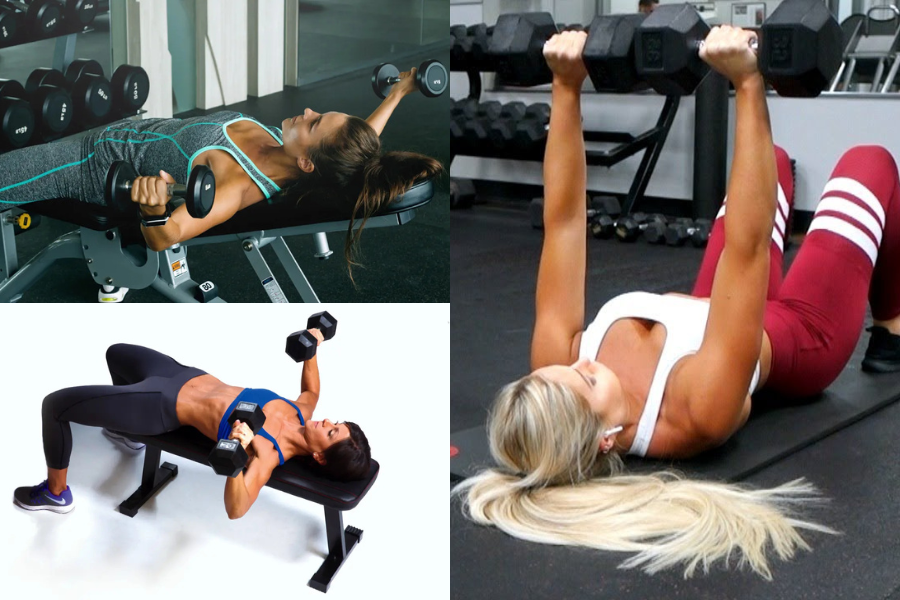
Dumbbell floor press
The dumbbell floor press trains your chest and triceps while making it easier to control range of motion, which is helpful if you have sensitive shoulders.
- Lie on your back on the floor, knees bent and feet flat. Hold a dumbbell in each hand above your chest, palms facing forward.
- Bend your elbows and lower the weights until your upper arms gently touch the floor.
- Press the dumbbells back up, stopping just short of locking out your elbows to keep tension in your chest.
Because each arm moves independently, this exercise can help you spot and correct strength imbalances between sides.
Incline pushup
Incline pushups are a great stepping stone toward full pushups and let you adjust difficulty by changing the height of your support.
- Place your hands on a bench, box, or the edge of a sturdy table, slightly wider than shoulder width.
- Walk your feet back until your body forms a straight line.
- Bend your elbows to lower your chest toward the edge, keeping your elbows about 45 degrees from your ribs.
- Push back up to the starting position.
Lower the incline over time, moving from a high surface to a lower one, then eventually to the floor as you get stronger.
Chest press with dumbbells or barbell
The chest press targets your pecs, front shoulders, and triceps, and can be done on a flat or incline bench. At home, you can use water bottles or cans as improvised weights if you do not have dumbbells.
- Lie on a bench with your feet flat on the floor. Hold the weights above your chest with straight arms, palms facing forward.
- Retract your shoulder blades and maintain a small natural arch in your lower back.
- Lower the weights slowly until your elbows are just below bench level, keeping them at a 30 to 45 degree angle from your body.
- Press the weights back up, focusing on squeezing your chest at the top.
Avoid bouncing the bar or letting your wrists bend backward. Keep movement smooth and deliberate.
Close grip press
Narrowing your hand position shifts more work to your triceps while still engaging your chest.
- Set up as you would for a normal bench or floor press.
- Place your hands slightly closer than shoulder width, with your elbows tucked in closer to your sides.
- Lower the weights to mid chest, then press back up, focusing on driving through your triceps.
Use a lighter weight than your regular press until you are familiar with the movement.
Dumbbell or cable fly
Fly variations are excellent for targeting the inner chest and improving the “hugging” function of your pecs.
For a dumbbell fly:
- Lie on a flat bench with a dumbbell in each hand, palms facing each other, arms extended above your chest with a slight bend in your elbows.
- Slowly open your arms out to the sides in a wide arc, lowering the weights until your elbows reach chest level or just below.
- Bring the weights back together above your chest, as if you are wrapping your arms around a big tree, and squeeze your chest at the top.
For a cable fly, stand in the middle of a cable station, hold the handles at shoulder height, and perform the same hugging motion while keeping a slight bend in your elbows.
Sample 20 minute chest workout
Use the exercises above to create a simple, effective chest workout for women you can repeat twice a week. Here is one example circuit:
- Incline pushups, 50 seconds of work, 15 seconds of rest
- Dumbbell floor press, 10 to 12 reps
- Hand release pushups, as many quality reps as possible in 50 seconds
- Dumbbell chest press, 10 to 12 reps
- Dumbbell fly, 10 to 12 reps
Rest 60 to 90 seconds after you complete all five moves, then repeat the circuit 2 more times. Choose weights that make the last few reps challenging but do not force you to compromise your form.
If you are a beginner, start with 1 to 2 rounds and longer rest periods. As you get stronger, you can shorten rest times, add a fourth round, or gradually increase weight.
Progression, intensity, and common mistakes
Once you feel comfortable with basic chest exercises, you can build intensity without spending more time in the gym.
You might:
- Use drop sets by starting with a heavier weight for as many reps as possible, then immediately using a lighter weight to continue.
- Add partial reps after you hit full range of motion failure. For example, finish a set of presses with small top half pulses.
- Pause for 2 to 3 seconds during the lowering phase of presses or flys to increase time under tension.
At the same time, avoid some common chest training mistakes:
- Relying only on barbell bench presses, which can overdevelop the lower part of your chest and place extra stress on shoulders, elbows, and wrists.
- Ignoring the upper chest. Adding incline presses or incline pushups helps balance your chest development and creates a more lifted look.
- Using mostly machines. Free weights and body weight moves engage more stabilizing muscles and usually lead to better overall results.
- Rushing through reps with momentum instead of feeling a full stretch and squeeze on every rep.
If you have pre existing shoulder or wrist issues, use lighter weights, adjust your range of motion, or swap in more joint friendly moves like incline dumbbell presses. Wrist wraps can also provide extra support when you are ready to push heavier loads.
Bringing it all together
A powerful chest workout for women is not about lifting the heaviest weight in the gym. It is about moving with control, working through a full range of motion, and training often enough to see steady progress.
Start with one or two of the exercises above in your next upper body session, focus on strong form, and build from there. Over a few weeks, you will likely notice that your posture improves, daily tasks feel lighter, and your upper body looks more defined, all without spending hours in the gym.
About the Author