Rowing might look simple, but a few minutes on the machine quickly proves otherwise. Full body rowing workouts challenge your legs, core, back, and arms at the same time, which is why they are so effective for weight loss and overall health.
Below, you will learn how full body rowing works, what benefits you can expect, how to use good technique, and how to structure beginner friendly rowing workouts you can stick with.
Understand why rowing is a full body workout
Rowing is one of the few cardio options that truly works your whole body in a single movement. Around 65 to 75 percent of the work comes from your legs, and 25 to 35 percent from your upper body, according to the American Fitness Professionals Association (Healthline).
That means you are training major muscles in your:
- Legs: quadriceps, hamstrings, calves, and glutes
- Core: abdominals and obliques
- Back: lats, rhomboids, and spinal muscles
- Upper body: biceps, shoulders, and forearms
Because so many muscles are pulling their weight, you burn more calories than with many other machines at similar effort levels. A 30 minute vigorous rowing workout can burn roughly 369 calories for a 155 pound person, which outperforms an elliptical session of the same length (Healthline).
Learn the basic rowing stroke
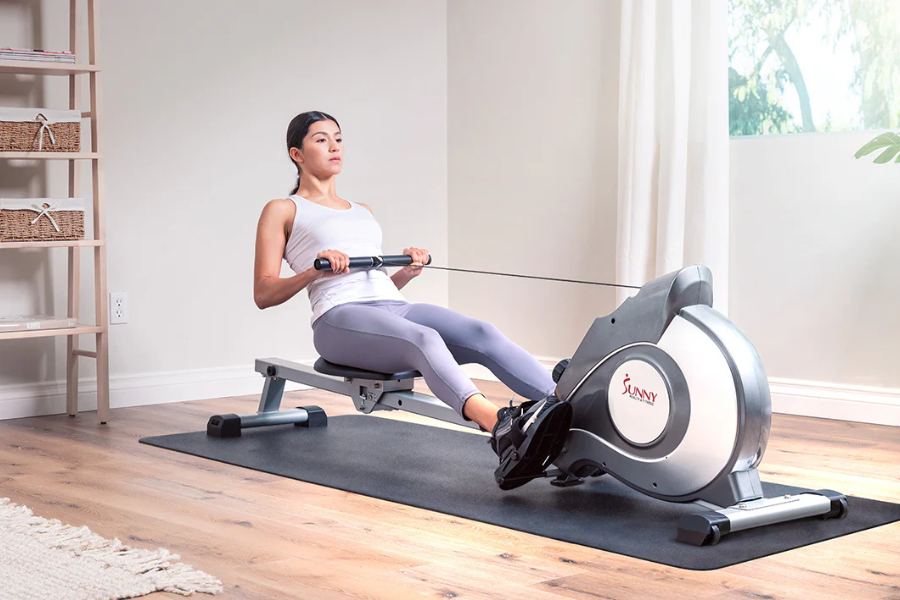
Good form is the secret to safe, effective full body rowing workouts. The stroke has four main phases: catch, drive, finish, and recovery. Once you understand these, you can focus on moving smoothly instead of guessing with each pull.
The catch
This is your starting position at the front of the machine.
- Sit tall with a neutral spine, not hunched
- Knees bent and shins roughly vertical
- Arms straight, shoulders relaxed, core lightly engaged
- Hands holding the handle with flat wrists
Here, your abdominals flex slightly to lean you forward, and your triceps extend your arms while your fingers grip the handle (Concept2).
The drive
This is where the power happens.
- Push hard through your feet, using your legs first while your arms stay straight
- As your legs approach extension, swing your torso back slightly from the hips
- Finish by pulling the handle toward the lower ribs, not your neck or face
During the drive, your glutes and hamstrings extend the hips, your quadriceps extend the knees, and your back and shoulder muscles take over to finish the pull (Concept2, NordicTrack).
The finish
At the back of the stroke you should be:
- Sitting tall with a slight backward lean, just past upright
- Legs straight but not locked
- Handle pulled to your lower chest or the base of your ribs
- Elbows pointing out and back, core braced
Your abdominals keep you stable while your glutes, quads, biceps, and back muscles hold the position (Concept2).
The recovery
The recovery is the way back to the catch and should feel controlled and relaxed.
- Straighten your arms first
- Tip your torso forward from the hips
- Then bend your knees to slide back to the start
This phase lets your muscles reset and prepares you for the next powerful drive, while still engaging your triceps, abdominals, hamstrings, and calves as you return to the catch (Concept2).
British Rowing stresses that good indoor rowing technique includes a long, strong drive, followed by a relaxed and controlled recovery, with equal attention on both phases to reduce injury risk (British Rowing).
Protect your body with proper form
Correct technique protects your back, knees, and shoulders while letting you work harder with less strain.
Key form cues to remember:
- Maintain a neutral spine, think flat back that pivots from the hips, not rounded through the mid back (British Rowing)
- Initiate each stroke with your legs, not your arms, so you use bigger muscles for power (Sunny Health and Fitness)
- Keep arms straight through most of the drive, then pull only at the end
- Do not lock your knees aggressively at the finish to avoid knee stress
- Keep your wrists flat and grip relaxed to protect your wrists and forearms
Improper rowing form, especially rounding your lower back or jerking the handle, can lead to lower back, wrist, and knee issues, so it is worth slowing down at first to get it right (Sunny Health and Fitness).
If you can, film a short video of yourself rowing and compare it to a technique guide, or ask a coach at your gym to watch a few strokes. Even one or two small corrections can make long sessions feel more comfortable.
Know the health and weight loss benefits
Full body rowing workouts are popular for weight loss because you get cardio and strength benefits in the same session.
Calorie burn and fat loss
Rowing engages around 86 percent of the muscles in your body, which helps you burn more calories in less time and supports fat loss when combined with a balanced diet (Fit&Well). A 30 minute session can burn roughly 300 calories at moderate intensity, and up to about 369 calories at a vigorous pace for a 155 pound person (Rowing Machine Workouts, Healthline).
One study found that rowing 5 days a week for 6 weeks significantly reduced fat mass and total body fat percentage, and also improved cholesterol and back strength in people with low vision (Healthline).
Strength, endurance, and metabolism
Because you are using both upper and lower body in a coordinated way, rowing builds:
- Muscular power in your legs and back
- Cardiovascular endurance
- Core strength and postural control
Over time you build lean muscle mass, which can raise your resting metabolic rate, meaning you burn slightly more calories even when you are not working out (Rowing Machine Workouts, NordicTrack).
Low impact joint friendly cardio
Rowing is low impact, and since you are seated, it is gentler on your joints than high impact options like running. This makes it a good choice if you have early stage osteoarthritis or simply want to give your knees and hips a break while still burning significant calories (Healthline, Cleveland Clinic).
Regular rowing can also improve posture, balance, and coordination because of how strongly it trains your core and back muscles, which support your spine and alignment (Cleveland Clinic).
Mental health and energy
Like other forms of cardio, rowing can reduce stress, boost mood, and support better sleep quality, especially when you row consistently several times per week (Rowing Machine Workouts, NordicTrack). You might notice improved energy and stamina in your daily life within a couple of weeks.
Use the right intensity and stroke rate
If you are new to rowing, it is easy to fixate on distance or speed and forget about how the effort actually feels. At first, focus on time, stroke rate, and perceived effort.
- Time: Aim for 15 to 30 minutes, including warm up and cool down
- Stroke rate: A moderate 20 to 26 strokes per minute is ideal for most full body rowing workouts, so you can maintain good form without rushing (Rowing Machine Workouts)
- Effort: On a scale from 1 to 10, easy rowing feels like a 3 to 4, moderate is a 5 to 6, and hard intervals should feel more like 7 to 8
Most machines also show split time, which is your pace per 500 meters, and sometimes power in watts. As a beginner, it is fine to ignore these at first and simply pay attention to consistent stroke rate and breathing (Garage Gym Reviews).
Try beginner friendly rowing workout structures
You do not need complicated programming to benefit from full body rowing workouts. A simple weekly plan that combines steady rows and interval sessions works well for both health and fat loss.
Here are three basic formats you can rotate through.
Steady state endurance row
Use this to build cardiovascular fitness while practicing technique.
- Warm up: 5 minutes of easy rowing at 18 to 22 SPM
- Main set: 15 to 25 minutes at a comfortable pace, around 20 to 24 SPM, where you can talk in short sentences
- Cool down: 5 minutes of very light rowing
Steady rows like this help you maintain good form for longer periods and improve your aerobic base (Garage Gym Reviews).
Simple interval workout for fat loss
Intervals let you burn more calories in less time by alternating hard pushes with easier recovery.
- Warm up: 5 minutes easy
- Main set:
- Row hard for 1 minute at about 7 out of 10 effort
- Row easy for 1 to 2 minutes
- Repeat for 6 to 8 rounds
- Cool down: 5 minutes easy
As you get fitter, you can increase to 10 rounds, or adjust the work to rest ratio, for example 40 seconds hard, 20 seconds easy. Short bursts of higher intensity rowing are a common feature in 4 week rowing weight loss plans (Rowing Machine Workouts, Fit&Well).
Mixed session with off rower exercises
Once you feel comfortable, you can combine rowing with bodyweight moves for a total body circuit.
Example 25 minute session:
- Row 3 minutes at moderate pace
- Step off and do 10 to 15 bodyweight squats and 10 pushups
- Rest 1 minute
- Repeat the sequence 4 to 5 times
This type of workout keeps your heart rate elevated while building additional strength in muscles that also support your rowing.
Plan your weekly rowing routine
For health benefits, the CDC recommends at least 150 minutes of moderate intensity exercise per week, which you can meet with 20 to 30 minute rowing sessions most days (Cleveland Clinic).
If your primary goal is weight loss and improved fitness, you might aim for:
- 3 to 4 rowing workouts per week
- At least 3 rest or light activity days per week to allow recovery
A typical beginner schedule could look like this:
- Day 1: Steady state row
- Day 2: Rest or light walk
- Day 3: Interval row
- Day 4: Rest
- Day 5: Mixed session or another steady row
- Day 6: Optional easy row or cross training
- Day 7: Rest
Both a 4 week rowing routine and 30 day rowing plans emphasize building variety with steady rows, high intensity intervals, and rest days so your muscles can adapt and grow stronger without burning out (Rowing Machine Workouts, Fit&Well).
Rest days are not wasted days. They are when muscle repair and growth happen, especially if you support your training with good nutrition and sleep. Using a foam roller or gentle stretching on off days can also ease soreness and keep you ready for your next session (Fit&Well).
Support your workouts with smart nutrition
You will feel and perform better on the rower if you fuel your body properly.
General guidelines drawn from rowing weight loss plans include:
- Before rowing: Eat a high carbohydrate meal 2 to 4 hours before your workout for energy, such as oats with fruit or rice with lean protein (Fit&Well)
- After rowing: Have a light carb plus high protein snack within an hour or so, like yogurt with berries or a small turkey sandwich, to help muscle recovery
- Throughout the day: Focus on balanced meals with plenty of protein, vegetables, whole grains, and healthy fats to support ongoing muscle development and satiety
Hydration also matters. Sip water consistently rather than waiting until you are very thirsty during your session.
Put it all together
Full body rowing workouts offer a rare combination of high calorie burn, muscle strengthening, and joint friendly movement. By learning the basic stroke, paying attention to your form, and following a simple weekly plan, you can use the rowing machine to support weight loss, cardiovascular health, and stronger muscles from head to toe.
Start small. Try 10 to 15 minutes at an easy pace to practice your technique. As you get more comfortable, build toward a mix of steady rows and intervals. With consistent effort and enough rest, you will likely notice changes in your stamina, posture, and energy in a matter of weeks.
About the Author