Quadricep exercises at home let you build strong, defined legs without a gym membership or bulky machines. With a few smart moves and a bit of consistency, you can grow muscle fast using only your body weight or simple equipment like a chair, step, or pair of dumbbells.
Below, you will learn why your quads matter, how to warm up, the best quad-focused moves to do at home, and how to put them together into a muscle-building routine.
Understand your quadriceps
Your quadriceps, or quads, are the big muscles on the front of your thighs. They include four main muscles that straighten your knee and help flex your hip. Strong quads make it easier to climb stairs, stand up from the floor, and power through runs, squats, and jumps.
Many classic leg exercises work your quads along with other muscles. However, some do not fully challenge all four quad muscles, especially the rectus femoris. Research summarized by Built With Science explains that exercises like squats and leg presses do not optimally target the rectus femoris and that you need more isolated knee extension moves like leg extensions or sissy squats for maximum growth, based on a 2021 study.
When you understand how the quads work, you can choose exercises and technique tweaks that actually grow muscle instead of just making your legs tired.
Set up safely at home
You can perform most quadricep exercises at home without special machines. Before you start, prepare your space and your body so you can train hard while staying safe.
Clear a small area of floor space. A yoga mat or carpet works well so your knees do not dig into a hard surface. Have a sturdy chair, bench, or couch nearby for balance and step-up variations. If you own dumbbells or a kettlebell, keep them handy, but know that body weight alone is enough to start.
Begin every quad workout with a 5 to 10 minute warm up. March in place, do light jogging, or perform dynamic moves like leg swings and bodyweight squats. The goal is to increase your heart rate and loosen your hips, knees, and ankles.
If you have any existing knee, hip, or back issues, talk to your doctor or a physical therapist before starting a new lower body routine. This is especially important if you plan to push close to muscle failure, which is one of the main drivers of quad growth.
Use form that builds muscle
Good form matters as much as the exercise you choose. When you train quadricep exercises at home, a few technique principles will help you grow muscle faster and protect your joints.
Focus on full range of motion. For squats and similar patterns, you want your thighs to move until they are at least parallel to the floor or perpendicular to your calves. Partial reps limit quad development because the muscle never has to work hard in its most challenging positions.
Keep your torso as upright as is comfortable. If you lean too far forward or push your hips too far back, you shift work into your glutes and lower back. Built With Science notes that this can also increase stress on the spine and reduce quad activation.
Use loads that let you move well. Heavier is not better if it forces you into shallow, rushed reps. Lighter weights with full range of motion and control will stimulate more growth than heavy, short, bouncy reps.
Finally, pay attention to effort. To fully stimulate your quads during home workouts, you should push sets close to muscular failure. That means you finish a set with only one to three good reps left in the tank. Stopping early, right when the burn shows up, leaves growth on the table, as highlighted in the Built With Science quad training breakdown.
Try essential bodyweight quad moves
You can build serious quad strength and size at home with bodyweight alone. Start with these foundation moves, then adjust depth and tempo to match your level.
Bodyweight squats
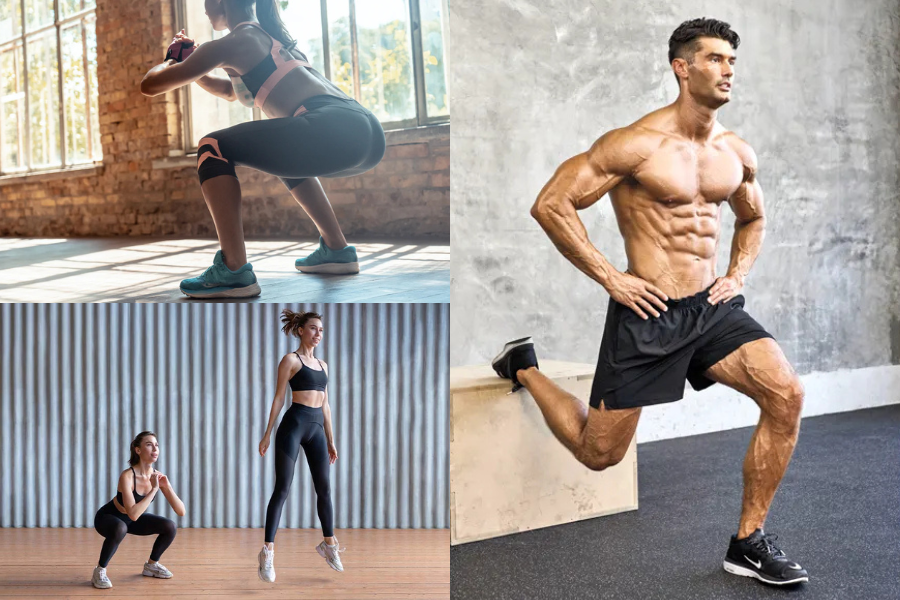
Bodyweight squats are one of the best at home exercises for strengthening your quadriceps along with your core, hamstrings, glutes, and spinal erectors. To perform them, stand with your feet about shoulder width apart, sit your hips down and slightly back, and bend your knees until your thighs are at least parallel to the floor. Keep your chest lifted and your knees tracking over your toes.
If you are a beginner, you can reduce squat depth and use a chair behind you as a target. The chair gives you feedback on how low to go and increases confidence.
To make squats more quad focused, you can elevate your heels slightly on a book or small plate. Built With Science notes that elevating your heels increases the forward shin angle and emphasizes quadriceps activation, especially if your ankle mobility is limited.
Walking lunges
Walking lunges challenge each leg individually and heavily recruit the quads, hamstrings, glutes, and core. From standing, step forward with one foot, bend both knees, then push through your front leg to step into the next lunge.
You can adjust the length of your step to change the emphasis. A slightly shorter step with your knee traveling over your toes will increase quad demand. If balance is a challenge, perform stationary lunges in place, holding on to a wall or chair for support.
Step ups
Step ups mimic climbing stairs and are excellent for quad strength. Stand in front of a sturdy step or low bench. Place one foot fully on the step, then push through that foot to stand tall, bringing the back foot up to meet it. Lower under control and repeat.
You can increase difficulty by holding dumbbells at your sides or by lowering the step height if you are working on basic strength. This move also trains your glutes and hamstrings while challenging your balance.
Progress to advanced home quad exercises
Once you feel comfortable with basic squats and lunges, you can build even more quad muscle with advanced at home variations. These exercises require more strength and stability, so progress gradually.
Bulgarian split squats
Bulgarian split squats target stabilizing muscles around your knees and hips and can be very quad focused with a few simple tweaks. Stand a step or two in front of a chair or couch with your back foot resting on it. Bend your front knee and lower your hips straight down, then push back up through the front leg.
For more quad emphasis, use a shorter stance with the front foot closer to the bench and keep your torso more upright. Make sure your front knee tracks over your toes, not collapsing inward. You can also elevate the front heel on a small plate to further increase quadriceps engagement, as suggested by Built With Science for home friendly variations.
Beginners can hold on to a wall or countertop for balance. Advanced lifters can hold dumbbells or a loaded backpack.
Pistol squat variations
The pistol squat, a one legged squat, is an advanced move that demands strength, mobility, and balance. From standing, you extend one leg forward and squat down on the other leg. Because this is so challenging, most people benefit from easier variations first.
You can practice supported pistol squats by holding a doorframe or TRX style strap. Alternatively, perform box pistols by sitting back onto a chair on one leg, then standing up again. These variations still hit the quads hard, especially as you lower the chair height over time.
Sissy squats
Sissy squats are a powerful way to isolate the quadriceps and especially the rectus femoris at home. You rise up onto your tiptoes, lean your body back, and drive your knees forward over your toes while keeping your hips extended. This removes most hip involvement and puts nearly all the tension straight through the front of your thighs.
Because this exercise is demanding on the knees and requires stability, it is best to learn it using support. Many people loop a resistance band around a sturdy anchor or hold on to a countertop for assistance. Built With Science recommends sissy squats or leg extension style movements to fully train the rectus femoris, as classic big lifts often miss it.
Make your quad workouts more effective
The way you perform each rep can dramatically change your results, especially when you train quadricep exercises at home with limited equipment. Use these technique upgrades to squeeze more growth out of every set.
Slow down the lowering phase. Spending two to three seconds on the downward part of a squat, lunge, or step up increases tension and time under load. Built With Science points out that a slower controlled tempo can create more quad growth even with lighter weights, which is ideal for home training where you may not have heavy loads.
Play with heel elevation. Placing your heels on a plate or wedge during goblet squats, lunges, and Bulgarian split squats increases knee bend and shifts the load toward your quads. This approach is especially useful if you struggle to keep your heels down or your torso upright in regular squats.
Drive your knees over your toes on purpose. For quad focused lunges and split squats, allowing and even emphasizing knee travel over the toes increases quadriceps activation. A small plate under the front foot can help you achieve this angle and feel the burn more directly in the front of your thighs.
Most importantly, stay honest about your effort. Home workouts can be just as effective as gym sessions if you push sets close to failure and avoid stopping when it first feels uncomfortable.
A useful rule of thumb: during your last one or two sets of each exercise, stop only when your form begins to break or you feel that you could not complete one more clean rep.
Build a simple quad routine at home
To build muscle fast, you need more than good exercises. You need structure. A basic at home quad routine does not have to be complicated to work well.
Aim to train your quads twice per week with at least two quad focused exercises each session. Research summarized by Built With Science suggests that for optimal quad growth you should perform a minimum of about five working sets per workout for your quads and use an 8 to 12 rep range across three to four sets per exercise, leaving at least 48 hours of recovery between hard sessions.
Here is a sample beginner friendly quad workout:
- Warm up for 5 to 10 minutes with light cardio and dynamic leg swings.
- Bodyweight squats, 3 sets of 10 to 12 reps.
- Walking lunges or stationary lunges, 3 sets of 10 reps per leg.
- Step ups, 2 to 3 sets of 10 reps per leg.
As you get stronger, you can transition to a more advanced quad day:
- Heel elevated goblet squats, 3 to 4 sets of 8 to 12 reps.
- Bulgarian split squats, 3 sets of 8 to 10 reps per leg.
- Sissy squats or a rectus femoris focused variation, 2 to 3 sets of as many quality reps as you can manage.
Rest one to two minutes between sets. If a set feels too easy, increase the difficulty by slowing the tempo, adding a pause at the bottom, or holding weight.
Recover and track your progress
Muscle is built between workouts, not during them. Give your quads time to recover and grow. That means getting enough sleep, eating enough protein and calories to support muscle repair, and spacing hard quad sessions at least 48 hours apart.
Track your progress by noting how many reps you can do with good form and how hard sets feel. You can also take photos or measure your thighs every few weeks to see changes that might not be obvious in the mirror.
If you feel persistent joint pain, especially in the knees, reduce the volume and check your form rather than pushing through. Sometimes a small tweak like reducing depth, adjusting stance, or using support can make quad exercises at home much more comfortable.
When you combine smart exercise choices, solid technique, and consistent effort, your living room becomes a perfectly capable leg day studio. Start with just one or two of the exercises above, add them to your weekly routine, and you will feel your quads getting stronger every time you climb a flight of stairs.
About the Author