Building stronger triceps does more than fill out your sleeves. The right gym tricep workouts help you press more weight, support your shoulders, and make everyday movements like pushing a door or lifting groceries feel easier. Since the triceps make up most of your upper arm size, focusing on them gives you a bigger visual payoff than biceps alone, as recent guides from Muscle & Fitness and Gymshark explain.
Below, you will learn how your triceps work, how to structure effective gym tricep workouts, and the best beginner friendly and intermediate exercises to add to your routine.
Understand your tricep muscles
Your triceps are not a single strand of muscle. They have three heads that work together when you straighten your arm.
- Long head, runs along the back of your upper arm and crosses your shoulder
- Lateral head, sits on the outside of your upper arm and gives that “horseshoe” look
- Medial head, lies deeper under the other two and helps with endurance work
To build balanced, pain free arms, your gym tricep workouts should hit all three heads. The long head responds best to overhead movements that place it in a stretched position, such as seated or standing overhead extensions. If you skip these and only do pushdowns or bench presses, you risk imbalances and triceps pain after workouts.
Set up your workout for success
How you arrange your tricep exercises matters just as much as which ones you choose. Proper exercise order helps you lift more, avoid burnout, and keep your joints happy.
Start with compound movements
Begin each tricep focused session with multi joint, or compound, exercises. These moves let you use heavier weight because they also involve your chest and shoulders.
Good choices include:
- Close grip bench press
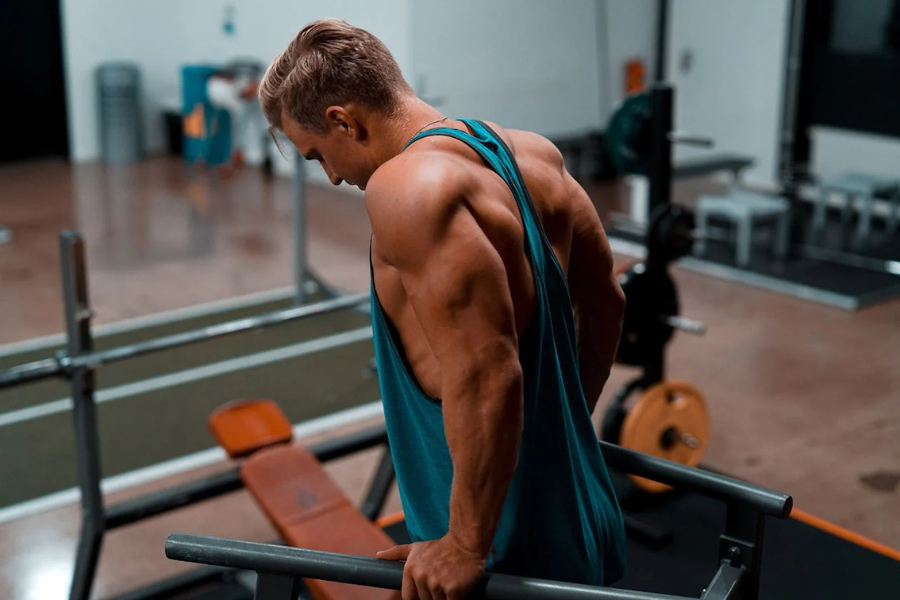
- Parallel bar or bench dips
- Push ups and diamond push ups
Starting with heavy isolation work, such as single arm overhead extensions, tires your triceps too early. You will not have much strength left for the big lifts that actually drive growth.
Then move to isolation work
After your main compound work, you can focus on isolating the triceps with more targeted exercises. This is where you add:
- Pushdowns on the cable machine
- Overhead extensions with dumbbells or cables
- Skull crushers or lying tricep extensions
- Tricep kickbacks
By this point, your triceps are warmed up and activated, so you can feel them working without overloading your joints.
Balance effort and recovery
Training your triceps hard is important, but they also need time to recover. Overdoing it by hitting them every day or stacking too many pressing movements can lead to nagging elbow and shoulder discomfort.
A practical guideline is:
- Train triceps at least twice per week for growth, with 3 to 6 sets of 6 to 12 reps each session at 60 to 80 percent of your one rep max, according to Gymshark’s June 2024 guide that highlights scientific research
- Allow at least 24 hours, and preferably 24 to 48 hours, of recovery after upper body push days so your triceps can rebuild instead of staying sore and fatigued
Since the triceps have three heads, they often benefit from 2 to 4 more all out sets than you would typically give biceps in the same week.
Choose the right tricep exercises
You have a lot of options when building gym tricep workouts. The key is combining bodyweight, cable or machine, and free weight moves so you challenge the muscles from different angles.
Bodyweight tricep staples
Bodyweight exercises are a low equipment way to strengthen and grow your triceps. You can use them both at the gym and at home.
Great choices include:
- Tricep dips, on parallel bars or off a bench
- Standard push ups, with elbows close to your sides
- Diamond push ups, with your hands close together under your chest
Guides from Gymshark and others list tricep dips and diamond push ups among the top exercises for building bigger triceps, since they challenge several heads at once within a strength friendly rep range.
Cable and machine movements
Cables and machines keep constant tension on the triceps and are especially helpful for beginners who want more control over form.
The research highlights seven beginner friendly tricep moves that are easy to learn in a gym setting:
- Tricep dips
- Push ups
- Tricep pushdowns on the cable machine
- Cable overhead tricep extensions
- Triceps press machine
- Dumbbell tricep kickbacks
- Standing or seated dumbbell tricep extensions
Tricep pushdowns are particularly effective for targeting all three heads of the triceps brachii. Beginners can start with about 4 sets of 8 reps at a lighter weight and gradually add resistance over time. To protect your elbows and shoulders, keep your elbows close to your sides, avoid flaring, and resist the urge to lean your back into the movement.
You can also make pushdowns more challenging or joint friendly by changing attachments. Using a straight bar, E Z bar, V angled bar, or rope shifts the feel slightly and can help you find a grip that is both comfortable and effective.
Free weight and dumbbell options
While machines are useful, relying on them exclusively can limit your range of motion and slow your progress. Free weights such as dumbbells allow your arms to move more naturally and force stabilizing muscles to engage.
Recent training articles point out several advantages of dumbbell tricep exercises:
- You can train each arm independently, which helps fix strength imbalances
- You often get a longer range of motion, which can increase muscle activation and stretch
- Dumbbells are portable and easy to store, so you can train consistently even without full gym access
Effective dumbbell tricep exercises include:
- Close grip dumbbell bench press, comparable to the barbell version but with less shoulder stress
- Lying dumbbell tricep extensions, also called skull crushers, which place a deep stretch on the long head when you lower the weights slightly behind your head
- Overhead single arm or two arm dumbbell tricep extensions, excellent for the long head
- Rolling dumbbell tricep extensions, that blend a press and extension for extra time under tension
- Dumbbell tricep kickbacks, which excel at fully shortening the muscle when your upper arm stays behind your torso
- Upright dumbbell dips, where you hold or strap a dumbbell for added challenge
- Dumbbell JM presses, a power oriented move that focuses on driving the elbows and moving weight quickly without sacrificing load
For muscle size, lifters and coaches often highlight lying dumbbell tricep extensions because of the intense long head stretch. For peak contraction, dumbbell kickbacks stand out when you keep your upper arm fixed and straighten the elbow fully on every rep.
Focus on proper form and elbow health
Good technique is not just a safety measure. It is what makes your gym tricep workouts actually target the muscles you are trying to grow.
Posture and movement control
During tricep exercises, you want to:
- Maintain a neutral spine with a lightly engaged core
- Keep your upper arms relatively still, unless the exercise specifically calls for shoulder movement
- Move the weight in a slow and controlled way, especially on the way down
Rushing through reps or swinging the weight shifts the load to momentum and to other muscles like your shoulders. This reduces tricep engagement and increases joint stress.
Use a full range of motion
A common mistake is stopping short of full elbow extension. Many of the fibers in the triceps fire hardest in the last third of the movement, so you miss a big growth signal if you never lock out.
Aim to straighten your elbows completely at the bottom of pushdowns, presses, and extensions, while keeping control at all times. Locking out under control is different from snapping your joints straight. If you feel discomfort, reduce the weight until you can move smoothly through the full range.
Protect your shoulders and elbows
Because many tricep exercises involve the elbow and sometimes the shoulder joint, pay attention to any sharp or lingering pain. To reduce your risk of irritation:
- Avoid flaring your elbows too wide on presses and pushdowns
- Warm up with light sets and simple movements like arm circles or band pull aparts
- Stop your range of motion just before any painful position rather than pushing through it
If you are unsure about your form, consider asking a trainer on site to check your technique. Many commercial gyms, including Planet Fitness locations that promote a Judgement Free Zone® and beginner friendly environment, have staff available to help you adjust your setup and posture.
Try this beginner gym tricep workout
If you are new to focused tricep training, you do not need a long or complicated plan. The research suggests a simple routine that you can finish in about 30 minutes, including a quick warm up and cool down.
Here is one example:
- Tricep dips, bench or assisted machine
- 3 sets of 10 reps
- Tricep pushdowns on the cable machine
- 3 sets of 12 reps
- Dumbbell tricep extensions, standing or seated
- 3 sets of 10 reps
Rest about 60 to 90 seconds between sets. Choose weights that challenge you while still allowing you to finish the last couple of reps with good form.
You can plug this workout into your week 1 to 2 times, depending on your overall training. If you already have a push day with chest and shoulders, you can place this routine at the end of that session, or run a shorter version that uses only two of the movements.
Training your triceps at least twice per week with a mix of compound and isolation movements, plus enough recovery, is a proven way to build strength and size over time.
Add stretching and recovery to your plan
Stretching and recovery are often overlooked, but they are essential for steady progress and joint comfort.
After your gym tricep workouts, spend a few minutes on:
- Overhead tricep stretches, one arm at a time, holding each for 20 to 30 seconds
- Chest and shoulder stretches to relieve tension from pressing movements
- Light arm circles or band stretches to promote blood flow
Regular stretching can improve flexibility, reduce muscle tightness, and lower your risk of injury when you return for your next session. Combine this with adequate sleep, hydration, and protein intake so your muscles have what they need to repair and grow.
Putting it all together
When you structure your gym tricep workouts around the way the muscle actually works, training becomes more effective and more enjoyable. You now know that:
- Your triceps have three heads that respond best to a mix of overhead work, presses, and extensions
- Starting with compound movements, then moving to isolation work, lets you lift heavier and reduces early fatigue
- Free weights, cables, and bodyweight exercises each offer unique benefits, so combining them gives you fuller development
- Proper form, full but controlled lockouts, and at least 24 to 48 hours of recovery help you avoid joint pain and stalled progress
Pick one or two new exercises to add to your next session, or try the beginner routine outlined above. As you grow more confident, you can increase sets, experiment with different attachments, and add new dumbbell variations. With consistent practice and smart recovery, you will feel the difference in your presses, your everyday strength, and yes, the way your sleeves fit.
About the Author