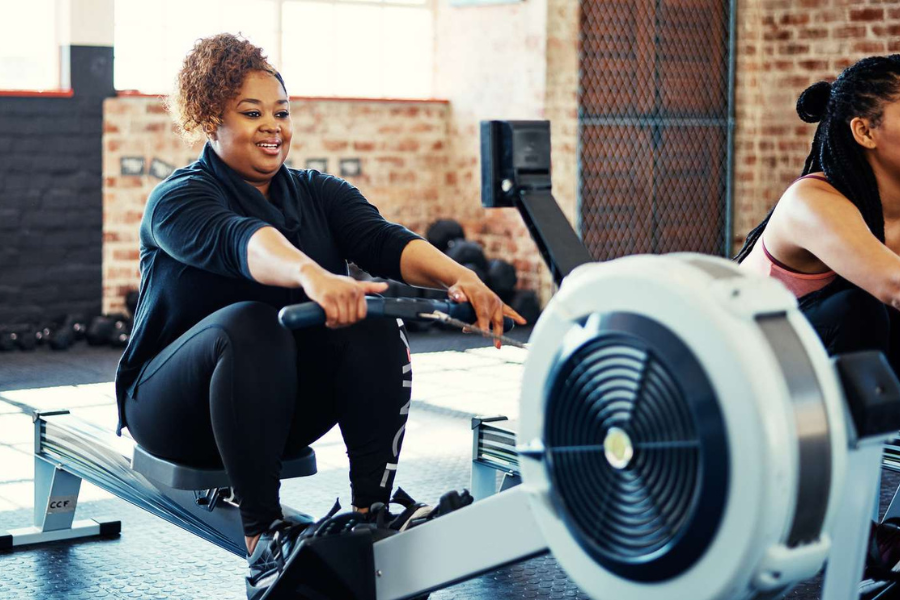
Rowing machine cardio workouts are one of the most efficient ways to work your heart, lungs, and muscles in a single session. With each stroke you recruit your legs, core, back, and arms, so you get more total body work than you would on many other cardio machines (GQ). If you are looking for a workout that supports weight loss, protects your joints, and fits into a busy schedule, the rower deserves a serious look.
Below, you will learn how rowing benefits your health, what it can and cannot do for weight loss, and how to build simple rowing machine cardio workouts you can start this week.
Understand why rowing is powerful cardio
When you sit down on a rowing machine, you are not just doing a leg workout. Research suggests you engage 80 to 85 percent of your main muscle groups with each stroke, including your legs, glutes, back, core, and arms (GQ). That high level of muscle involvement means your body has to move a lot of blood and oxygen, which is exactly what strengthens your cardiovascular system.
A 2021 study found that rowing on a Concept2 ergometer matched treadmill running for peak oxygen uptake, or VO₂ max, and actually outperformed the elliptical, while still involving your entire body instead of mostly your legs (GQ). In practical terms, this means that a well designed rowing session can improve your fitness as effectively as a run, but with less impact on your joints.
Cleveland Clinic notes that a 30 minute session on a rowing machine provides a strong cardio workout that challenges your heart and lungs in a way that is comparable to running, yet is typically gentler on your knees and back (Cleveland Clinic). If you struggle with high impact exercise, rowing gives you an alternative that still moves the needle for your health.
Learn the basic rowing technique
Good technique is the difference between a safe, effective workout and one that leaves your back feeling tight. Proper rowing form follows a clear sequence. First your legs drive. Then your body swings back slightly from the hips. Last your arms finish the pull. Rowing coach John Steventon describes this as three phases that flow smoothly together, with the legs always starting the movement (Men’s Health).
On each stroke you want a powerful leg drive through your heels, followed by a controlled lean back of about 10 to 15 degrees, and then a pull of the handle to your lower ribs. On the way back in, you simply reverse that order. Arms extend, body pivots forward from the hips, and then knees bend so you can slide back to the start.
Rowers often say that beginners need a couple of weeks of consistent practice to really feel this pattern. In fact, some rowers suggest that it can take up to three weeks of focused coaching to dial in safe form, especially if you have a history of back or shoulder issues (Reddit Fitness). Take your time early on. A short technique focused session is more valuable than a long workout done with sloppy strokes.
Adjust settings for a smart workout
Once you understand the stroke, the next step is to set up the machine in a way that suits your goals. On a Concept2 rower, you will see a dial on the side of the flywheel that many people call the resistance. In reality, this dial controls the drag factor, or how heavy each stroke feels. For most users, keeping the drag factor in the 4 to 6 range is ideal for cardio workouts, while higher settings are usually reserved for brief sprints (Men’s Health).
Cranking the dial up to the maximum is rarely helpful, even for very strong or experienced rowers. Excessive drag can slow your stroke, increase strain on your lower back and shoulders, and reduce your ability to maintain good technique when you are tired. You will generally get better fitness results by rowing longer at a moderate drag than by grinding through heavy strokes that you cannot sustain.
Another useful guideline is to pay attention to stroke rate, or how many strokes you take per minute. A classic cardio benchmark is a 30 minute row at around 20 strokes per minute, which builds aerobic endurance in a calm, controlled way (Men’s Health). Once you feel comfortable there, you can start mixing in slightly faster rates for short periods to add variety and challenge.
Compare rowing to running for weight loss
If your main goal is weight loss, you might wonder how rowing stacks up against running. Both can burn a meaningful number of calories. For example, a 175 pound adult may burn about 139 calories during 15 minutes of moderate rowing, which makes it a solid aerobic option that can rival running in energy use for many people (Healthline).
At the same time, several sources point out that running usually burns more calories in the same amount of time, especially at higher intensities. American Home Fitness notes that running tends to produce a more continuous, high intensity calorie burn that may lead to greater weight loss results than rowing alone, at least if you are looking strictly at calories per minute (American Home Fitness). Some rowers on Reddit estimate that running can burn roughly 30 percent more calories than rowing, depending on pace and duration (Reddit Fitness).
However, calorie burn is not the only factor. Rowing is low impact and more joint friendly than running, which can be important if you have knee, hip, or ankle issues. Studies have shown that guided rowing can reduce knee pain, strengthen thigh muscles, and improve how quickly older adults can stand from a chair, even in people with mild knee osteoarthritis (GQ). If high impact running leaves you sore or sidelined, rowing allows you to stay active and consistent, which matters far more than the exact number of calories on the screen.
Use rowing to support healthy weight loss
Rowing can absolutely help you lose weight, as long as you pair it with a reasonable eating plan. Healthline notes that rowing workouts can be an effective part of creating a calorie deficit of around 500 calories per day, a common starting point for gradual weight loss (Healthline). But rowing alone is not a magic solution. People in the rowing community regularly emphasize that diet remains the primary driver of weight change, and that exercise plays a supporting role (Reddit r/Rowing).
Where rowing really shines is its ability to combine calorie burning with muscle engagement. Because you are working your legs, back, and core on every stroke, you are also building or maintaining muscle, especially when you keep your technique powerful and controlled. Over time, that extra muscle can help you feel stronger and can slightly increase your resting energy use, which helps support long term weight management.
To keep your weight loss efforts realistic and sustainable, think of rowing as your go to way to meet or exceed the 150 minutes of moderate intensity exercise per week recommended by the CDC. Cleveland Clinic notes that roughly 20 minutes of rowing most days of the week is enough to reach that guideline and still leave room for rest days or other activities you enjoy (Cleveland Clinic).
Choose the right rowing workouts for your level
You can tailor rowing machine cardio workouts very easily. You do not need complicated programming. A few simple structures will cover most of your needs and can grow with you as you get fitter.
Beginner friendly steady state workouts
If you are new to rowing, start with steady, moderate sessions. Healthline suggests beginner plans that involve about 20 minutes of moderate rowing, where you can still speak in short sentences but feel that you are working (Healthline). At this stage, your focus is on learning good form and getting comfortable staying on the machine.
You might begin with something as simple as alternating 2 minutes of easy rowing with 1 minute slightly faster for 15 to 20 minutes total. Keep your stroke rate around 20 to 22 strokes per minute, and use a drag setting in the middle of the range. As you feel more confident, you can gradually lengthen the moderate sections and shorten your easy periods.
Build endurance with longer sessions
Once you can row comfortably for 20 minutes, steady state or Zone 2 training becomes a powerful tool. Members of the r/Rowing community often recommend longer moderate sessions for maximizing calorie burn without leaving you overly hungry or exhausted afterward (Reddit r/Rowing). In Zone 2, you breathe faster than normal, but you can still hold a basic conversation.
A classic endurance workout is a 30 minute row at around 20 strokes per minute, which Men’s Health highlights as a proven way to develop your aerobic engine (Men’s Health). You can make this more engaging by inserting 10 stronger strokes every few minutes, or by breaking the half hour into three 10 minute blocks with slightly different stroke rates.
Add intervals for intensity and variety
High intensity interval training, or HIIT, is another efficient way to use the rowing machine. Healthline notes that alternating bursts of hard rowing with easy recovery can help you burn more calories in less time and can also improve your VO₂ max and overall exercise capacity (Healthline). The key is to keep the hard segments truly powerful and the easy sections genuinely relaxing.
Men’s Health shares several interval ideas you can try, including:
- 1 minute of strong rowing followed by 1 minute of easy rowing, repeated for 10 to 20 minutes
- Short, all out 100 meter sprints with generous rest in between
- Alternating blocks of low stroke rate, such as 20, and higher stroke rate, such as 30, to teach you to control pace (Men’s Health)
If you are short on time, even 10 to 15 minutes of well structured intervals can provide a challenging workout. Just be sure you have a solid technical foundation first, since intensity will magnify any form issues.
A simple way to program your week is to mix 2 steady state sessions with 1 interval workout. This gives you both endurance and intensity while still allowing your body to recover.
Combine rowing with strength for full body benefits
Rowing is already a nearly full body exercise, but pairing it with basic strength work can round out your routine. GQ highlights row and lift circuits where you alternate moderate rowing, such as 400 meters at a strong but sustainable pace, with exercises like kettlebell deadlifts and push ups (GQ). This approach builds your heart and your muscles in the same session and can keep boredom at bay.
Men’s Health also describes workouts where you row and then do bodyweight moves, such as burpees or kettlebell thrusters, to create a high energy, time efficient session that supports both fat burning and muscular endurance (Men’s Health). If you enjoy variety, you can use the rower as your cardio base and add one or two simple strength movements afterward, for example squats, rows, or planks.
Healthline points out that combining rowing with resistance training is an effective way to support fat loss while still building or preserving strength (Healthline). You do not need a complicated gym plan. Even a few sets of basic movements, two or three times a week, can complement your rowing.
Track your progress and stay consistent
To make your rowing machine cardio workouts count, you need a way to monitor your effort. Many rowers use heart rate monitors and connect them to apps like ErgData or Garmin Connect, since some machine displays tend to overestimate calories burned (Reddit r/Rowing). Tracking your distance, split times, and heart rate will help you see progress and adjust your workouts as your fitness improves.
Rowing is also mentally rewarding. Participation in indoor rowing grew by nearly 20 percent from 2014 to 2021, and you now see rowers not only in dedicated studios but also in CrossFit and other group fitness programs (Men’s Health). Many people find rowing more enjoyable and less monotonous than other forms of cardio, and they appreciate that it is easier on the joints than running or high impact classes (Reddit Fitness).
If you are just getting started, pick one small step this week. You might schedule two 15 minute beginner sessions, or try a short interval workout to see how it feels. Pay attention to your form, listen to your body, and give yourself time to build up. With consistency, rowing can become a reliable cornerstone of your health routine, helping you improve your cardiovascular fitness, support weight loss, and feel stronger from head to toe.
About the Author