A stronger, rounder butt is not just about looks. A smart glute building workout helps you move better, protect your back, and feel more powerful in everyday life. With the right mix of exercises, reps, and recovery, you can build noticeable curves and real strength at the same time.
Below, you will find a complete guide to building your glutes, from what to eat to exactly how to train.
Understand your glute muscles
Your glutes are not just one muscle. You have three main muscles working together every time you walk, squat, or climb stairs.
- Gluteus maximus is the largest and gives most of your shape and power. It is responsible for hip extension, like when you stand up from a squat or drive your hips up in a hip thrust.
- Gluteus medius sits on the side of your hip and helps with hip abduction and stability. You feel it when you balance on one leg or step side to side.
- Gluteus minimus is the smallest and lies under the medius. It plays a key role in stabilizing your hips when you walk or run.
A good glute building workout trains all three muscles with different movement patterns so you get both shape and function, not just soreness in one spot.
Fuel your glute building workout
If your training is on point but your glutes are not growing, your nutrition is often the missing piece. Up to 80% of your health outcomes, including muscle building, are driven by diet. That includes how firm and toned your glutes can become.
Eat enough to actually grow
To build muscle, including your glutes, you need a small calorie surplus plus resistance training. If you are constantly dieting, you make it hard for your body to add size, no matter how perfect your workout is.
Dr. Mar Mira of the Mira+Cueto Clinic in Madrid recommends a specific “glute diet” that focuses on:
- High quality protein
- Healthy fats
- Low glycemic index carbohydrates
- Micronutrients that support collagen and muscle like vitamin C, zinc, magnesium and collagen itself
Follow this style of eating for at least 6 to 8 weeks along with a consistent glute building workout and enough sleep to start seeing firmer, more lifted glutes.
Hit your macros for glute growth
A practical daily target for muscle gain is:
- Protein: about 2 grams per kilogram of body weight
- Carbohydrates: 2 to 4 grams per kilogram
- Fats: around 0.8 grams per kilogram
Protein provides the building blocks to repair the tiny muscle tears you create with training. Carbs fuel your workouts and replenish glycogen. Fats help keep your hormones in a healthy range, which supports muscle building.
Time your nutrients around training
You do not need to obsess over exact minutes, but nutrient timing can give you an edge.
- Around 1 to 2 hours before training, aim for about 25% of your daily carbs plus 20 to 30 grams of protein. This fuels your session and supports performance.
- Within 60 to 90 minutes after training, have another 25% of your daily carbs plus 20 to 30 grams of protein to kickstart recovery and muscle repair.
Think of it as bookending your glute workout with solid meals or snacks so your body has what it needs to grow.
Keep supplements simple
Most products that promise a bigger butt in a bottle do not live up to the hype. The research-backed essentials are:
- A protein powder if you struggle to hit your protein target with food. Plant based options work well if you prefer them.
- Creatine, which can support strength and muscle gains across your whole body.
- Moderate caffeine, such as a coffee, for a small performance boost before training.
Expensive pre workouts and “booty builder” pills are often overpriced and unnecessary compared to these basics.
Master the key glute exercises
Your glute building workout should be built around compound lifts that load your hips heavily, supported by isolation moves that really burn out the muscles.
Focus on hip extension, not just abduction
Fitness coach Jeremy Ethier points out that many trendy “booty band” exercises mainly train hip abduction, not the glutes’ main job, which is hip extension. To grow your glutes efficiently, you want movements where you extend your hips against resistance.
The six most effective compound exercises for glute strength, size, and power include:
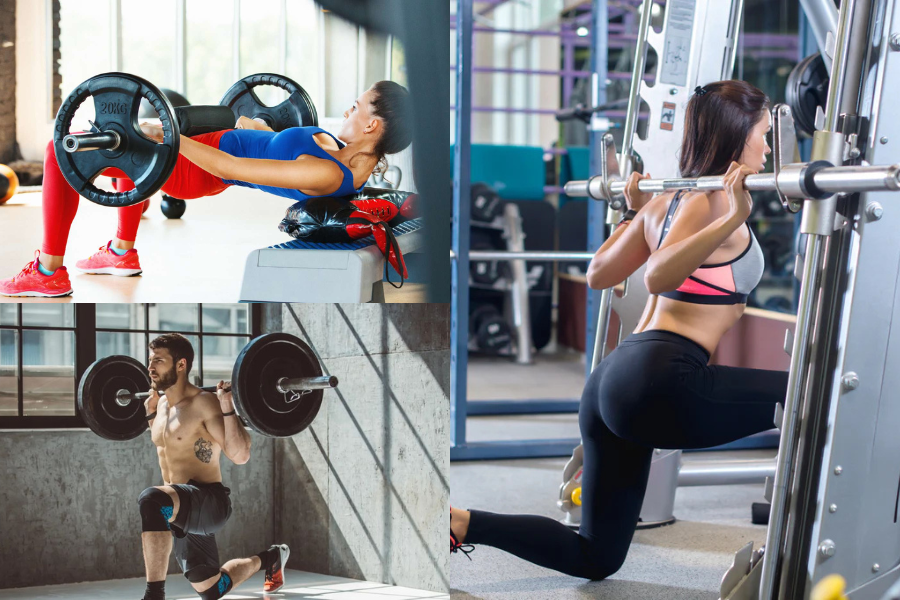
- Barbell hip thrusts
- Back squats
- Front squats
- Bulgarian split squats
- Conventional deadlifts
- Romanian deadlifts
Hip thrusts in particular are standout glute builders. Research highlights that barbell hip thrusts create higher gluteus maximus activation than back squats and split squats, making them especially effective for lower glute development and overall power.
Train every major glute pattern
For full, balanced glutes, aim to cover four key movement patterns in your weekly training:
- Squatting (deep hip flexion): back squats, front squats, goblet squats
- Hinging (bending at the hips): Romanian deadlifts, conventional deadlifts, good mornings
- Thrusting (hip extension from a flexed position): barbell hip thrusts, glute bridges, single leg hip thrusts
- Abduction and lateral work: lateral band walks, curtsy lunges, lateral step overs
The Ladies Who Lift glute program recommends at least 3 variations of squat, hinge and thrust exercises and 2 abduction variations per week for a rounded, strong glute complex.
Do not skip unilateral work
Single leg exercises help fix side to side imbalances, improve stability, and challenge the glutes through a greater range of motion. Useful options include:
- Single leg deadlifts
- Single leg hip thrusts or glute bridges
- Walking lunges
- Rear foot elevated split squats
- Step ups
Unilateral work is especially important if one hip feels weaker, your knees cave in during squats, or you notice one side of your glutes is visibly smaller.
Use rep ranges that actually build muscle
You build muscle when your glutes experience enough tension, for long enough, with enough total work. Different rep ranges hit different aspects of that process.
A glute hypertrophy friendly structure might look like this:
- Heavy compound strength work: 4 to 8 reps with heavier weights for mechanical tension and strength
- Moderate rep hypertrophy sets: 8 to 12 reps at about 60% to 80% of your one rep max for most of your muscle growth
- High rep finishers: 12 to 20 reps with lighter weights or bands to create metabolic stress and a deep burn
Perform the last few reps of each working set with focus and effort. They should feel challenging while still allowing you to keep solid form.
Apply progressive overload
Your body adapts quickly. To keep your glute building workout effective, you must gradually increase the challenge over time. This is called progressive overload and it is non negotiable for growth.
You can progress by:
- Adding a small amount of weight to the bar or dumbbells
- Doing more reps with the same weight
- Slowing down the eccentric phase (the lowering portion)
- Pausing at the bottom or top to increase time under tension
- Extending your range of motion, for example by using a deficit for split squats
Guides from Gymshark and other strength coaches emphasize that progressive overload is one of the most important factors in a glute building workout and should be present in your plan week to week.
Train your glutes with enough frequency
Glutes respond well to being trained several times per week as long as you recover well. A common mistake is blasting them once a week with huge volume and then waiting seven days.
Personal trainers and researchers recommend training your glutes 2 to 3 times per week for effective growth. Glute expert Bret Contreras suggests an optimal range of 2 to 6 sessions per week, depending on your genetics, exercise selection, and lifestyle.
A realistic sweet spot for most people is:
- 2 full body days with a glute focus
- 1 dedicated lower body or glute day
This gives you enough total sets while still allowing recovery between sessions.
Sample glute building workout
Use this as a starting point 2 to 3 times per week, with at least one rest or upper body day between sessions.
Warm up
Spend 5 to 10 minutes preparing your hips, core, and glutes:
- 5 minutes on a cross trainer or brisk incline walk
- Leg swings front to back and side to side
- 1 to 2 light sets of bodyweight glute bridges and air squats
If you sit a lot, add simple glute activation drills such as clamshells or banded lateral walks to wake the muscles up before heavier sets, as Jeremy Ethier recommends.
Main workout
- Barbell squats
- 3 sets of 6 to 8 reps
- Focus on squatting to at least parallel to increase glute activation.
- Romanian deadlifts
- 4 sets of 8 to 10 reps
- Hinge at the hips, keep your back neutral, and feel a strong stretch in your hamstrings and glutes.
- Barbell hip thrusts
- 3 sets of 10 to 12 reps
- Pause and squeeze at the top for 1 to 2 seconds to fully shorten the glutes.
- Cable kickbacks or glute kickbacks
- 4 sets of 15 to 20 reps per leg
- Control each rep, avoid swinging your leg, and focus on feeling the glute contract.
- Lying hamstring curls or banded leg curls
- 3 sets of 10 to 12 reps
- Strong hamstrings support your glutes and protect your knees.
Finish with 5 to 10 minutes of gentle stretching for your hips, quads, and hamstrings.
If you want an overview of the set and rep goals for this session, here it is in a quick reference format:
| Exercise | Sets | Reps | Focus |
|---|---|---|---|
| Barbell squats | 3 | 6–8 | Strength and depth |
| Romanian deadlifts | 4 | 8–10 | Hip hinge and stretch |
| Barbell hip thrusts | 3 | 10–12 | Peak squeeze and contraction |
| Cable glute kickbacks | 4 | 15–20 / leg | Burnout and metabolic stress |
| Hamstring curls | 3 | 10–12 | Support muscles and balance |
Adjust the weights so the last 2 repetitions of each set feel challenging while still being controlled.
Use smart technique to target your glutes
Form matters as much as the exercise selection. Jeremy Ethier notes that people often shift the work into their quads, lower back, or hamstrings instead of the glutes.
Keep these cues in mind:
- Maintain a neutral spine rather than overarching your lower back.
- Think about driving through your heels or mid foot, not your toes.
- On hip thrusts and bridges, tuck your pelvis slightly and avoid pushing your hips so high that your low back takes over.
- Move with control, especially on the way down, and avoid bouncing out of the bottom.
Slowing your reps, adding brief pauses, and paying attention to the muscle you want to feel can significantly increase glute activation and growth.
Prioritize recovery and consistency
Your glutes grow when you rest, not while you are in the gym. To make the most of your glute building workout:
- Aim for 7 to 9 hours of sleep per night so your body can repair and rebuild muscle tissue.
- Leave 24 to 48 hours between intense leg and glute sessions so soreness and fatigue do not accumulate.
- Stick with a structured plan for at least 6 to 8 weeks, just like Dr. Mar Mira recommends for the glute diet, before you judge your results.
Combine consistent training, a glute focused diet, and solid sleep and you will feel your hips getting stronger, your posture improving, and your curves becoming more defined.
Start with one change today, whether that is adding hip thrusts to your next workout or increasing your daily protein. Your future glutes will thank you.
About the Author