A strong calf workout does more than change how your legs look. When you learn how to get bigger calves, you also improve your balance, jumping power, and confidence in the gym. With the right mix of exercises, reps, and recovery, you can finally see progress in a muscle group that often feels stubborn.
Below, you will find a clear, practical guide to building bigger calves, even if you are starting from scratch.
Understand your calf muscles first
If you want bigger calves, it helps to know what you are actually training. Your calves are not just one muscle. They are mainly two.
The gastrocnemius is the larger, two‑headed muscle you see when you flex your calves. It is most active when your knees are straight, such as during standing calf raises.
Underneath it is the soleus, a thick, endurance‑oriented muscle that works hardest when your knees are bent. According to the International Sports Sciences Association, the gastrocnemius is primarily activated with straight knees and the soleus with bent knees, which is important when you choose exercises and positions to target both parts of your calves effectively (ISSA, May 2023).
When you train both muscles with intention, your lower legs look fuller from every angle and feel noticeably stronger.
Set realistic expectations and goals
Calves respond to smart training, but they do not grow overnight. Genetics play a role in how easily you add size, especially in lower legs, but they do not decide everything. You can still make meaningful changes with consistent effort.
Start by setting specific and measurable goals. Instead of simply thinking “I want bigger calves,” aim for something you can track, like adding half an inch to calf circumference in three to four months or adding 20 pounds to your standing calf raise over eight weeks.
You might also set performance goals, such as doing 3 sets of 20 full‑range calf raises on each leg without losing balance. Performance improvements usually show up before visible growth, which gives you small wins to celebrate along the way.
Choose the right calf exercises
You do not need a long exercise list to grow your calves. You just need the right mix and a plan to stick with it.
Effective calf exercises to build bigger calves include:
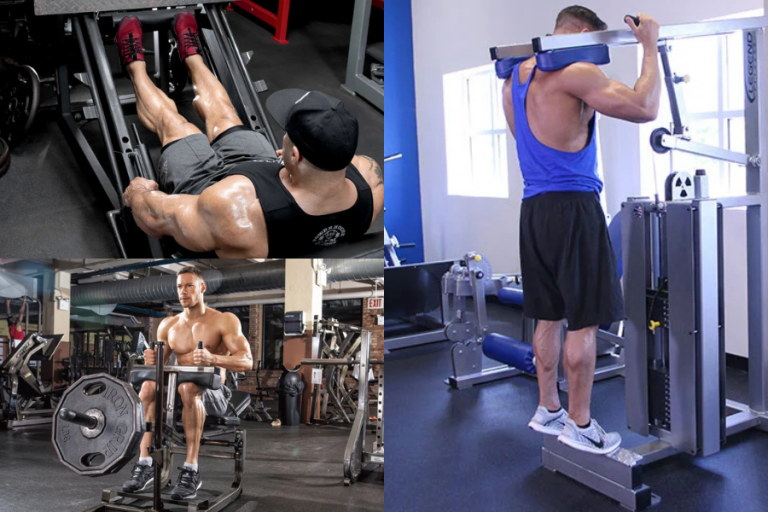
- Standing calf raises
- Seated calf raises
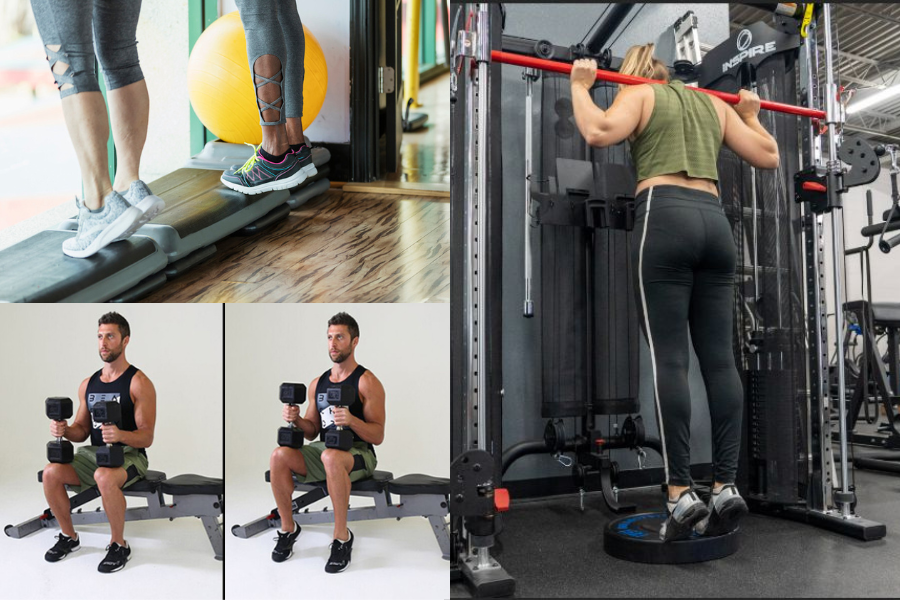
- Elevated calf raises
- Bent‑knee calf raises
- Single‑leg calf raises
- Jump rope
- Farmer’s carry
These movements cover both straight‑leg and bent‑knee positions so you can challenge the gastrocnemius and the soleus.
According to hypertrophy recommendations, including between 1 and 3 different calf exercises per session and 2 to 4 different exercises per week is a good balance. This gives you enough variety to hit the muscles from different angles without overuse or unnecessary complexity (RP Strength, 2024).
Straight‑leg vs bent‑knee work
Straight‑leg exercises such as standing calf raises, elevated calf raises, and farmer’s carry focus more on the gastrocnemius. These build the visible “diamond” shape on the back of your lower leg.
Bent‑knee exercises such as seated calf raises and bent‑knee calf raises pull more tension into the soleus. Since the soleus has a large volume and responds well to higher reps, training it helps add thickness and overall size.
For balanced growth, try to include at least one straight‑leg and one bent‑knee movement in your weekly plan.
Use rep ranges that actually build muscle
If you have been rushing through a few random sets at the end of your workout, your calves have probably not been getting a strong enough signal to grow.
Research on hypertrophy shows that calf training can benefit from a wide range of loads, roughly 5 to 30 reps per set (RP Strength, 2024). Here is a simple way to structure that.
Aim for most of your calf work in the 10 to 20 rep range, then sprinkle in heavier 5 to 10 rep sets and lighter 20 to 30 rep sets over the week for maximum growth.
You can think of it like this:
- Heavy sets of 5 to 10 reps for strength and density
- Moderate sets of 10 to 20 reps as your main growth driver
- Light sets of 20 to 30 reps for endurance and extra volume
The key is that your last few reps in a set should feel challenging, while your form stays controlled.
Lean into a full stretch and strong squeeze
How you perform each rep matters as much as how many you do.
A powerful growth tool for calves is using a deep, slightly uncomfortable stretch at the bottom of the movement. The RP Strength hypertrophy guide suggests holding this stretched position for up to 2 seconds on calf raises to boost muscle growth (2024). This loaded stretch creates a strong signal to your muscle fibers.
If you are a beginner, start gently. That deep stretch can cause intense delayed onset muscle soreness, so keep your volume low at first and give your legs time to adapt.
Time under tension is your friend. Rather than bouncing, lower your heels slowly, pause in the stretch, then drive up and hold the squeeze at the top for a brief moment. This controlled style makes even light weights feel surprisingly effective.
Plan your weekly calf training
You do not have to train calves for an hour every day to see results, but you do need consistent attention.
Many people can train calves 3 to 6 times per week at effective volumes, since calves recover relatively quickly. They have good blood flow and are not as limited by assisting muscles, which also allows for shorter rest intervals, sometimes even as short as 10 seconds between sets, as long as your performance stays solid (RP Strength, 2024).
A simple, realistic starting point is 2 to 3 focused calf sessions per week. As your tolerance improves, you can add an extra day if you like.
Here is a sample structure:
- Session 1: Standing calf raise + seated calf raise
- Session 2: Single‑leg elevated calf raise + jump rope
- Session 3 (optional): Farmer’s carry + bent‑knee calf raise
Alternate exercises between sessions to avoid overuse and keep your training interesting.
How many sets should you do?
A practical target is 4 to 5 sets per exercise, 1 to 3 exercises per session. Focus on quality, not just counting sets.
Keep rests short but not rushed. Start with 30 to 60 seconds between sets. If your reps fall off dramatically, rest a bit longer. If you feel fully recovered and your technique holds, you can experiment with shorter rests to fit more work into less time.
Apply progressive overload to your calves
To make your calves grow, you must gradually ask them to do more.
Progressive overload does not only mean adding weight. For calf training, you can rotate through several ways to increase the challenge:
- Add a small amount of weight when you hit the top of your target rep range
- Add an extra set once your current workload feels too easy
- Slow your tempo, especially on the way down, to increase time under tension
- Use a deeper range of motion, dropping your heels slightly lower on a safe, stable surface
- Shorten rest periods slightly while keeping reps and form solid
Key training principles for calf hypertrophy include increasing workout volume over time, slowing tempo, expanding range of motion, shortening rest when appropriate, and consistently overloading the muscles to push them to adapt and grow.
Choose just one of these overload methods at a time. Small, steady progress adds up faster than random, drastic changes.
Add power with plyometrics and carries
Traditional calf raises are important. Yet your calves also respond well when you challenge them dynamically.
Plyometric and explosive movements such as box jumps, jump squats, and single‑leg jumping have been shown to positively impact calf muscle hypertrophy by stressing the muscles differently from standard resistance training. These moves also improve your springiness for activities like running, court sports, and hiking.
Start with low volumes, such as 2 or 3 short sets, especially if you are not used to jumping. Focus on landing softly and using your calves to absorb impact as quietly as possible.
Farmer’s carries are another useful addition. When you walk slowly while holding heavy weights at your sides, your calves help stabilize your ankles and support your stride. Over time this helps with both strength and resilience.
Support growth with recovery, sleep, and nutrition
The work in the gym breaks your muscles down. You grow when you recover.
Adequate sleep is essential for calf muscle growth. During deep sleep your body regulates key hormones, repairs muscle tissue, and carries out protein synthesis. If you are constantly short on sleep, it becomes harder to add any muscle, calves included.
Nutrition plays an equal role. To support overall hypertrophy, make sure you are getting:
- Enough protein spread throughout the day
- Sufficient carbohydrates to fuel your workouts
- Healthy fats for hormone health
- Plenty of fluids for hydration
- Micronutrients from fruits, vegetables, and whole foods
A diet that supports recovery helps you come back stronger to your next calf session instead of feeling drained and flat.
Common mistakes that limit calf growth
If your calves have not changed much despite effort, you might be running into one or more common pitfalls.
Many people train calves quickly at the end of a workout when they are tired and distracted. Sets are rushed, the range of motion is short, and the weight is too light to challenge the muscles. Others stick to the exact same exercise, weight, and rep scheme for months, which gives the body no reason to adapt.
You might also be skipping either straight‑leg or bent‑knee work, which leaves one part of your calves undertrained. Or you may simply not be training frequently enough to send a strong growth signal during the week.
By giving calves their own dedicated focus, using a deep stretch and full squeeze, mixing rep ranges, and gradually overloading, you remove most of the barriers that keep this muscle group from growing.
Put it all together
Bigger calves are not just about vanity. They help you feel stronger, more stable, and more capable in everything from daily walks to weekend sports. Learning how to get bigger calves is really about creating a simple, repeatable system:
- Train both the gastrocnemius and soleus with straight‑leg and bent‑knee exercises
- Use a variety of rep ranges between 5 and 30, with most sets in the 10 to 20 range
- Emphasize a deep stretch and controlled tempo, especially at the bottom of the movement
- Train calves several times per week with 1 to 3 exercises per session
- Progress gradually by adding weight, reps, or tension over time
- Back your training with solid sleep and nutrition so your muscles can grow
Choose one or two ideas from this guide and apply them to your next leg day. As your calves respond and your lower legs grow stronger, your confidence will follow right along with them.
About the Author