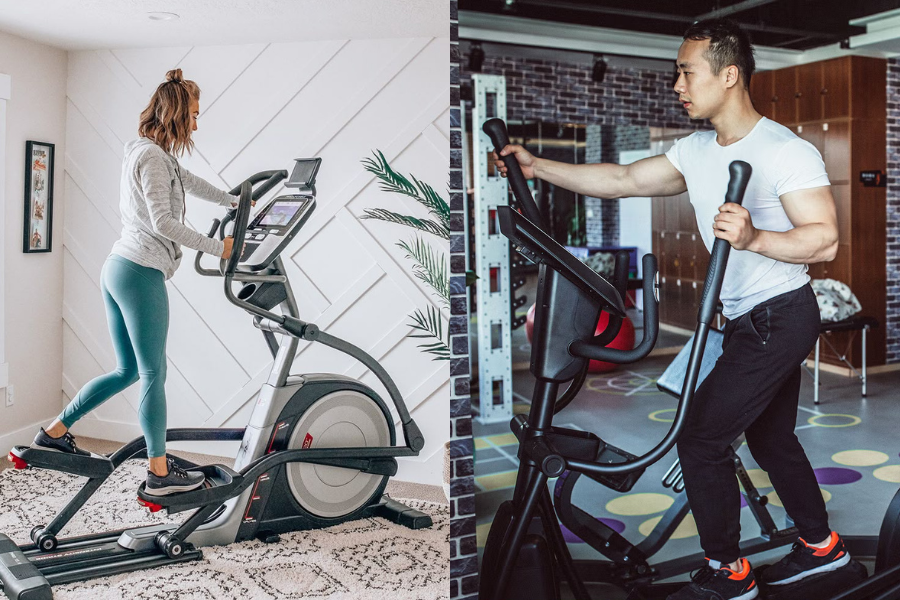
You can spend months on an elliptical workout for weight loss and still feel stuck if one thing is missing: a clear strategy for how you use the machine.
Simply hopping on, selecting “quick start,” and coasting at the same pace every time burns some calories, but it may not be enough to change your body in the way you want. With a few targeted tweaks, you can turn the same 30 minutes into a much more efficient fat‑burning and health‑boosting session.
Below, you will see how to structure an elliptical workout for weight loss, how many calories you might actually be burning, and what to adjust if your progress has stalled.
Understand what the elliptical really does
The elliptical is more than a “gentler treadmill.” It is a low impact cardio machine that lets you work your heart, lungs, and multiple muscle groups at once.
Because your feet stay on the pedals, there is far less stress on your knees, hips, and back compared with running, which makes it easier to use often, even if you have joint issues (Healthline, Lose It!). That lower impact means you can train frequently without feeling beaten up.
You also use more muscles than you might realize. When you use the moving handles, you engage your glutes, quads, hamstrings, calves, core, chest, and back at the same time. Working all of these muscles together increases your overall energy use, which supports fat loss and muscle toning (Healthline, Garage Gym Reviews).
So the machine itself is not the problem. The issue is usually how you are using it.
Check your calorie burn expectations
To use your elliptical workout for weight loss, you need a basic idea of what each session is doing for your energy balance.
Research suggests:
- A typical person may burn roughly 175 to 225 calories in 30 minutes at a moderate effort on an elliptical (MDApp).
- Other estimates place a 30 minute session closer to 270 to 400 calories, depending on your body weight and intensity (Healthline).
- Harvard data show a 155 pound person burning about 324 to 335 calories in 30 minutes, which is similar to or slightly higher than easy jogging (ProForm, Lose It).
The exact number depends on your weight, fitness level, and how hard you are actually working. Many built in calorie counters overestimate your burn, so treat those numbers as a rough guide, not hard truth (Reddit Fitness).
For steady and realistic weight loss, experts commonly recommend a daily deficit of about 500 calories, which adds up to roughly one pound per week (MDApp). You can create that deficit through a mix of slightly eating less and burning more with exercise.
If you assume your machine’s display is perfectly accurate and then “eat back” all those calories, progress will be slow. A better approach is to see your elliptical sessions as a meaningful contribution to your deficit, but not a free pass to overeat afterward.
The missing piece: intensity and variety
If your elliptical workout for weight loss has been the same for months, that is probably what is missing: enough intensity and variety to challenge your body.
Your body adapts quickly. What felt tough in week one becomes easy by week four, which means you burn fewer calories at the same settings. To keep seeing results, you need to change one or more of these variables:
- Speed
- Resistance
- Incline
- Workout structure (steady state vs intervals)
- Duration
A key concept here is the metabolic equivalent of task, or MET, which measures how much energy an activity uses. Higher intensity elliptical work has a higher MET value and burns more calories per minute (MDApp).
At very low intensity, you still get health benefits like better insulin sensitivity and improved blood lipids, but you do not burn as many calories, so fat loss will be slower (MDApp). That gentle pace is useful on recovery days, but it should not be your only style of workout if weight loss is your main goal.
Use your heart rate as a guide
Instead of guessing, you can use your heart rate to gauge how hard you are working on the elliptical.
A simple estimate for your maximum heart rate is 220 minus your age. For effective fat burning and cardio health, aim for roughly 50 to 85 percent of that number, with many weight loss workouts sitting around 70 percent of your max (ProForm, Lose It).
If your heart rate barely changes and you could easily carry on a full conversation, you are probably working at a low intensity. That is fine sometimes, but not enough if every workout looks like that.
On the other hand, if you are breathless within a couple of minutes and have to quit early, you may be pushing a bit too hard for now. Adjust resistance, incline, and speed so you spend most of your time in a challenging but sustainable zone where you feel your breathing increase and can talk in short phrases.
Build smarter elliptical workouts
You do not have to design a complex program to turn your elliptical workout for weight loss into something more effective. You just need to pair consistency with a bit of structure.
A simple weekly framework
Aim for at least 150 minutes of moderate cardio each week, which could be five 30 minute sessions, to support weight loss and heart health (Garage Gym Reviews). If you can handle more, you can extend some sessions to 45 or 60 minutes.
Within that time, mix:
- 2 days of moderate steady state workouts
- 2 days of interval or HIIT style workouts
- 1 optional longer, easier session for extra calorie burn
This blend gives you variety, challenges your body in different ways, and can be adjusted based on how you feel.
Sample steady state workout (30 to 45 minutes)
- Warm up for 5 minutes at low resistance.
- Increase resistance to a level that feels like a 6 or 7 out of 10 in effort. Maintain a steady pace for 20 to 30 minutes.
- Cool down for 5 to 10 minutes at a lighter setting.
You should feel worked but not exhausted by the end. This style is great for building cardiovascular base and burning a solid chunk of calories.
Sample HIIT elliptical workout (about 30 minutes)
High intensity interval training, or HIIT, alternates hard efforts with easier recovery. Research indicates that interval style elliptical workouts can burn more calories in less time and keep your metabolism elevated briefly after you finish (Healthline, ProForm, Garage Gym Reviews).
Try this:
- Warm up for 5 minutes at an easy pace.
- Alternate 1 minute hard (8 or 9 out of 10 effort) with 2 minutes easy. Repeat 8 to 10 times.
- Cool down for 5 minutes.
You can shorten intervals or extend recovery if you are new, and gradually progress over time.
Longer programmed sessions like hill climbers, mid intensity long intervals, and ladder workouts are also effective ways to increase calorie burn and keep things interesting (Lose It!).
Turn it into a full body fat burner
One of the elliptical’s biggest advantages is its ability to engage both your upper and lower body. If you are barely touching the handles and letting your legs do everything, you are leaving calories on the table.
To get more out of every minute:
- Use the moving handlebars and actively push and pull with your arms. This recruits your chest, shoulders, and back muscles which increases total energy use (Healthline, ProForm).
- Adjust incline and resistance periodically. A higher incline and heavier resistance make your glutes and hamstrings work harder and can increase calorie burn (ProForm).
- Focus on posture. Stand tall, engage your core, and avoid leaning on the console so your muscles, not the machine, are doing the work.
Wearing supportive running shoes or cross trainers with good cushioning and arch support helps you move more confidently and reduces the risk of discomfort or injury, which means you are more likely to keep up your routine over time (Lose It!).
Small adjustments, like actually using the handles and bumping resistance one level higher, can noticeably change how taxing the same 20 minutes feels and how many calories you burn.
Protect your joints while you lose weight
If you are worried that working out more will hurt your knees or back, the elliptical is one of the friendliest options you can choose.
Because your feet never leave the pedals, there is less impact on your joints compared to running, which makes it a smart choice if you have a history of joint pain or are carrying extra weight (Healthline, Lose It, Garage Gym Reviews). Users often report that they can use an elliptical almost daily without feeling beaten up, and some have lost large amounts of weight this way, such as a Reddit user who shared losing around 30 kilograms primarily through elliptical training (Reddit Fitness).
At the same time, running does have a unique benefit for bone density due to the impact it provides, so you can keep that in mind if your doctor has specific recommendations for your bone health (Lose It). If impact is not an issue, combining occasional walks or light jogs with elliptical sessions can give you the best of both worlds.
Connect your workouts to your lifestyle
Even the best designed elliptical workout for weight loss will only take you so far if your habits outside the gym fight against it.
A few simple practices will support your efforts:
- Pair your workouts with a modest, sustainable calorie deficit, instead of extreme dieting.
- Prioritize protein and fiber at meals so you stay satisfied and preserve lean muscle.
- Sleep plenty and manage stress so you avoid using food as your main coping tool.
- Add strength training on 2 or more days per week, which helps you maintain or build muscle and burn more calories at rest (Garage Gym Reviews).
You do not have to overhaul everything at once. Start by being consistent with your elliptical sessions and then slowly align your eating and daily habits with your goals.
Putting it all together
If your elliptical workout for weight loss has felt disappointing, you probably do not need a new machine. You likely need more thoughtful intensity, some interval work, and a clearer weekly plan.
Focus on these core ideas as you move forward:
- Use your heart rate and your breathing as guides so you are not stuck at a forever easy pace.
- Mix steady state and interval workouts to challenge your body in different ways.
- Engage both your upper and lower body, and play with resistance and incline to keep your muscles working.
- Support your workouts with reasonable nutrition, sleep, and stress management.
Choose one change to make in your very next session, such as adding five rounds of 1 minute hard, 2 minutes easy, and notice how different your usual 30 minutes can feel. Over the next few weeks, those small upgrades can be exactly what your routine was missing.
About the Author