A few smart tweaks to your elliptical interval training can turn a so-so workout into something that leaves you energized instead of wiped out. By adjusting how you structure your intervals, how hard you push, and how you recover, you can support weight loss and improve your health without punishing your joints.
Elliptical interval training simply means you alternate short bursts of higher intensity with easier efforts. You control intensity with speed, resistance, and incline. This style of workout is time efficient, joint friendly, and easy to adapt whether you are a beginner or already fairly fit (Healthline).
Understand what makes elliptical intervals effective
Intervals work because they ask your body to shift gears. During hard efforts, your heart rate and breathing increase. During recovery, your body clears some of that fatigue and gets ready for the next push.
Research suggests that high intensity interval training (HIIT) can improve cardiovascular fitness and endurance to a similar degree as longer steady-state cardio sessions, at least in untrained adults (Journal of Sports Science & Medicine). In one 8 week study, people doing HIIT, moderate intervals, or steady-state cardio all improved aerobic capacity by about 18 percent, with no significant difference between groups.
The key detail for you is this: intensity alone is not everything. Enjoyment and consistency matter just as much. That same study found that the most intense Tabata style HIIT protocol was less enjoyable and came with longer recovery times afterward (Journal of Sports Science & Medicine). For long term success, you want a structure that challenges you, but is still something you are willing to repeat next week.
Take advantage of the elliptical’s joint friendly design
If you want to lose weight and improve your health without pounding your knees or hips, elliptical interval training is a strong choice. The motion is similar to walking, jogging, or stair climbing, but your feet stay planted on the pedals. That means less pressure on your joints while you still get your heart rate up (Cleveland Clinic).
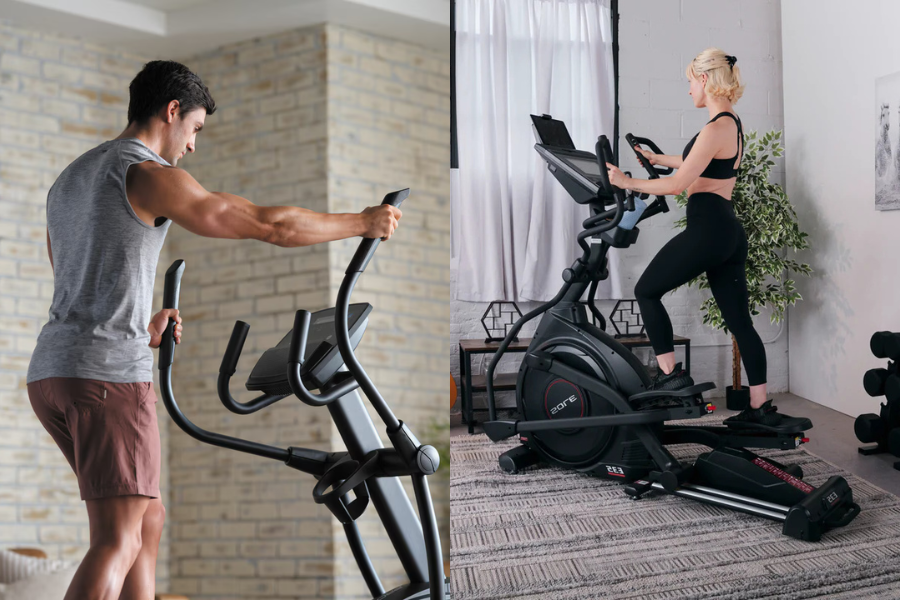
You also get an upper and lower body workout in one session. Many ellipticals have moving handles for your arms, so you are engaging your legs, core, and upper body at the same time. This full body involvement can help you burn more calories compared with some other cardio machines (Cleveland Clinic).
Because the impact is low, elliptical intervals often work well if:
- You are returning to exercise after a break
- You have joint pain or mild arthritis
- You are recovering from high impact sports and still want solid cardio
You still need to ease in and listen to your body, but you are lowering the mechanical stress on your ankles, knees, and hips compared with running (Healthline).
Set your intensity using RPE instead of guesswork
You do not need to be a numbers person to get good interval results. A simple rate of perceived exertion (RPE) scale from 1 to 10 works very well:
- 1 to 3: Very easy, light movement
- 4 to 5: Comfortable, can talk in full sentences
- 6 to 7: Challenging, can speak a few words at a time
- 8 to 9: Very hard, you want to stop soon
- 10: Maximum effort, only for very short bursts
Beginner elliptical workouts often sit between RPE 4 and 6, which feels moderate but still allows you to talk (Verywell Fit). For intervals, you can think in pairs:
- Recovery intervals: RPE 3 to 4
- Work intervals: RPE 6 to 8
By adjusting your speed, resistance, or incline, you can hit the right RPE without obsessing over heart rate numbers.
If you are slightly out of breath but can still hold a conversation, you are likely in a good moderate intensity zone for building endurance (Cleveland Clinic).
Start with a simple beginner interval structure
If you are new to elliptical interval training, keep your first sessions short and manageable. Your main goals are confidence and consistency, not all out effort.
A beginner friendly structure inspired by guidelines from certified trainers looks like this (Verywell Fit, Garage Gym Reviews):
- Warm up for 5 minutes at RPE 3 to 4
- Alternate 1 minute at RPE 6 with 2 minutes at RPE 3 to 4, for 6 to 8 rounds
- Cool down for 5 minutes at RPE 2 to 3
That gives you about 25 to 30 minutes total without overwhelming you. If 30 minutes feels like too much at first, you can start with 10 to 15 minutes of intervals and build up gradually (Verywell Fit).
On many machines, beginners do best with:
- Resistance under level 5
- Incline between 1 and 8, if your machine has incline
You can then increase one variable at a time as your fitness improves (Garage Gym Reviews).
Progress into true HIIT when you are ready
Once a moderate interval routine feels comfortable, you can move toward more traditional HIIT if you want to burn more calories in less time. HIIT on an elliptical usually means shorter, harder efforts with short recovery windows.
Health and fitness experts suggest patterns such as 30 to 45 seconds of high intensity effort followed by 15 seconds of easier pedaling, repeated for 10 to 20 minutes (Healthline, Garage Gym Reviews). Another common pattern is a 1 to 1 work to recovery ratio, such as 3 minutes hard, 3 minutes easy (Cleveland Clinic).
To keep HIIT sustainable:
- Limit HIIT to 2 or 3 sessions per week
- Leave at least one easy or rest day between HIIT days
- Keep most work intervals in the RPE 7 to 8 range, not 10
Extremely intense protocols like Tabata (20 seconds all out, 10 seconds rest) are demanding and were rated as less enjoyable and more stressful in research, with higher heart rates and blood lactate levels compared with more moderate options (Journal of Sports Science & Medicine). You do not need to push that hard to see results, and for general health and weight loss, they are often unnecessary.
Use resistance and incline to shape your workout
The beauty of elliptical interval training is how easily you can customize it without touching the clock. Two of your most powerful tools are resistance and incline.
- Resistance: Higher resistance makes the movement heavier and more muscular. It is useful for intervals that focus on strength and power.
- Incline: A higher incline can shift emphasis toward your glutes and hamstrings. A lower incline feels more like running or flat walking.
You can combine these settings into different styles of intervals (Healthline, Garage Gym Reviews):
- Speed intervals: Keep resistance moderate and increase speed during work intervals.
- Hill intervals: Increase incline and resistance slightly during work intervals.
- Power intervals: Keep incline moderate and raise resistance for a slower, stronger push.
Always start changes in small steps. If you raise resistance, keep the same incline until your legs adjust. You can also take advantage of preprogrammed interval settings that many ellipticals offer. These built in programs automatically adjust resistance and sometimes incline over the workout, which saves you from constant manual changes (Cleveland Clinic).
Make your intervals safer and more enjoyable
You are more likely to stick with elliptical interval training if it feels good on your body and fits your schedule. A few simple habits can make a big difference.
Warm up and cool down every time
Even very short HIIT sessions should start with at least 3 to 5 minutes of easy movement and end with a cooldown. Some trainer led beginner workouts use 60 second warmup and cooldown blocks at the lowest resistance to help your body transition safely (Sunny Health & Fitness). You can always extend these if you feel stiff or tired.
Watch your posture and grip
Check in with your form during intervals. You want:
- Upright posture, no slouching into the console
- Relaxed shoulders
- Light grip on the handles
If you feel your low back, neck, or shoulders tensing up, ease the intensity slightly and reset your posture.
Balance intensity with recovery
HIIT is powerful, but it does create more physiological stress than moderate steady-state cardio. In the Tabata research group, heart rates and blood lactate levels were significantly higher than in other groups, and people needed longer to feel recovered afterward (Journal of Sports Science & Medicine). If you feel drained for hours after every session, your work intervals are probably too intense or too frequent.
It is perfectly reasonable to alternate:
- One day of intervals
- One day of easier steady-state elliptical or walking
Both styles of training can improve your fitness and support weight management. The best choice is the one you can keep doing.
Match your intervals to your goals
You can use elliptical interval training for several different outcomes. Slight tweaks in how you structure your workout will help you prioritize what matters most to you.
| Goal | Focus your intervals on | Practical tip |
|---|---|---|
| Weight loss | Total weekly time and consistency | Aim for 2 to 3 interval days plus lighter movement on other days |
| Cardiovascular health | Moderate intensity and regularity | Include longer, moderate intervals and steady-state sessions (Garage Gym Reviews) |
| Joint friendly fitness | Low impact, shorter hard efforts | Keep impact low with the elliptical and monitor any joint discomfort (Healthline) |
| Time efficiency | Shorter, focused HIIT | Keep sessions to 15 to 20 minutes of intervals plus warmup and cooldown (Sunny Health & Fitness) |
Research on people with pre-diabetes or type 2 diabetes found that just three HIIT elliptical sessions per week for 12 weeks improved fasting blood glucose, waist and hip size, blood pressure, and heart rate (PureGym). While your exact results will vary, this shows how a consistent, realistic routine can support your health over time.
Put it all together
Elliptical interval training gives you a flexible way to burn calories, protect your joints, and build cardiovascular fitness. You do not need extreme protocols to see benefits. A balanced approach that uses moderate to hard efforts, regular recovery, and gradual progression is often easier to maintain and just as effective in the long run.
If you are unsure where to begin, start with one or two short interval sessions this week. Keep the structure simple, notice how your body responds, and adjust your resistance or timing slowly. Over time, small consistent sessions can give you more energy, better endurance, and a workout routine that feels like it fits your life instead of fighting against it.
About the Author