A pair of dumbbells is all you need to build stronger, more defined triceps at home or in the gym. Well-planned dumbbell tricep workouts help you add size to your arms, boost pressing strength, and improve joint stability without relying on big machines or a full weight room.
Below, you will learn simple tricep exercises, how to use them in workouts, and how to train safely for real results.
Why train your triceps with dumbbells
Your triceps make up most of your upper arm. In fact, they account for significantly more muscle mass than your biceps, which is why tricep training has such a big impact on arm size and strength. The triceps have three heads, the long, lateral, and medial head, and all three need attention for balanced growth and healthy elbows.
Dumbbells are especially effective for tricep workouts because they give you a larger range of motion and force each side to work independently. This helps you correct strength imbalances, improves stability, and often feels more natural than a barbell or fixed machine. You can also store a set of dumbbells easily at home, so you can train your triceps whenever it fits your schedule.
Key dumbbell tricep exercises to know
You do not need dozens of movements to see results. A handful of well chosen dumbbell tricep exercises can cover strength, muscle growth, and lockout power.
Close grip dumbbell bench press
This is your heavy strength builder. By bringing the dumbbells close together and keeping your elbows tucked, you shift more work from your chest to your triceps.
How to do it:
Lie on a bench with a dumbbell in each hand, palms facing each other. Press the weights up over your chest so they touch or nearly touch. Lower them slowly, keeping your elbows close to your sides, then press back up by driving through the elbows.
Why it works:
You can usually lift nearly as much weight as a barbell close grip press, but with less shoulder stress because your elbows stay down and in. This makes it a great option when you want to load your triceps hard without irritating your shoulders.
Lying dumbbell tricep extension (skull crusher)
This exercise targets the long head of your triceps through a deep stretch, which is very effective for muscle growth.
How to do it:
Lie on a flat bench, hold a dumbbell with both hands or one in each hand, arms extended above your chest. Bend at the elbows to lower the weight toward the back of your head, keeping your upper arms mostly still. Stop before your arms fully straighten at the top so you keep constant tension on the muscle.
Why it works:
The long head of your triceps is under strong stretch during the lowering phase. That stretch under load is excellent for hypertrophy, as long as you control the movement and avoid snapping the elbows straight.
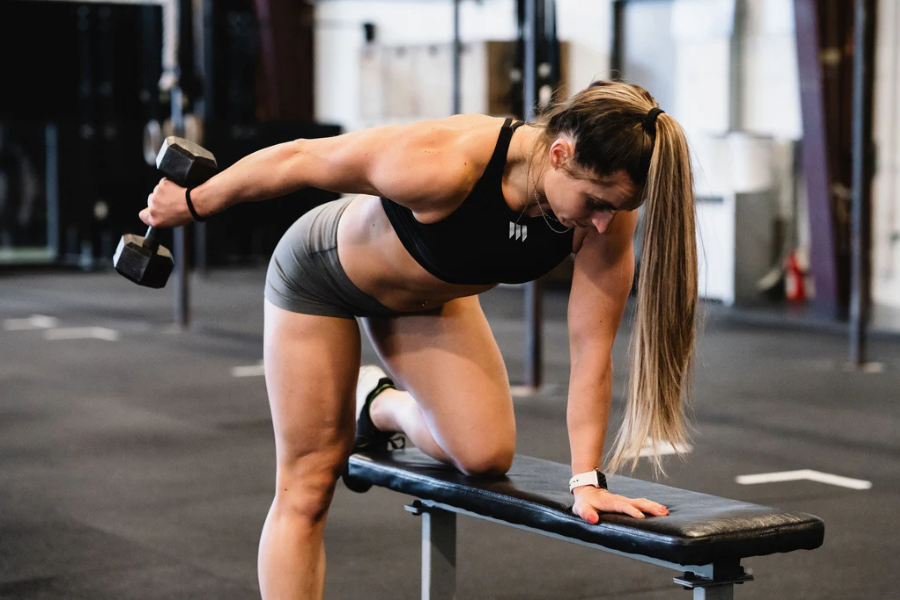
Dumbbell triceps kickback
Kickbacks are one of the best movements for achieving a full contraction and maximum shortening of your triceps.
How to do it:
Hold a dumbbell in each hand, hinge forward at the hips until your torso is nearly parallel to the floor, and bend your elbows to about 90 degrees. Keep your upper arms pinned by your sides and straighten your elbows until your arms are behind your body. Squeeze hard at the top, then return with control.
Why it works:
With your arm behind your body and the elbow fully extended, the triceps are in a shortened, fully contracted position, which is ideal for finishing a workout and improving definition.
Overhead dumbbell tricep extension
Any overhead tricep exercise hits the long head strongly, which is important for both size and shoulder stability.
How to do it:
Sit or stand tall and hold one dumbbell with both hands, or one dumbbell in each hand, overhead with your arms straight. Keeping your upper arms close to your head, bend your elbows to lower the weight behind your head. Press the weight back up by straightening your elbows, without letting your ribs flare or your lower back arch.
Why it works:
The overhead position puts the long head of the triceps on stretch while it works. This strengthens the muscle in a shoulder friendly way and supports strong overhead pressing.
Dumbbell JM press
The JM press is a powerful hybrid between a press and an extension that trains explosive tricep strength.
How to do it:
Lie on a bench with dumbbells held like a close grip bench, palms facing each other. As you lower the weights, bend your elbows and bring the dumbbells toward your face or upper chest so the movement is driven mainly by the elbows. Reverse direction quickly and press back up, focusing on fast but controlled elbow extension.
Why it works:
The JM press is elbow driven, so your triceps initiate the lift. You can accelerate the weights quickly without needing extremely heavy loads, which makes it useful for power and keeping speed through the lockout phase of your presses.
Close grip push up on a dumbbell
This bodyweight and dumbbell hybrid is a simple way to smoke your triceps with minimal equipment.
How to do it:
Place one dumbbell on the floor and grip it with both hands while you set up in a plank position. Your hands are close together under your chest. Lower your chest to the dumbbell, keeping your elbows close to your sides, then push back up explosively.
Why it works:
The close grip forces your triceps to work hard and the deep stretch at the bottom challenges them in a different way than standard push ups. It is an easy movement to add at home or at the end of your workout.
Aim to include at least one heavy press, one stretch focused extension, and one contraction focused movement in your dumbbell tricep workouts to cover all angles of training.
Form tips for safe and effective training
Good technique protects your elbows and shoulders and ensures your triceps do the work instead of other muscles taking over.
Focus on these basics during each set:
- Keep your upper arm as still as possible during extensions and kickbacks so your elbow joint does the work.
- Move slowly and smoothly, without jerking the weights. Sudden movements reduce muscle tension and increase injury risk.
- Avoid locking your elbows aggressively at the top of each rep, especially during skull crushers and overhead extensions. Slightly softening the joint keeps tension on the muscle and spares your joints.
- Brace your core and keep your head, spine, and lower body stable, particularly when lying on a bench or performing overhead movements.
If you struggle to keep your arm in position, you can use your free hand to support the working arm at a 90 degree angle, as suggested in triceps extension guidelines from Mayo Clinic.
How to structure simple dumbbell tricep workouts
You can organize your training differently depending on whether you want stronger arms, more muscle size, or general toning. Start with one of the templates below and adjust as you gain experience.
Beginner friendly routine
If you are new to dumbbell tricep workouts, keep things straightforward and focus on control.
Two times per week:
- Close grip dumbbell bench press, 3 sets of 8 to 10 reps
- Lying dumbbell tricep extension, 2 to 3 sets of 10 to 12 reps
- Dumbbell triceps kickback, 2 sets of 12 to 15 reps
Rest 60 to 90 seconds between sets. Choose a weight that makes the last 2 reps of each set challenging but still doable with good form.
Muscle growth focused routine
For size gains, you will use a mix of heavier and moderate sets and work each head of the triceps.
Two to three times per week:
- Close grip dumbbell bench press, 4 sets of 6 to 8 reps
- Overhead dumbbell tricep extension, 3 sets of 8 to 10 reps
- Lying dumbbell tricep extension, 3 sets of 10 to 12 reps
- Dumbbell triceps kickback, 2 sets of 12 to 15 reps
Rest 60 to 120 seconds on the heavier presses and about 60 seconds on the lighter isolation movements. Focus on a strong squeeze at the top of each rep and slow, controlled lowering.
Strength and power focused routine
If your goal is stronger lockouts for bench press and push ups, emphasize heavier loads and some speed work.
Two times per week:
- Close grip dumbbell bench press, 5 sets of 4 to 6 reps
- Dumbbell JM press, 4 sets of 5 to 6 reps with fast but controlled intent
- Overhead dumbbell tricep extension, 3 sets of 8 to 10 reps
- Close grip push up on a dumbbell, 3 sets to near fatigue
Keep your total weekly volume in check so your elbows can recover. Increase weight only when you can complete all sets with solid technique.
Avoiding common mistakes and overtraining
Triceps already work hard during chest and shoulder exercises, so it is easy to overdo it if you are not careful.
Try to avoid these common errors:
- Training triceps hard immediately after an intense chest or shoulder day. Your triceps are already fatigued, which hurts performance and recovery. Aim for at least 24 hours between heavy upper body sessions.
- Relying only on machines and cables. These limit your range of motion and can create weaker, less flexible muscles over time. Free weights like dumbbells let you move more naturally and hit the triceps from multiple angles.
- Ignoring one or more heads of the triceps. Combine overhead work for the long head, presses for overall mass, and kickbacks or skull crushers for detail and full range contraction.
- Letting form deteriorate to chase heavier weights. Poor technique shifts stress to your shoulders and elbows instead of your triceps, which raises injury risk and slows gains.
Listening to your body matters. Mild soreness is normal, sharp joint pain is not. If you feel discomfort in your elbows or shoulders, reduce the weight, tighten your form, or cut back your volume.
How often you should train triceps
Most people see good progress training triceps 2 to 3 times per week with 8 to 12 working sets per week in total. That includes the tricep work you get from pressing exercises like dumbbell bench presses or overhead presses.
You can:
- Add 2 or 3 tricep exercises at the end of your upper body days.
- Or dedicate one short session just to dumbbell tricep workouts and pair it with light pulling or core work.
As you get stronger, slowly increase the load or add a set here and there, rather than jumping up too quickly.
Putting it all together
With a small selection of solid movements, thoughtful form, and consistent effort, you can build impressive triceps using only dumbbells. Mix a heavy press, a stretch focused extension, and a contraction focused finisher in each session. Give yourself enough recovery between workouts and keep an eye on how your joints feel.
Start with one of the simple routines above at your next workout. After a few weeks of focused dumbbell tricep training, you should notice firmer, stronger arms and more power in every push.
About the Author