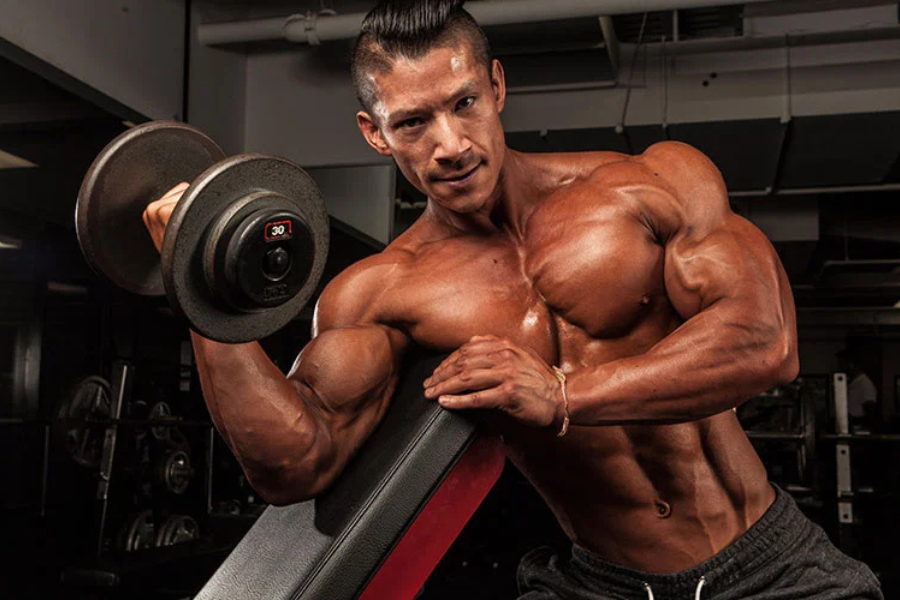
A pair of dumbbells is often all you need to build strong, defined arms. The right dumbbell bicep exercises help you add size, improve strength, and support everyday movements like lifting groceries or carrying bags. With a few key variations and smart technique, you can turn a simple curl into a full biceps workout.
Below, you will learn how to perform essential dumbbell bicep exercises with good form, how to avoid common mistakes, and how to put everything together into a simple routine.
Understand your biceps and why dumbbells help
Your biceps sit on the front of your upper arm and have two heads: the long head and the short head. Both help you bend your elbow and rotate your forearm, which is why curls are so effective.
Dumbbells are especially useful for biceps because they:
- Allow each arm to work independently, so you can spot and correct strength imbalances
- Offer a natural range of motion that is often easier on your wrists than a barbell
- Let you change grip position and angle to target different parts of the muscle
According to the Mayo Clinic, a standard dumbbell biceps curl is a simple way to strengthen the front of your upper arm, and it can be done standing or sitting as long as you avoid swinging the weight and keep your wrist straight.
Master the basic dumbbell bicep curl
If you only choose one dumbbell bicep exercise, make it the standing dumbbell curl. It targets both heads of the biceps and also works the brachialis and brachioradialis muscles in your lower arm, which adds thickness and overall strength.
How to do a standing dumbbell curl
- Stand tall with your feet hip-width apart and a dumbbell in each hand. Let your arms hang by your sides with your palms facing forward.
- Brace your core, keep your shoulders relaxed, and lock your elbows close to your torso.
- Keeping your upper arms still, bend your elbows and curl the dumbbells upward.
- As you lift, keep your forearms supinated, which means palms turning slightly up and in. Aim to bring your pinky fingers toward your shoulders.
- Pause at the top, squeeze your biceps, then slowly lower the weights back to the starting position.
Jeff Cavaliere of Athlean-X recommends a very slow tempo for curls, about four seconds up and four seconds down, to keep tension on the biceps and protect your joints. This kind of controlled rep increases muscle activation and makes lighter weights feel challenging.
Form cues to focus on
To get the most from this curl:
- Keep your elbows just in front of your hips rather than drifting behind your body. This keeps constant tension on the biceps.
- Do not lean back or swing your torso to move the weight. Losing core tension shifts the load to your lower back instead of your arms.
- Squeeze the handle, especially at the top, and slightly turn your wrists inward. This can increase biceps activation without adding more weight.
If you are new to strength training, choose a weight you can lift with good form for about 10 reps, with the last few feeling tough but controlled. Over time you can add weight and reps as you get stronger.
Use key dumbbell variations for complete growth
Once you are comfortable with the basic curl, you can introduce other dumbbell bicep exercises to hit all areas of the muscle. Small changes in grip, arm position, and body angle can shift the emphasis and help you build fuller arms.
Alternating curls with iso-hold
The alternating bicep curl with an isometric hold keeps your biceps under constant tension. That means more work in less time.
How to do it:
- Curl both dumbbells up.
- Keep one arm held at the top position while you slowly lower and curl the other arm.
- Alternate sides without letting either arm fully relax at the bottom.
This combination of movement plus a static hold increases time under tension, which is linked to muscle growth. Cavaliere calls similar strategies “purgatory reps” because one arm is working while the other is stuck in a demanding position.
Strict wall curl
If you tend to cheat on curls, the strict wall curl can quickly fix your form.
- Stand against a wall with your head, upper back, and glutes touching it.
- Press the backs of your arms lightly into the wall.
- Curl the dumbbells by bending only at the elbows, with no torso movement.
Keeping your body fixed reduces momentum and forces your biceps to do the work. This is a great option at the end of a workout when you want to fully fatigue the muscle without loading your lower back.
Target the long head with hammer and incline curls
The long head of the biceps helps create that “peak” when you flex. To emphasize it, use dumbbell bicep exercises that place your arm behind your torso or use a neutral grip.
Dumbbell hammer curls
Hammer curls use a palms-facing-each-other, or neutral, grip. This hits the long head of the biceps along with the brachialis and brachioradialis.
How to do them:
- Stand or sit with a dumbbell in each hand, palms facing inward.
- Keep your elbows close to your sides.
- Curl the weights up while maintaining the neutral grip.
- Squeeze at the top, then lower slowly.
Hammer curls are especially helpful for improving grip strength, which carries over to activities like rock climbing or tennis, and they contribute to overall arm thickness.
Incline dumbbell curls
The incline curl stretches the long head of the biceps at the bottom of the movement, which can stimulate extra growth.
- Set an adjustable bench to about a 45 to 60 degree angle.
- Sit back with your head and shoulders supported. Let your arms hang straight down behind your body.
- With your palms facing forward, curl the dumbbells up without moving your upper arms.
- Lower slowly until you feel a gentle stretch in your biceps at the bottom.
You will likely need lighter weights here because other muscles cannot help as much. This exercise is demanding but very effective for building a noticeable peak over time.
Target the short head with concentration and preacher curls
The short head of the biceps contributes to the width and overall fullness of your upper arm. Curls that keep your arms in front of your body with a supinated grip are great for this.
Concentration curls
Concentration curls are known for isolating the biceps and improving your mind muscle connection. They reduce help from your shoulders and momentum from your torso.
- Sit on a bench with your legs apart and a dumbbell in one hand.
- Lean forward slightly and rest the back of that arm against your inner thigh, just above the knee.
- With your palm facing upward, curl the weight toward your shoulder.
- Squeeze the biceps at the top, then lower slowly.
Because this movement is strict, you usually use lighter weights, focusing on control and a strong squeeze. This variation is particularly effective for bringing out the biceps peak and refining shape.
Dumbbell preacher curls
If you have access to a preacher bench, dumbbell preacher curls are a joint friendly alternative to an EZ bar. The angled pad keeps your upper arm fixed, which isolates the biceps.
- Sit on the preacher bench and position your upper arm on the pad, holding a dumbbell with your palm facing up.
- Start with your arm almost straight, but keep a small bend in your elbow.
- Curl the weight up, pausing near the top.
- Lower under control, never letting your elbow lock fully.
Because your arm is supported, there is less chance to cheat, and the biceps stay engaged throughout the entire range of motion.
Avoid common mistakes with dumbbell curls
Even effective dumbbell bicep exercises can become less useful or risky if your form breaks down. Watch for these common issues as you train.
Rushing the movement
Going too fast is one of the most frequent mistakes. Quick reps rely on momentum instead of muscle effort. A smooth, slow curl with a focused negative phase on the way down causes more muscle tension and tends to be safer for your elbows and shoulders.
Moving your elbows around
Letting your elbows drift away from your torso or swing forward and back reduces tension on the biceps and shifts work to your shoulders. For most curls, think about keeping your elbows pinned slightly in front of your body and moving only at the elbow joint.
Turning curls into hammer curls
Another subtle mistake is starting a set as a regular curl and then gradually letting your grip turn into a neutral one halfway up to make the movement easier. This changes the emphasis from the biceps to the brachialis and brachioradialis and skips the hardest part of the range of motion. If you want to do hammer curls, commit to them for the full set instead of blending the two.
Try a simple dumbbell bicep workout
You can build a solid routine with just a few of these dumbbell bicep exercises. Here is a sample progression that grows with your experience.
Aim to train your biceps 1 to 2 times per week, leaving at least one full rest day between sessions so your muscles can recover.
Beginner plan
Start with two exercises:
- Standing dumbbell curl, 3 sets of 10 to 12 reps
- Concentration or preacher curl, 3 sets of 8 to 12 reps
Focus on slow, controlled reps and consistent technique. If you are just starting out, even a single set of 12 to 15 reps can be effective as suggested by the Mayo Clinic.
Intermediate plan
When you feel comfortable, add volume and variation:
- Standing dumbbell curl, 3 to 4 sets of 8 to 12 reps
- Hammer curl, 3 sets of 8 to 12 reps
- Concentration curl, 3 sets of 10 to 12 reps
Alternate your starting exercise from workout to workout so all parts of the biceps get a fair share of your energy.
Advanced ideas
As you advance, you can experiment with:
- Incline dumbbell curls to emphasize the long head
- Strict wall curls to finish a session with very strict reps
- Mechanical drop sets, where you change the angle or style of curl, for example from strict curls to slightly looser curls, to continue your set past fatigue without lowering the weight
Techniques like cheat reps, where you use a bit of momentum to lift a heavy weight then focus on slowly lowering it, place a lot of stress on the muscles and joints. These are best left to experienced lifters and should not be your starting point.
Build stronger arms, one curl at a time
You do not need endless machines or complicated routines to carve impressive biceps. A few well chosen dumbbell bicep exercises, performed with attention and consistency, are enough to build size, strength, and better control over your arms.
Start with the basics, move slowly, and keep your elbows where they belong. As your form improves, introduce variations like hammer curls, incline curls, and concentration curls to round out your development. With practice, you will feel the difference every time you pick something up, not just when you flex in the mirror.
About the Author