A strong biceps routine does more than shape your arms. Effective bicep workouts for women help you bend your elbows, pull, lift, and twist with more ease every day, whether you are opening a tight jar or carrying groceries. With the right exercises, you can build strength and definition at home in just a few focused sessions each week.
Below, you will find simple, clear steps to train your biceps using minimal equipment, plus tips on form, reps, and recovery so you can see progress safely and steadily.
Understand your biceps muscles
Your biceps sit on the front of your upper arm and are more than a “show” muscle. They play a key role in bending your elbow, lifting or pulling objects, and rotating your forearm, like when you twist a bottle cap or turn a doorknob, according to experts cited in a 2023 overview from Women’s Health.
Anatomically, the biceps brachii has two heads:
- The long head runs along the outside of your upper arm. It contributes to that rounded “peak.”
- The short head sits more toward the inner side and adds support and width.
When your bicep workouts for women target both heads, you set yourself up for stronger, more balanced arms and better performance in daily tasks and workouts.
How often to train your biceps
You do not need to train biceps every day to see results. In fact, you should not.
Research summarized in the fitness community suggests that training a muscle group 2 to 3 times per week is more effective for hypertrophy, or muscle growth, than training it once per week. One review notes roughly 3.1 percent greater weekly growth when you spread your sets across multiple days instead of packing everything into a single session.
For most women, this schedule works well:
- Aim for 2 biceps focused sessions per week
- Add a third session only if you recover well and feel ready
Between those days, give your arms time to rest. Recovery is when the muscle tissue you stressed during your workout repairs and builds back stronger. If you train biceps intensely every day, you risk fatigue, soreness, and slower progress.
How many sets, reps, and weight to use
To build strength and visible muscle, you want the right mix of volume and intensity.
A practical structure for bicep workouts for women is:
- 2 to 4 exercises per session
- 3 to 4 sets per exercise
- 8 to 12 repetitions per set
Choose a weight that feels challenging but manageable. You should be able to complete the full set with good form, yet the last 2 or 3 reps should feel noticeably tough. If you can easily do more than 12 to 15 reps and feel fresh at the end, it is time to increase the load.
ACE certified trainer Colette Nguyen suggests increasing your dumbbell weight by about 1 to 2.5 pounds once sets feel easy and you no longer reach fatigue by the final rep. That small bump keeps your muscles challenged without compromising form.
Warm up before you curl
Warming up only takes a few minutes, but it helps protect your joints and tendons and can improve your performance.
You can try a simple 5 minute routine:
- 30 seconds of light cardio, such as marching in place or gentle jumping jacks
- Arm circles forward and backward
- Shoulder rolls
- A few bodyweight “backpack curls” with no weight, just mimicking the curl motion slowly
Some coaches also use banded chin up holds, rotational dumbbell curls with very light weights, and gentle biceps stretches to increase blood flow before harder sets. The main goal is to feel warm and mobile, not tired.
Best at home bicep exercises with dumbbells
If you have a pair of dumbbells, you can build a very effective at home routine. Below are key moves that target different parts of the biceps and surrounding muscles.
Supinated biceps curl
This is the classic curl and a foundation of most bicep workouts for women.
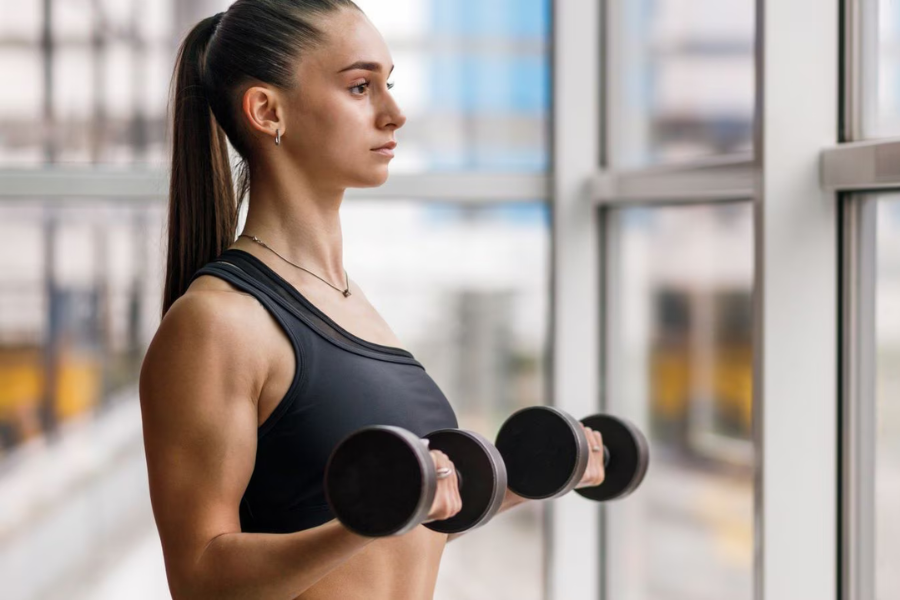
- Stand tall with a dumbbell in each hand, arms by your sides, palms facing forward.
- Keep your elbows close to your torso as you curl the weights toward your shoulders.
- Squeeze your biceps at the top without shrugging your shoulders.
- Lower the weights slowly back to the starting position.
Focus on a smooth, controlled pace. A one to two second lift and one to two second lowering phase gives your muscles more time under tension, which supports growth and helps prevent injuries.
Hammer curl
Hammer curls emphasize the long head of your biceps and also recruit the brachialis and brachioradialis, muscles that add shape and strength to your upper arm and forearm.
- Hold dumbbells at your sides with palms facing each other, thumbs pointing forward.
- Curl the weights up while keeping that neutral grip.
- Pause briefly at the top, then lower slowly.
Hammer curls are joint friendly for many people and often feel better on the wrists than traditional curls.
Tempo curls
You can use either a regular or hammer grip and simply slow one part of the movement.
- Eccentric tempo: Raise the weights in one to two seconds. Lower them in four slow seconds.
- Concentric tempo: Take three or four seconds to lift and one to two seconds to lower.
Playing with tempo increases the challenge without needing heavier dumbbells. This can be especially useful if your home weights are limited.
Isometric biceps hold
Isometric work builds endurance and increases time under tension.
- Stand with a dumbbell in each hand, palms facing up.
- Curl until your elbows are at roughly a 90 degree angle.
- Hold that position, keeping your elbows tight to your sides, for 20 to 30 seconds.
- Lower with control.
You can add an isometric hold at the end of a set of curls for an extra burn without adding more reps.
Bodyweight and minimal equipment bicep moves
If you do not have dumbbells, you can still build strong arms at home using bodyweight, resistance bands, or household items.
Backpack curls
- Fill a sturdy backpack with books or water bottles.
- Hold the top handle with both hands, palms facing up.
- Curl the backpack toward your chest, then lower with control.
You can also hold one strap in each hand for a wider grip that more closely mimics dumbbells.
Resistance band curls
- Stand on the middle of a resistance band and hold one end in each hand.
- Start with arms straight, palms facing forward.
- Curl your hands toward your shoulders, keeping your elbows pinned to your sides.
- Slowly return to the starting position.
Bands provide more resistance as you reach the top of the curl, which keeps the muscle working hard throughout the movement.
Chin up variations
Chin ups are an advanced option that use your bodyweight for a serious biceps and upper back challenge.
- Standard chin up: Grip a bar with palms facing you, hands about shoulder width apart, and pull your chest toward the bar.
- Assisted chin up: Loop a resistance band around the bar and place one knee or foot in the band for support.
Chin ups work both heads of the biceps as well as your upper back and shoulders, so they are very efficient if you have a bar available.
Sample 15 minute bicep workouts for women
You can finish a focused session in 15 minutes or less, especially if you keep rest breaks around 45 to 60 seconds.
Beginner dumbbell routine
Try this 2 times per week:
- Seated dumbbell curls, 3 sets of 10 to 12 reps
- Hammer curls, 3 sets of 10 to 12 reps
Sitting for curls limits momentum from your hips and lower back, so your biceps do more of the work. Focus on full range of motion from a straight arm at the bottom to a strong squeeze at the top.
Intermediate mixed grip routine
Once you are comfortable with the basics, add variation:
- Supinated biceps curls, 3 to 4 sets of 8 to 12 reps
- Hammer curls, 3 sets of 8 to 10 reps
- Isometric biceps hold, 2 sets of 20 to 30 seconds
Choose no more than two main curl variations per session, plus one short finisher like the isometric hold. This helps you avoid overtraining and keeps the quality of each set high.
Quick guideline: most women can see noticeable strength improvements within 1 to 2 weeks of consistent sessions, especially if they are new to lifting, according to trainer insights shared in Women’s Health.
Form tips to protect your joints
Good technique turns a simple home routine into a safe, effective biceps program.
Keep these cues in mind:
- Keep your elbows close to your sides instead of letting them swing forward.
- Stand or sit tall, and avoid using your hips or lower back to “cheat” the weights up.
- Let your arms straighten nearly completely between reps so each repetition starts from a similar position.
- Control the pace, especially on the way down. This is where a lot of muscle building happens.
Some coaches also highlight wrist position. Instead of curling with your wrists limp, think of them extended and strong, like you are balancing a tray. This reduces strain and can help you feel a better contraction in the muscle.
How to progress over time
As your biceps get stronger, you need to continue challenging them to keep seeing gains.
You can progress by:
- Increasing weight by 1 to 2.5 pounds when sets feel easy
- Adding an extra set to one exercise
- Slowing the tempo for more time under tension
- Swapping in a more challenging variation, such as moving from backpack curls to dumbbell curls, or from band assisted chin ups to unassisted reps
Avoid making several changes at once. Adjust one variable every week or two and watch how your body responds.
Putting it all together
When you focus your bicep workouts for women on smart exercise choices, solid form, and steady progression, you can build stronger, more defined arms without leaving home. Two or three focused sessions per week, 8 to 12 reps per set, and small, consistent weight increases are often enough to see and feel a difference.
Start with one small step today. Pick a simple combination like backpack curls and hammer curls, warm up for a few minutes, and complete 2 or 3 sets. In a few weeks, everyday tasks can feel lighter, your arms can look more toned, and you will have a routine you can keep building on.
About the Author