A solid bicep workout at home does not require a full gym or expensive machines. With smart exercise choices and things you already own, you can build stronger, bigger arms in your living room, bedroom, or even a hallway.
Below you will find a complete guide that helps you warm up, choose the right exercises for your setup, and progress over time so your arms do not stop growing.
Understand your biceps first
Your biceps are responsible for bending your elbow and rotating your forearm so your palm faces up. They work together with other muscles in your forearm and upper arm to pull, lift, and carry.
For a balanced bicep workout at home, you want to:
- Train both heads of the biceps, the long head and short head
- Include movements that curl and rotate your forearm
- Use a mix of bodyweight, household items, and, if you have them, free weights
If you keep those three ideas in mind, it becomes easier to build a simple routine that actually works.
Warm up for safer, stronger curls
Even if you train at home, a quick warm-up helps protect your elbows and shoulders and makes each curl feel smoother. Aim for about 5 minutes before your main workout.
You can use this beginner-friendly bicep warm-up as a template:
- Light full body movement for 1 minute, marching in place or easy jumping jacks
- Banded chin ups, or assisted hangs if you are a beginner
- Rotational dumbbell curls with light weights or water bottles
- Inverted plank to wake up your core and upper back
- Straight arm, behind the back bicep stretch, holding gently, not to failure
Keep the warm-up comfortable, not exhausting. You should feel warm and loose, not tired, when you start your first working set.
A good rule of thumb is to move through a full range of motion in the warm-up, but never take your muscles to failure before your main sets.
Try a no equipment bicep workout
If you have no weights at all, you can still train your biceps effectively. Focus on bodyweight moves and simple leverage, and use higher reps to make up for the lighter resistance.
Here is a sample no equipment bicep workout at home:
1. Biceps push ups
Biceps push ups are a twist on the classic push up that shifts more stress onto your biceps.
- Start in a standard push up position
- Turn your hands so your fingers point toward your feet, not forward
- Keep your elbows tucked close to your body as you lower and push up
This hand position targets your biceps more than your triceps. Begin on your knees if a full push up is too difficult, and aim for 2 to 3 sets to near failure.
2. Door frame bodyweight curls
If you have a sturdy doorway, you have a built-in curl station.
- Stand in a doorway and grab the frame at about chest height
- Lean your body back so your arms are straight
- Bend your elbows to pull your chest toward the frame, then slowly lower
The more you lean back, the harder the exercise feels. This is a great way to mimic a curl pattern without any weights and is ideal if you want a compact bicep workout at home.
3. Close stance bent knee push ups
Changing your stance and elbow path can make a push up more bicep focused.
- Get into a push up position with your hands close together under your chest
- Bend your knees and keep them on the floor to reduce the load
- As you lower, keep your elbows tucked tight and think about pulling yourself down
This variation hits your chest and shoulders too, but your biceps will work hard, especially if you control the tempo.
Start with 2 sets of each exercise and progress to 3 sets performed close to failure. Rest 45 to 75 seconds between sets.
Use household items as “weights”
If you have access to basic household items you can turn them into effective tools for your bicep workout at home. The key is to hold them securely and focus on slow, controlled reps.
Common options include:
- Filled water bottles or milk jugs
- Heavy purses or tote bags
- Loaded backpacks with books or cans
When you use these, pay extra attention to the lowering phase, also called the eccentric phase. Slowing this part down, for example 3 to 4 seconds on the way down, can increase strength and hypertrophy even with lighter loads.
Backpack curls
A loaded backpack can act like an adjustable dumbbell.
- Fill the backpack with books or other heavy items
- Hold it by the top handle or shoulder strap with both hands
- Stand tall and curl the bag up toward your chest, then lower slowly
You can also hold the backpack in one hand for single arm curls if the handle allows for a comfortable grip.
Wide lifted biceps curls
You can perform wide lifted curls with water bottles, cans, or light dumbbells if you have them.
- Stand with your arms slightly out to the sides in a “W” position
- Keep your elbows lifted and curl your hands toward your shoulders
- Stop when your biceps are fully contracted, then return with control
Because your elbows stay lifted, you will feel constant tension along the front of your arm and shoulders. Increase repetitions until you reach muscle fatigue, especially if the objects you are holding are relatively light.
Isometric bicep curls with a belt or sheet
Isometrics place tension on your muscles without moving your joints and they are ideal if you have very limited space.
- Loop a belt, rope, or bedsheet under one foot
- Hold the ends in your hands as if you are going to curl
- Try to curl the “weight” while your foot resists, so nothing actually moves
- Squeeze as hard as you can for 10 to 20 seconds, then relax
Repeat 3 to 5 times per arm. This style of training can still strengthen your biceps by keeping them under continuous tension.
Add basic free weights if you have them
If you own dumbbells or a barbell, you can follow a more traditional bicep workout at home that looks very similar to what you might do in a gym. You do not need many exercises, but you do need consistent form.
Core beginner bicep routine
A simple, effective beginner routine can revolve around three exercises:
- Seated dumbbell curls
- Standing barbell curls
- Single arm preacher curls
These target both the long and short heads of your biceps and give you a mix of bilateral and unilateral work.
Seated dumbbell curls
Seated curls help you minimize momentum so your biceps do most of the work.
- Sit upright with your hips pushed back and chest lifted
- Hold a dumbbell in each hand with your palms facing forward
- Curl the weights up until about chest height, then lower under control
Aim for 3 sets of 12 to 10 reps. Stop the curl where your biceps contract best and avoid swinging the weights.
Standing barbell curls
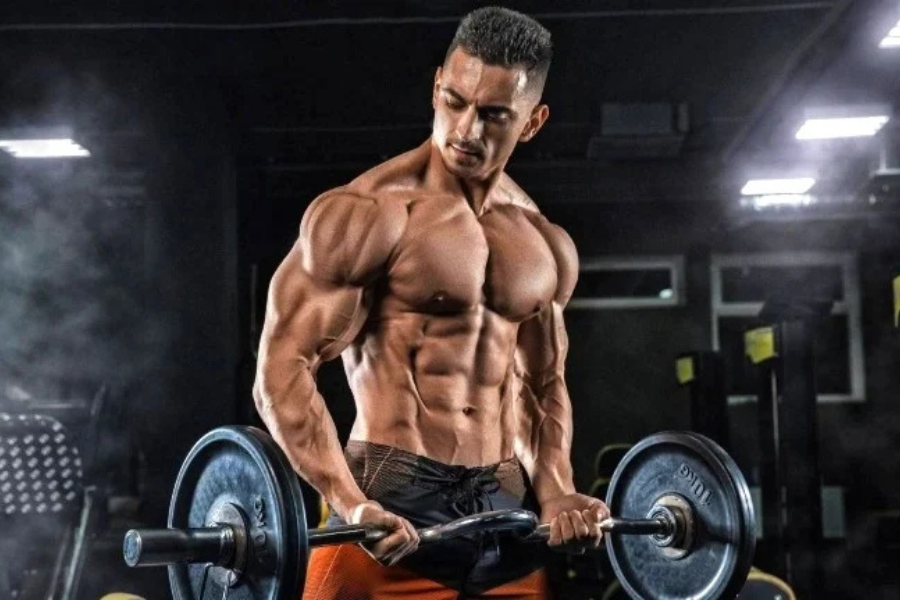
Barbell curls are a classic for building mass and strength.
- Stand tall with the barbell held at your thighs, palms up
- Keep your upper arms pinned to your sides
- Curl the bar toward your chest, squeeze at the top, and lower slowly
To maximize growth, focus on strict form and minimising elbow movement and body swing, especially on the last few reps of each set. Try 3 sets of 10 to 8 reps.
Single arm preacher curls
If you have an incline bench at home, you can set it up to mimic a preacher bench.
- Place the back of your upper arm along the inclined surface
- Start with your arm fully extended and a dumbbell in hand
- Curl up through a full range of motion, then lower until your arm is straight again
Because your arm is supported, this move isolates the short head of your biceps and helps you address any left to right strength differences. Perform 2 to 3 sets of 12 to 10 reps per arm.
Consider compact bicep machines for home gyms
If you have the space and budget, certain compact machines can make your home bicep workout more varied and joint friendly.
- Dedicated biceps curl machines, for example models like the PLS-0600, often offer multiple grip options such as narrow, wide, reverse, and one arm curls and use an offset pivot so you can set your preferred elbow position
- Preacher curl benches lock your upper arms in place, which helps isolate the biceps and reduce involvement from your shoulders and back
- Adjustable seat curl machines allow you to line up your elbows with the machine’s pivot point, which improves comfort and muscle activation
- Cable machines give you consistent resistance through the range of motion, and with different attachments you can perform standard curls, hammer curls, and high cable curls for variety
Even with these tools, dumbbells and barbells remain essential for many home lifters because they allow natural wrist movement and easy progression, and they support effective variations such as incline dumbbell curls.
Structure a weekly home bicep plan
For most people training at a beginner or early intermediate level, working your biceps 2 times per week is enough to see progress. You can train them on their own or pair them with back or full body days.
Here is a simple way to organize your week:
- Day 1, No equipment or bodyweight focused bicep workout
- Day 2, Rest or train other muscles
- Day 3, Household items and isometric bicep focus
- Day 4, Rest
- Day 5, Free weight or machine based bicep routine if you have the equipment
If you prefer, you can combine these into 2 sessions by doing bodyweight and household items together in one day, and free weight or machine work on another.
When you start, aim for 2 sets of each exercise. As you adapt, move up to 3 sets, and gradually push most sets close to failure. This progression helps you maintain or build biceps muscle mass even without a commercial gym.
Key takeaways for your at home bicep training
- You can build a challenging bicep workout at home with bodyweight, household items, or basic free weights
- Warming up with controlled movements prepares your muscles and joints and improves performance
- No equipment options like biceps push ups and door frame curls are effective if you train near failure
- Backpack curls, wide lifted bicep curls, and isometric belt curls turn everyday objects into training tools
- Classic movements such as seated dumbbell curls, standing barbell curls, and single arm preacher curls remain highly effective in a home setting
- Training 2 times per week and focusing on slow, controlled reps, especially on the lowering phase, will help you grow stronger, bigger arms over time
Pick two or three exercises you can perform today with what you already have at home, and build from there. Consistency matters far more than equipment, and your biceps will respond as long as you give them regular, focused work.
About the Author