Understanding bicep muscle anatomy is the difference between just “doing curls” and actually building stronger, fuller arms. When you know how your biceps are built and how they work, you can choose smarter exercises, avoid common injuries, and make better progress from the time you put in at the gym.
Below, you will walk through what your biceps look like under the skin, how they move your arm, what can go wrong, and how to train them for growth.
Get to know your bicep muscle anatomy
When you think of the bicep, you probably picture one big lump of muscle on the front of your upper arm. In reality, your biceps brachii is a large, thick muscle with two heads that work together.
The two heads of the biceps
The word “biceps” literally means “two heads.” You have:
- A long head that sits on the outer side of your upper arm
- A short head that sits on the inner side, closer to your body
Both heads start on your shoulder blade (scapula), then travel down the front of your arm and merge into a single muscle belly on the anterior side of the humerus. They finally attach to your forearm at the radial tuberosity and into the forearm fascia via the bicipital aponeurosis, so when the biceps contract, they pull on the radius bone rather than the upper arm itself. This structure is described in detail by sources such as Physiopedia.
You will also often hear about the “biceps tendon” as if it is one thing, but you actually rely on three main tendons that attach your biceps to bone. Any of these can be irritated or even torn if the load is too heavy or if you repeat the same motion too often.
Where the biceps sit in your arm
The biceps lie on the front of your upper arm between the shoulder and the elbow. They are part of the anterior compartment of the arm, where they sit on top of the brachialis and near the coracobrachialis. Together, these muscles create most of the size you see when you flex.
Along the inner side of the biceps runs the medial bicipital groove, which contains important structures like the brachial artery and the ulnar and median nerves. This is one reason good technique matters. Aggressive or sloppy movements around the elbow and shoulder can irritate not just muscle and tendon but also surrounding nerves.
How your biceps actually move your arm
You use your biceps for far more than flexing in the mirror. The biceps brachii cross two joints, the elbow and the shoulder, so they help with several key movements throughout your day.
Main functions at the elbow and forearm
At the elbow and forearm, your biceps are responsible for:
- Flexion of the elbow, bending your arm to bring your hand toward your shoulder
- Supination of the forearm, turning your palm upward, for example turning a doorknob or opening a jar
Supination is actually where your biceps are the most powerful, especially when your elbow is already bent to about 90 degrees. The muscle connects to the radius with a slight twist, about 90 degrees, which gives it excellent leverage to spin the forearm so your palm faces up, as described in current anatomy reviews from sources like Physiopedia and the medical literature.
What the biceps do at the shoulder
Since your biceps originate on the shoulder blade, they assist in movements at the shoulder too. The long head helps with shoulder abduction and inward rotation, while the short head contributes to shoulder adduction and flexion. Together, they help stabilize the shoulder during the first part of arm elevation, especially up to about 30 degrees.
Your biceps are not the prime movers for shoulder exercises in the way your deltoids or rotator cuff are, but they do add dynamic stability. This is one reason shoulder health and biceps health are closely tied.
Common biceps injuries and warning signs
Because your biceps are involved in so many daily tasks, and because they cross two joints, they are vulnerable to several types of strain and tendon issues.
Typical causes of biceps damage
Biceps muscle and tendon problems usually come from:
- Sudden injury, for example falling on your outstretched arm
- Lifting something heavy with poor control or form
- Overuse, particularly repetitive motions such as tennis, weightlifting, or manual labor
The risk of biceps tendon damage goes up with age as tendons naturally wear and weaken over time. Over many years, tiny microtears accumulate, and a single awkward lift can finally cause a noticeable tear or rupture.
Biceps tendinitis, tendon tears, or dislocations all fall under this umbrella of overuse and overload. In biceps tendinitis, for example, the tendon becomes inflamed and painful, often where it passes near the front of your shoulder along the bicipital groove, a region that is also closely related to the rotator cuff.
Shoulder versus elbow biceps tears
You can injure the biceps tendon at two main locations:
- At the shoulder, especially the long head of the biceps
- At the elbow, where the tendon attaches near the radius
A tear of the long head near the shoulder can create a noticeable bulge in the muscle belly closer to the elbow, often called a “Popeye” muscle. This happens because the tendon snaps back and the muscle bunches up in one spot.
Partial tears, either at the shoulder or elbow, often respond well to non surgical treatment. Rest, anti inflammatory strategies, and focused physiotherapy can let the tendon heal and relieve pain.
Complete ruptures at the elbow are different. These frequently require surgical repair if you want to restore full strength, especially if you are active or rely on your arms for work. Without repair, you may notice lasting weakness when you try to lift or rotate your forearm.
Tendon instability and dislocation
The long head of the biceps tendon normally sits snugly in a groove near the front of your shoulder. Injuries to the pulley system that holds it in place, often tied to rotator cuff tears, can allow this tendon to slip out of its groove. That movement is called dislocation or subluxation.
Tendon instability can feel like catching or snapping at the front of your shoulder when you move your arm, often combined with pain and weakness. Since the biceps tendon lies close to the rotator cuff, problems in one structure often go hand in hand with the other.
How biceps issues are diagnosed and treated
If you think you have more than simple post workout soreness, it helps to know what to expect when you see a medical professional and how typical treatment progresses.
What diagnosis usually involves
A clinician will usually start with:
- Your history. When the pain started, what you were doing, and what makes it worse.
- A physical exam. They will check range of motion, strength, pain with specific movements, and any visible swelling, bruising, or bulging.
Depending on what they find, they might suggest imaging. X rays do not show soft tissue details very well, but they help rule out fractures or other bone issues. An MRI can reveal the severity and exact location of a tendon tear or chronic degeneration.
Your biceps reflex may also be tested by lightly tapping the tendon near its insertion. The response gives information about nerve roots C5 and C6 through the musculocutaneous nerve.
First line treatment options
For many biceps injuries, particularly mild strains or partial tendon tears, initial treatment focuses on reducing pain and giving the tissue a chance to heal. That often includes:
- Rest and avoiding movements that cause sharp pain
- Anti inflammatory medications when appropriate
- Ice or other local measures to calm down irritation in the first days
- Physiotherapy exercises to restore strength and movement without overloading healing tissue
Some clinicians follow the POLICE approach in the first 48 to 72 hours after injury. This stands for protection, optimal loading, ice, compression, and elevation, a set of steps that helps manage early swelling while keeping some gentle movement as long as it is safe.
When surgery might be recommended
If more than half of a tendon is torn, or if shoulder pain stays high despite months of conservative treatment, surgery may be suggested. In the case of complete elbow biceps rupture, surgery is often the first recommendation for active people who want to regain near normal strength.
One common option for persistent long head tendon problems at the shoulder is biceps tenodesis. In this procedure, the damaged portion of the tendon is repaired or reattached, then secured in a new position on the arm bone. Recovery usually involves a period of immobilization followed by four to six weeks of progressive physical therapy, with many people returning to more strenuous activity around three months, depending on their specific case and medical guidance.
Training your biceps for balanced growth
Once you have a clear picture of how your biceps are built and how they move, you can plan smarter workouts. The goal is not just bigger biceps, but stronger, more resilient arms.
Choose exercises that match biceps function
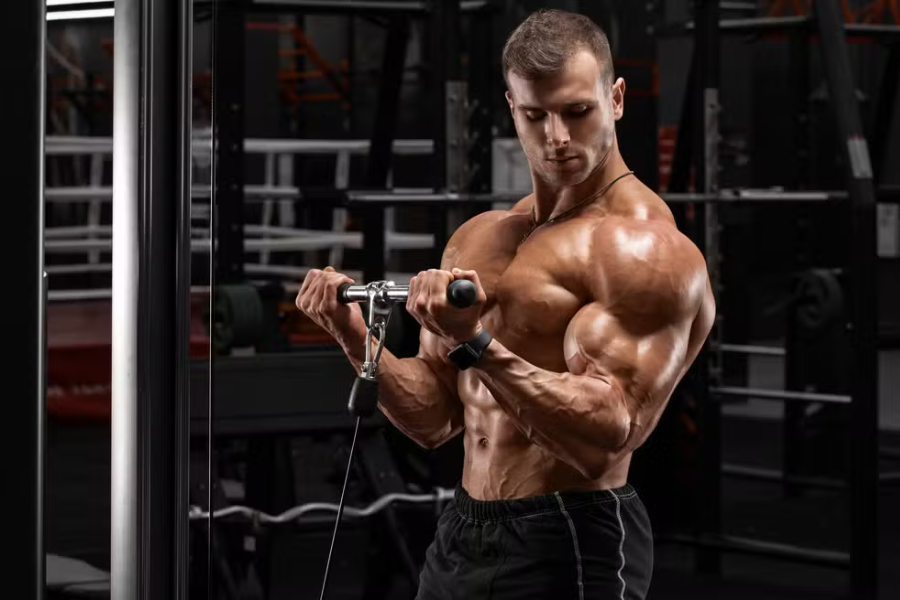
Since your biceps flex the elbow and supinate the forearm, your exercise selection should reflect that. Curls that keep your palms facing up through the movement directly challenge elbow flexion and supination. Variations that alter grip or arm position can shift emphasis slightly between the long and short heads.
For example:
- Standing or seated dumbbell curls with a supinated grip target both heads
- Incline dumbbell curls place more stretch on the long head
- Concentration curls emphasize peak contraction and can improve mind muscle connection
- Hammer curls, while involving the brachialis and brachioradialis more, still hit the biceps and support overall arm strength
Rows and pull ups also recruit the biceps, especially when you use an underhand grip. These compound movements train your back and biceps together and tend to support joint health because several muscles share the load.
Respect volume and recovery
Your biceps are not a huge muscle group, and they work indirectly on many upper body days. You do not need endless sets of curls to make progress. Instead, aim for a moderate number of quality sets, generally in the 8 to 15 rep range for hypertrophy, and focus on controlled motion.
Pay attention to:
- Smooth lifting and lowering, not swinging the weight
- Avoiding excessive shoulder movement to “cheat” the weight up
- Stopping a set when form fails, not after you feel a sharp pain
You also need rest days. Since your biceps assist in many pulling movements, training them hard the day before a heavy back workout can limit performance and increase injury risk. Rotating heavier and lighter sessions across the week lets your biceps adapt and grow.
Support your joints as well as your muscles
Because your biceps cross both the shoulder and the elbow, joint care should be part of your training plan. That includes:
- Warm up with light, pain free ranges of motion for the shoulder and elbow
- Strengthen surrounding muscles like the rotator cuff, rear delts, and forearm flexors
- Cycle your grip widths and curl variations to avoid repetitive stress in a single pattern
If you start to notice front shoulder pain, persistent elbow soreness, or a sense of catching or snapping with movement, back off heavy biceps work and consider a visit to a medical or rehab professional. Catching small issues early is much easier than pushing through until you have a tear that needs months of rehab or even surgery.
A simple rule of thumb: if your biceps hurt in everyday tasks, not just during a tough final set, treat that as a sign to slow down and get it checked out.
Putting your anatomy knowledge into practice
You now know that bicep muscle anatomy involves two heads working together, three key tendons attaching to bone, and a close relationship with nearby structures like the rotator cuff and major nerves. That structure allows powerful elbow flexion and forearm supination, but it also makes your biceps vulnerable to overuse, tendinitis, tears, and tendon dislocation if you overload them without enough care.
Use this understanding to choose exercises that match how your biceps actually function, to program enough recovery, and to notice red flags before they become serious injuries. With thoughtful training built around the way your body is designed, you give yourself the best chance at stronger, healthier, and better looking arms over the long term.
About the Author