A strong calf routine does more than build definition. The best exercises for calves help you walk, run, jump, and change direction with less effort and more control. With a few smart moves, you can strengthen your calves without turning every workout into a chore.
Below, you will find calf exercises that are effective, easy to learn, and simple to plug into your existing routine, whether you train at the gym or at home.
Understand your calf muscles
Before you dive into the best exercises for calves, it helps to know what you are actually training.
Your calf is mainly two muscles working together:
- Gastrocnemius: The larger, upper muscle that gives your calves their shape. It has more fast twitch fibers, so it powers explosive moves like sprinting and jumping. This is the muscle you target most when your knee is straight.
- Soleus: The deeper, lower muscle that supports posture and endurance. It is rich in slow twitch fibers, so it works hard during walking, standing, and long runs. You hit this muscle more when your knee is bent.
Both muscles connect to your heel through the Achilles tendon and help control your ankle. Because knee angle changes which muscle you use most, you get better results when you include both straight knee and bent knee calf exercises in your workouts.
Research also shows your calves are packed with slow twitch fibers. That means they respond well to higher reps with lighter loads, as long as you push close to fatigue. Heavy weights are optional, not essential.
Why strong calves matter
If you have ever finished a run with burning lower legs, or rolled an ankle during sports, your calves were part of the story.
Stronger calves help you to:
- Run and sprint better. Dynamic maximum calf strength is closely linked to faster short sprints and better change of direction in athletes.
- Jump higher and move quicker. Your gastrocnemius contributes to vertical jumps and quick pushes off the ground, which is helpful for sports like basketball or volleyball.
- Protect your ankles and shins. Well trained calves support ankle stability and can help reduce the risk of ankle sprains, shin splints, and other overuse issues when combined with good stretching and mobility work.
- Handle daily life with less fatigue. Walking, climbing stairs, and standing for long periods all rely heavily on calf strength and endurance.
In short, you use your calves more than you realize. Training them directly pays off both in the gym and in everyday movement.
How to train calves for growth and strength
To get the most out of the best exercises for calves, keep a few principles in mind.
Train with enough volume
Because calf muscles are endurance focused, they often need more total repetitions to grow. A common sweet spot is:
- 2 to 3 sessions per week
- 3 to 5 sets per exercise
- 12 to 25 reps per set, sometimes more for bodyweight moves
You can make lighter loads just as effective as heavier ones if you work close to muscular fatigue. The important factor is effort.
Use different knee angles
You will see this theme often:
- Straight knee exercises focus more on the gastrocnemius.
- Bent knee exercises focus more on the soleus.
Include both in your weekly routine so your calves grow evenly and support your ankles properly.
Vary your foot position
Foot angle subtly changes which part of your gastrocnemius works hardest:
- Toes forward train both heads fairly evenly.
- Toes turned out emphasize the inner (medial) head.
- Toes turned in emphasize the outer (lateral) head.
A 2020 study on foot positioning supports rotating through these angles to maximize development. You can apply this by changing foot angle every set.
Best exercises for calves
These are some of the best, research backed calf exercises you can use to build strength, size, and endurance, without making your workouts feel repetitive.
1. Standing calf raises (straight knee)
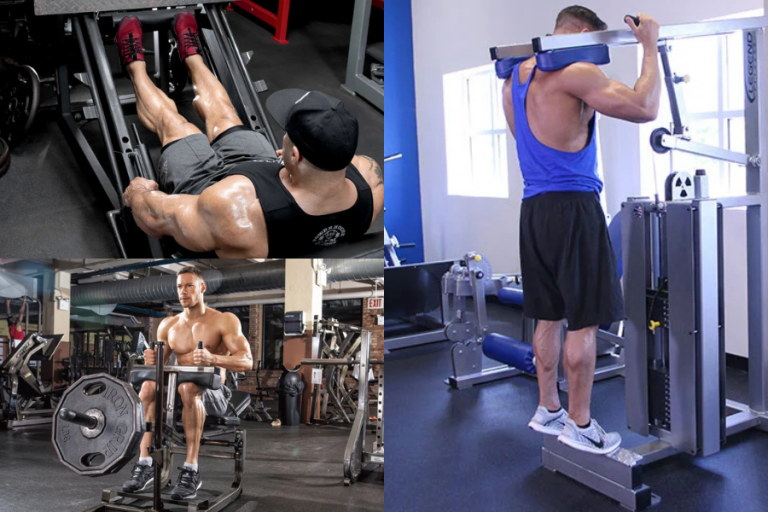
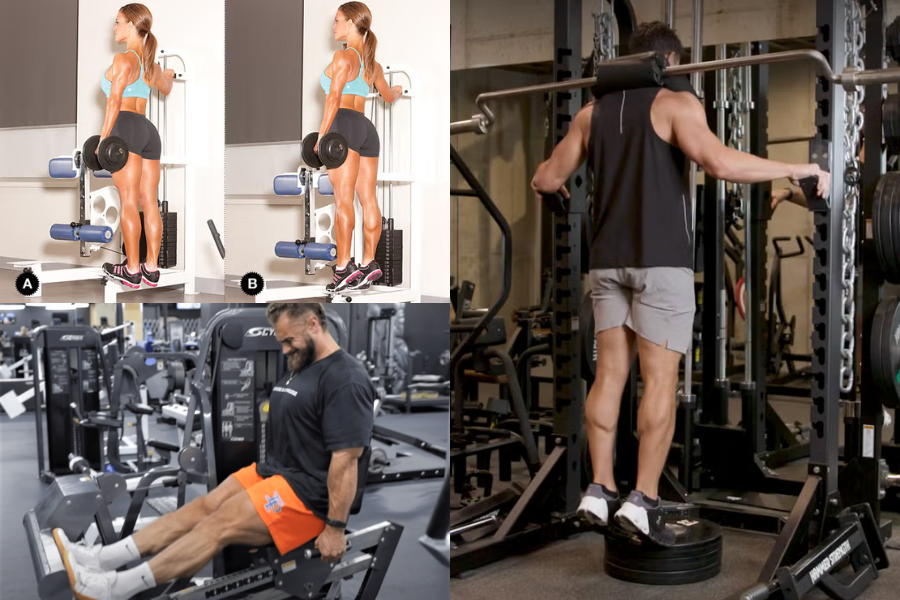
Standing calf raises are one of the simplest and best exercises for calves. They mainly target the gastrocnemius.
How to do them
- Stand tall with feet hip width apart, knees straight but not locked.
- Press through the balls of your feet to lift your heels as high as you can.
- Pause for a brief squeeze at the top.
- Lower your heels slowly until they are just below the level of your toes if you are on a step, or back to the floor.
According to Surrey Physio, you can start with 20 to 30 repetitions, twice per day, using just your bodyweight, then progress gradually.
Ways to progress
- Hold dumbbells or use a barbell on your back.
- Move to a single leg version.
- Add a small pause at the bottom for more control.
2. Single leg calf raises
Single leg calf raises build strength, balance, and ankle stability, and they highlight any strength differences between legs.
How to do them
- Stand on one leg, with the other leg slightly bent and off the floor.
- Hold onto a wall or chair for balance if needed.
- Lift your heel as high as you can on your standing leg.
- Lower slowly and repeat for all reps before switching sides.
Surrey Physio recommends 20 to 30 repetitions per leg, twice a day for strength and control.
Once bodyweight feels easy, you can hold a dumbbell in the hand on the same side as your working leg or stand on a step so you can lower your heel below your toes.
3. Seated calf raises (bent knee)
Seated calf raises emphasize your soleus muscle, which is important for posture and long term endurance.
How to do them
- Sit on a bench or sturdy chair with knees bent at about 90 degrees.
- Place your feet flat on the floor, hip width apart.
- Raise your heels as high as possible, keeping your toes and the balls of your feet on the ground.
- Lower slowly until your heels lightly touch the floor.
You can make this harder by placing a weight, such as a dumbbell or weight plate, across your thighs. Surrey Physio suggests 20 to 30 repetitions, twice daily for a solid stimulus.
If you have access to a seated calf raise machine, use it in the same way, focusing on full range of motion and a controlled tempo.
4. Bent knee calf raises
You can also train the soleus with a simple bent knee standing variation.
How to do them
- Stand with your knees slightly bent, as if you were about to start a small squat.
- Maintain that gentle bend while you raise your heels off the ground.
- Squeeze at the top, then lower with control.
This variation uses the same progressions as straight knee raises. You can:
- Increase reps and sets.
- Add weights.
- Perform it on one leg at a time for an extra challenge.
Research suggests including both straight and bent knee calf raises is key if you want complete calf development.
5. Step ups
Step ups are a great way to work your calves plus your glutes and quads at the same time. They train real world movements like climbing stairs.
How to do them
- Stand facing a sturdy step, box, or low bench.
- Place one foot on the step with your whole foot supported.
- Drive through the heel and ball of your front foot to stand tall on the step.
- Slowly lower yourself back down with control.
To target your calves more, focus on pushing through the ball of your front foot as you rise. Surrey Physio recommends 10 to 15 repetitions per leg, twice per day.
You can increase difficulty by raising the height of the box or holding dumbbells.
6. Plyometric calf step ups
If your joints are healthy and you are comfortable with impact, plyometric calf step ups add a power element and help with speed and agility.
How to do them
- Stand facing a bench or box.
- Place one foot lightly on top.
- Drive explosively through the front leg, lifting your body and bringing the opposite knee up.
- Land softly back on the ground and repeat on the same side, or alternate legs.
These should be quick but controlled. Surrey Physio suggests 10 to 15 repetitions per leg, twice daily, which is plenty because of the higher impact.
If you are new to plyometrics, keep the bench low and the movement small to protect your joints.
7. Hopping drills
Hopping is essentially a series of explosive single leg calf raises and it closely mimics the demands of running.
How to do them
- Stand on one leg with a slight bend in the knee.
- Hop lightly forward, backward, or side to side, using your calf to spring off the ground.
- Aim for soft, quiet landings with as little ground contact time as possible.
You can increase intensity by:
- Hopping faster.
- Hopping higher.
- Covering more distance.
- Adding obstacles to hop over.
Because these drills can be taxing, start with small sets and focus on quality. They pair well with quickness drills and lateral movement work as suggested in functional programs that include exercises like One Leg Over the Line and 3 Hurdle Drills.
8. Tiptoe farmers carry
The tiptoe farmers carry trains your calves in a functional, full body way. Your calves must work continuously to keep you on your toes while your grip and core stabilize the weights.
How to do them
- Hold a dumbbell or kettlebell in each hand at your sides.
- Rise onto the balls of your feet.
- Walk forward slowly while staying as tall as possible.
- Lower your heels to rest, then repeat for another round.
You can measure the exercise by time or distance. For example, walk for 20 to 40 seconds, rest, then repeat for 3 to 4 rounds. This move is one of the top five exercises identified for calf strength and growth when used in a high volume program.
9. Squats into calf raises
This hybrid move lets you sneak extra calf work into a leg day without adding a separate exercise.
How to do them
- Stand with feet about shoulder width apart.
- Perform a regular bodyweight squat, keeping your heels on the ground.
- As you stand back up, continue rising until you are on your tiptoes in a calf raise.
- Lower your heels, then go straight into the next squat.
You can hold dumbbells for more resistance or use just your bodyweight for higher rep sets. This exercise appears in several research based programs as one of the most effective combined moves for calf growth when done consistently 2 to 3 times per week.
Sample calf focused mini workout
To put the best exercises for calves together, try this simple routine 2 or 3 times per week. Perform it at the end of your usual workout.
- Standing calf raises
3 sets of 15 to 20 reps, toes forward - Seated calf raises
3 sets of 15 to 25 reps, with moderate weight or bodyweight - Single leg calf raises
2 sets of 12 to 15 reps per leg, on a step if available - Tiptoe farmers carry
3 rounds of 20 to 30 seconds walking
On a second day that week, you can rotate in step ups, hopping drills, or squats into calf raises for variety.
Finish with basic calf stretches and ankle mobility. For example, a standing calf stretch or a bent knee calf and ankle stretch, 2 sets of 10 controlled reps on each side, can help maintain flexibility and support recovery.
Make your calf training enjoyable
Calf workouts do not have to feel like an afterthought tacked onto the end of leg day.
You can keep them enjoyable by:
- Mixing classic strength moves like standing and seated raises with more dynamic drills like step ups or hops.
- Playing with foot angles and tempos so sets feel different even when the exercise is the same.
- Tracking small wins, such as being able to do more single leg reps or carrying heavier weights on tiptoes.
Choose two or three of the best exercises for calves from this guide and add them to your next workout. With a little consistency, you will notice stronger push offs, steadier ankles, and calves that finally feel like they are pulling their weight.
About the Author