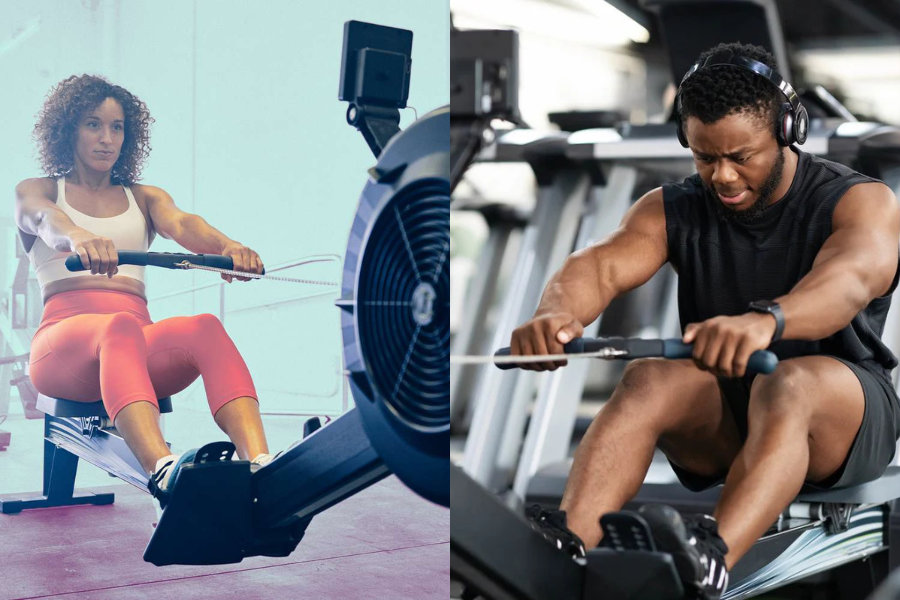
A rowing machine can look simple, but it is one of the most powerful tools you can use to burn fat, improve your cardio fitness, and build full‑body strength. When you add rowing machine interval training to your routine, you get those results in less time while keeping impact on your joints low.
This guide walks you through what intervals are, why they work so well on a rower, and exactly how to structure beginner and intermediate workouts for weight loss and general health.
Why rowing machine interval training works
Rowing already engages most of your body. With each stroke you use your legs, glutes, core, back, and arms. Estimates suggest the rowing stroke recruits around 86 percent of your muscles, which significantly raises cardiovascular and metabolic demand during your workout (Marathon Handbook).
When you pair that full‑body effort with interval training, you get several advantages.
Time efficient cardio
High intensity intervals on the rower raise your heart rate to at least 85 percent of your maximum during the hard segments. This gives you similar or greater benefits compared to moderate steady cardio in roughly 60 percent of the time (Marathon Handbook, RP3 Rowing). A focused 20 minute interval session can match or beat a 45 minute steady row in terms of cardiovascular and muscular endurance gains.
If you are busy, this time savings is one of the biggest reasons to choose rowing intervals over long, slow sessions.
Higher calorie burn and “afterburn”
Because so many muscles are working at once, rowing already burns more calories than many machine based exercises at the same perceived effort (Garage Gym Reviews). Intervals take this up a notch.
Research cited by rowing coaches suggests that high intensity rowing can keep your metabolic rate elevated for up to 14 hours after you finish, so you continue to burn extra calories long after you step off the machine (Marathon Handbook).
A typical 30 minute moderate intensity row burns roughly 200 to 300 calories, with higher values, around 400, for larger bodies, which makes rowing a practical tool for fat loss when combined with a calorie controlled diet (Rowing Machine Workouts).
Joint friendly but challenging
Rowing intervals give you high cardiovascular and muscular demand with very little impact on your ankles, knees, and hips. That makes them especially useful if you want to lose weight but find running uncomfortable. At the same time, both your upper and lower body are working hard, so the workout still feels intense and satisfying (Garage Gym Reviews).
Understanding effort, stroke rate, and resistance
Before you jump into rowing machine interval training, it helps to understand three variables you will adjust: effort level, stroke rate, and resistance.
Effort level
You can think of effort as how hard the work feels, similar to a 1 to 10 scale.
- Easy: You can talk in full sentences comfortably, usually under about 55 percent effort
- Moderate: You can say short phrases but not hold a long conversation
- Hard: Talking is difficult, especially above about 80 percent effort, you might manage a word or two at a time (Garage Gym Reviews)
For weight loss and fitness, your intervals will usually alternate between moderate and hard zones, while your warm up and cool down stay easy.
Stroke rate
Stroke rate is the number of complete strokes you take each minute. One full cycle includes the catch, drive, finish, and recovery. Beginner interval workouts often keep you between 20 and 26 strokes per minute to balance intensity and technique (Rowing Machine Workouts).
As a simple rule:
- Lower stroke rate with more power per stroke is better than frantic, fast strokes with weak drive
- During hard intervals you might aim for roughly 24 to 28 strokes per minute
- During easy rowing you can drop to around 18 to 22 strokes per minute
Resistance and damper setting
If you are on a machine with a damper, such as a Concept2, a middle setting between 3 and 5 usually works best for interval training. This range mimics the feel of rowing on water without causing unnecessary fatigue or poor form (The Fitness Outlet).
You should feel resistance, but you should not have to strain or jerk the handle to start the flywheel each stroke.
How rowing intervals help with weight loss
If your main goal is to lose weight and improve health, rowing machine interval training helps in three key ways.
First, intervals are very effective at creating a calorie deficit. You burn a substantial amount of energy during the workout itself and continue burning extra calories during recovery due to the afterburn effect (Marathon Handbook).
Second, rowing engages your large leg muscles along with your back and arms. This blend of strength and cardio encourages muscle maintenance or even growth while you are losing fat, which keeps your metabolism healthier over time (The Fitness Outlet).
Third, interval style rowing may help improve factors related to metabolic health. Alternating higher and lower intensity periods has been linked to better cardiovascular fitness and may support improvements in insulin resistance, based on a 2021 study discussed in rowing interval training guides (Garage Gym Reviews).
To get the best fat loss results, you still need a reasonable eating plan. The most effective routines combine rowing intervals with a calorie controlled diet and enough rest days for recovery (Rowing Machine Workouts).
Beginner friendly rowing interval workout
If you are new to rowing machine interval training or coming back after a long break, start with simple structure and focus on form. Even a 10 minute interval session can feel demanding because rowing uses muscles you may not usually engage in other cardio workouts (Marathon Handbook).
20 minute introductory interval session
This beginner workout teaches you how to manage intensity while keeping the joints happy and technique safe (The Fitness Outlet).
-
Warm up, 5 minutes
Row at an easy pace. Aim for 18 to 22 strokes per minute. You should breathe deeper than at rest but still talk comfortably. -
Main set, about 12 to 15 minutes
Repeat 8 to 10 times:
- 30 seconds hard rowing at 24 to 26 strokes per minute, around 80 percent effort
- 90 seconds light rowing at an easy intensity, focus on smooth strokes and recovery
- Cool down, 3 to 5 minutes
Row very gently, gradually lowering your heart rate. Then step off and stretch your legs, hips, and upper back.
If this feels overwhelming at first, cut the number of intervals in half and build up over a few sessions. You can also start with only 2 to 3 rounds and progress toward 8 to 10 as your endurance improves.
15 minute “pyramid” beginner workout
Once you are comfortable with the basic 30/90 pattern, try a short pyramid structure that gradually climbs and then eases effort (Garage Gym Reviews).
- 5 minutes easy warm up
- 30 seconds at 60 percent effort, 60 seconds moderate
- 30 seconds at 70 percent effort, 60 seconds moderate
- 30 seconds at 80 percent effort, 60 seconds moderate
- 30 seconds at 70 percent effort, 60 seconds moderate
- 30 seconds at 60 percent effort, 60 seconds moderate
- Finish with 3 minutes easy cool down
This style builds your ability to handle higher intensities without keeping you at the top end for very long.
Intermediate and advanced interval options
As your fitness grows, you can add variety by changing distance, time, or including simple strength moves between rowing bouts. This keeps workouts interesting and drives further progress.
Classic 500 meter repeats
For a straightforward but challenging option, try 500 meter intervals (The Fitness Outlet).
- Warm up for 5 to 8 minutes
- Row 500 meters at a strong but sustainable race pace
- Follow with 2 minutes of very light rowing
- Repeat 5 to 6 times
- Cool down 5 minutes
Over time you can track your average split time for the 500 meter intervals to see progress.
Fartlek “speed play” rowing
Fartlek, or speed play, involves mixing different intensities and durations more freely. A sample session might look like this (Garage Gym Reviews):
- 5 minutes easy warm up
- 2 minutes moderate, 1 minute hard
- 3 minutes easy
- 90 seconds hard, 90 seconds easy
- 4 minutes moderate
- 1 minute very hard, 2 minutes easy
- 5 minutes cool down
You can vary stroke rate and resistance from set to set to make the workout more engaging while still alternating higher and lower intensity blocks.
Strength focused rowing intervals
To combine strength and cardio in one workout, add bodyweight exercises between rowing pieces. This keeps your heart rate elevated and trains muscles in different ways (RP3 Rowing, Garage Gym Reviews).
For example:
- Row 250 meters at a challenging pace
- Step off and do 10 to 15 squats or push ups
- Rest briefly if needed, then repeat 6 to 8 times
You can also follow structured routines like a “Cardio Insanity” style circuit, which alternates segments of rowing with exercises such as planks or lunges. The key is to avoid treating the transition between exercises as a rest period so your workout stays effective (Garage Gym Reviews).
How often to do rowing intervals
For most people, 20 to 30 minute rowing interval sessions, including warm up and cool down, are enough to see progress without overloading the body (Garage Gym Reviews). A practical schedule is:
- Row 4 to 5 days per week, around 30 minutes per session, including intervals and easier days
- Avoid intense rowing on back to back days if you are new to intervals
- Cap total workout days at about 6 per week, with at least one full rest day
Some weight loss routines build around 4 rowing workouts per week, mixing high intensity days, medium interval days, and longer steady rows. This variety keeps calorie burn high without constantly increasing intensity (Rowing Machine Workouts).
Recovery is just as important as the work itself. At least three rest or light activity days each week help prevent overtraining, allow muscles to repair, and keep stress hormones like cortisol from staying chronically high, which could slow fat loss (Rowing Machine Workouts).
If your resting heart rate is not coming down between days, or you feel unusually sore and tired, reduce interval volume or intensity until you feel recovered.
Tracking your rowing progress
You do not need advanced gadgets to see improvements, but a little tracking helps you stay motivated and adjust your training.
Useful markers to watch include (RP3 Rowing):
- Split time for 500 meters during similar workouts
- Total distance rowed in a fixed time, such as 20 minutes
- How quickly your heart rate drops in the first 1 to 2 minutes after a hard interval
- Your perceived exertion for the same pace or stroke rate over time
If your splits are getting faster at the same effort, or if a once tough workout feels easier, you are moving in the right direction.
Putting it all together
Rowing machine interval training gives you a powerful blend of calorie burn, cardiovascular improvement, and full body strength in a compact time frame. By starting with manageable intervals, focusing on smooth form, and gradually layering in complexity, you can use the rower to support weight loss and overall health without pounding your joints.
Begin with one of the beginner workouts in this guide during your next gym visit. After a few weeks, experiment with 500 meter repeats or strength infused intervals. Adjust based on how your body feels, keep an eye on your progress markers, and allow enough recovery.
With consistent practice, the simple act of sliding back and forth on the rail becomes one of the most efficient tools in your entire fitness routine.
About the Author