A strong set of quads does much more than fill out your jeans. When you focus on the best quadricep exercises, you support your knees, improve balance, and power everyday movements like climbing stairs, standing up, and sprinting for the bus.
This guide walks you through what your quads do, the best exercises to train them, and how to put it all together into a simple leg workout you can actually stick with.
Understand your quadriceps
Your quadriceps sit on the front of your thighs and are made up of four muscles that work together to straighten your knee and help flex your hip.
Those four muscles are:
- Rectus femoris, helps flex your hips and extend your knee
- Vastus lateralis, the largest muscle on the outside of your thigh
- Vastus medialis, the teardrop-shaped muscle near the inside of your knee that helps stabilize the joint
- Vastus intermedius, sits deep between the others and helps extend the knee
When these muscles are strong and balanced, they help stabilize your knees and can lower your risk of injuries such as ACL or meniscus tears, as exercise physiologist Karen Feakes explains in guidance cited by the Cleveland Clinic. Strong quads also play a big role in fall prevention and overall balance.
Why quad strength matters
You use your quads far more often than you probably realize. Every time you:
- Stand up from a chair
- Walk, run, or jump
- Go up or down stairs
- Squat to pick something up
your quadriceps are doing a lot of the heavy lifting.
The Cleveland Clinic notes that quad strength is essential for daily activities like standing up from a seated position, sprinting, and jumping, and that it is also important for protecting your knees and supporting mobility as you age. Training them on purpose simply builds on what they already do for you all day long.
If your quads are weak compared to your hamstrings and glutes, your knees can feel wobbly and you might notice discomfort climbing stairs, squatting, or landing from a jump. The right exercises help you build strength, size, and control so your legs feel more powerful and more stable.
Best quadricep exercises for every level
You do not need an advanced lifting background to start building strong quads. Below you will find the best quadricep exercises arranged from simple bodyweight moves to more advanced barbell and machine work. You can mix and match based on your current fitness level and what equipment you have.
1. Bodyweight squats
Bodyweight squats are one of the best overall exercises to strengthen your quadriceps, along with your hamstrings, glutes, core, and spinal erectors, and you can do them almost anywhere without equipment. The Cleveland Clinic specifically lists air squats as a top quadriceps move for building everyday strength.
To do them, stand with your feet about hip to shoulder width apart, toes slightly turned out. Sit your hips back and bend your knees, as if you are lowering into a chair, keeping your chest tall and your heels on the floor. Go as low as you can without pain or your heels lifting, then drive through your midfoot and heels to stand back up.
If you are a beginner, start with smaller ranges of motion and gradually work lower as your strength and mobility improve. Think about tracking your knees in line with your toes, not letting them collapse inward.
2. Sit to stand
The sit to stand exercise is exactly what it sounds like, and it closely mimics one of the most common daily quad tasks. The Cleveland Clinic includes it among its recommended quad moves because it is accessible and easy to scale.
Sit on a sturdy chair with your feet under your knees. Lean slightly forward from your hips, press your feet into the floor, and stand up without using your hands, then slowly sit back down with control. If this is easy, use a lower chair or lightly hold a dumbbell at your chest to increase the challenge.
This move is especially useful if you are just starting out, rehabbing, or returning after time off. It helps you build functional strength that translates directly to getting up from sofas, car seats, and benches.
3. Forward lunges and walking lunges
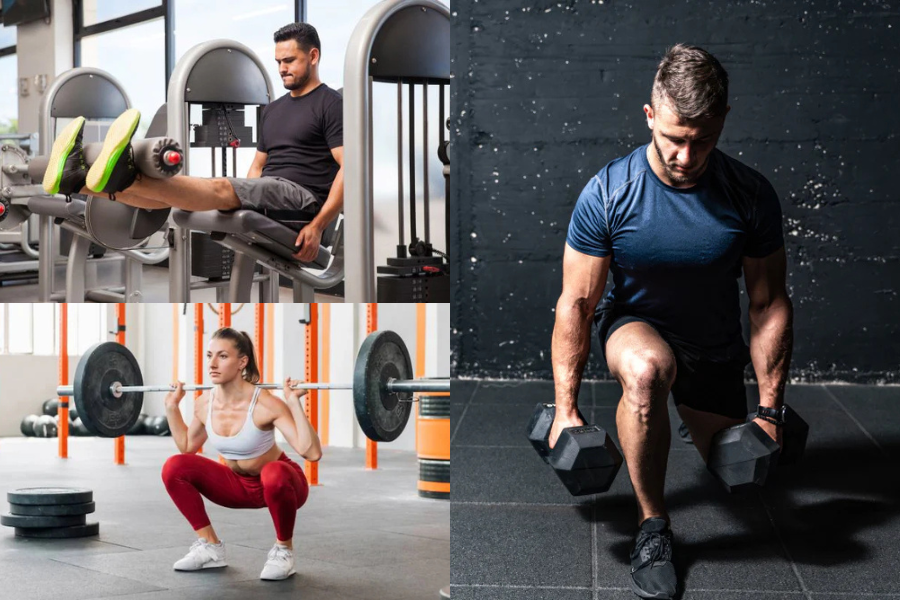
Lunges are a powerful quad builder because they work one leg at a time. Forward lunges, and their cousin, walking lunges, target your quadriceps while also challenging your hamstrings, glutes, and core for stability.
To perform a forward lunge, stand tall, then step one foot forward and bend both knees until your front thigh is roughly parallel to the floor. Your back knee should hover just above the ground. Push through your front foot to return to the starting position. Alternate legs.
Walking lunges use the same motion, but instead of stepping back to the start, you bring your back leg forward into the next lunge so you move across the room.
If full lunges feel uncomfortable, you can lunge only halfway down. To make them harder, hold dumbbells by your sides.
4. Bulgarian split squats
Bulgarian split squats are a favorite for building serious quad strength and size while also improving balance and coordination. They place a lot of tension on the front leg quads, and they encourage the smaller stabilizing muscles around your knee and hip to work hard.
Stand about two feet in front of a bench or sturdy chair and rest the top of one foot on it behind you. With your torso upright, bend your front knee and lower your hips straight down, then press through your front foot to stand back up. Keep most of your weight on the front leg.
If you shorten your stance slightly and stay more upright, you will feel more load in the quads. You can reduce the depth to halfway down to make it more approachable, or add dumbbells for extra intensity.
5. Step ups
Step ups train your quads one leg at a time and mimic climbing stairs. The Cleveland Clinic recommends step ups as an effective quadriceps exercise for building strength that transfers directly to everyday tasks.
Place one foot on a sturdy step or bench. Drive through your front foot to raise your body up until your front leg is straight. Slowly lower back down, keeping your weight over the working leg and your knee in line with your toes. Once you complete all your reps, switch legs.
To make this easier, use a lower step and hold onto a railing or wall for balance. To make it tougher, choose a higher step or hold dumbbells.
6. Front squats
Front squats are one of the best barbell exercises to emphasize your quads. By holding the bar in front of your body rather than on your upper back, you keep a more upright torso and increase the demand on your quadriceps.
Stand with your feet about shoulder width apart and rest the barbell across the front of your shoulders. Your elbows should point forward and your upper arms should be parallel to the floor. Squat down, keeping your chest tall and your knees tracking over your toes, then stand back up.
Because front squats challenge your posture and core, it is smart to start with a lighter weight and prioritize technique. As the Gymshark guide notes, front squats encourage more knee flexion and less hip involvement, which is ideal for quad growth when you control the load and range of motion.
7. Heel elevated goblet squats
If you want to really light up your quads without a barbell, heel elevated goblet squats are a great option. Elevating your heels slightly on small weight plates or a wedge shifts more of the work to the front of your thighs.
Hold a dumbbell or kettlebell at your chest, place your heels on a small lift, and your toes on the floor. Squat down as upright as you comfortably can, allowing your knees to travel forward over your toes. Press through your midfoot and forefoot to stand up.
The Gymshark quad training guide highlights heel elevated goblet squats as one of the most effective ways to increase knee extension demand while reducing hip dominance, which boosts quad activation when done with good form and appropriate weight.
8. Hack squats and leg press
If you have access to a gym, hack squat machines and leg presses let you load your quads heavily while your torso is supported.
On a hack squat machine, you place your shoulders under the pads and stand with your feet on the platform. By keeping your body more upright and placing your feet slightly lower on the platform, you emphasize knee drive and quad engagement. Gymshark notes that a lower foot placement and upright body position help maximize quad involvement, as long as you avoid rounding your lower back at the bottom of the movement.
On a leg press, sit with your back supported and place your feet on the platform. A lower, slightly narrower stance tends to hit the quads harder. Press the weight away by straightening your legs, then lower back with control, stopping before your lower back lifts off the pad.
Both machines are useful for building strength and size, especially when you are already tired from free weight work and want support.
9. Leg extensions
Leg extensions are the classic isolation move for quads, and for good reason. The leg extension machine lets you focus almost entirely on straightening the knee, with the rest of your body supported. That means you can target your quadriceps very directly without as much overall fatigue.
Sit on the machine with your knees aligned with the pivot point and the pad just above your ankles. Extend your legs until they are almost straight, squeeze your quads for a second, then lower the weight under control.
According to the Gymshark article, leg extensions are uniquely effective at maximizing quad activation, and they are especially useful for techniques such as single leg work or isometric holds at the top to further stimulate growth, while still allowing a relatively high training frequency.
How to increase intensity safely
Once the basic movements feel comfortable, you can gradually make your quad workouts more challenging. The Cleveland Clinic suggests adding resistance like dumbbells, ankle weights, or resistance bands, or using machines like the leg extension, to progress your exercises, as long as overall exertion stays at a moderate level and does not cause pain or overload.
You can also play with:
- Range of motion, going a little deeper in squats and lunges if your joints tolerate it
- Tempo, slowing down the lowering phase to create more time under tension
- Unilateral work, focusing on one leg at a time to correct imbalances
Pay attention to how your knees feel. Soreness in the muscles is normal, sharp or pinching pain in the joint is a sign to stop and adjust.
If you have existing knee issues or other medical conditions, it is a good idea to check with your healthcare provider before starting a new leg routine, and to work with a qualified trainer if you need help dialing in your form.
Build a simple quad focused workout
You do not need a complicated plan to see results. For general quad development and strength, many coaches recommend training your quads about twice per week, with at least two quad focused exercises per session and a total volume of around 10 or more working sets per week in the 8 to 12 rep range.
Here is a sample beginner friendly workout you can adjust to your level:
- Bodyweight or goblet squats, 3 sets of 8 to 12 reps
- Forward or walking lunges, 3 sets of 6 to 10 steps per leg
- Step ups or Bulgarian split squats, 2 to 3 sets of 8 to 10 reps per leg
- Leg extensions (if available), 2 to 3 sets of 10 to 15 reps
Rest about 60 to 90 seconds between sets. If you are brand new, you can start with fewer sets and longer rests, and build up gradually.
On a second leg day later in the week, you might rotate in front squats, heel elevated goblet squats, hack squats, or leg press, keeping at least one unilateral exercise and one machine or isolation exercise to cover your bases.
When to get extra guidance
If you are unsure about your form, have knee pain already, or have very specific goals like returning to sport, it is smart to get an expert set of eyes. The Cleveland Clinic suggests asking a fitness professional to help you choose and perform quad exercises correctly, and always clearing new routines with your healthcare provider if you have health concerns.
Even a single session with a personal trainer can help you learn proper squatting and lunging mechanics so your quads take the load and your knees stay happy.
Start by choosing two or three of the best quadricep exercises listed here that match your current level and equipment. Try them in your next leg day, focus on smooth, controlled reps, and notice how your legs feel stronger and more stable over the coming weeks.
About the Author