A strong pair of quads does much more than fill out your shorts. Effective quadricep workouts help you lift heavier, protect your knees, move better in daily life, and build a more balanced physique. With the right exercises and technique, you can transform your legs faster than you might think, without living in the gym.
Below, you will learn how your quadriceps work, what actually drives growth, and which quad exercises deserve a permanent spot in your routine, whether you train at home or in a gym.
Understand your quadriceps muscles
Before you load up the bar, it helps to know what you are trying to train. Your quadriceps are a group of four muscles on the front of your thigh that work together to extend your knee and, in one case, flex your hip.
The four key muscles are:
- Rectus femoris, crosses both the hip and knee, helps flex the hip and extend the knee
- Vastus lateralis, the largest muscle on the outer thigh that gives your legs width
- Vastus medialis, the inner “teardrop” muscle that helps straighten and stabilize the knee
- Vastus intermedius, sits deep between lateralis and medialis and assists with knee extension
Balanced quadricep workouts target all four. That is why you need a mix of compound lifts, like squats and lunges, plus isolation moves like leg extensions, rather than relying on a single exercise.
Why quadricep workouts matter
You use your quads every time you sit, stand, climb stairs, or pick something up from the floor. When you train them properly, you feel the difference almost everywhere.
Strength, performance, and aesthetics
Strong quadriceps improve performance in squats, deadlifts, and other big lifts because they help you drive out of the bottom position. They are also central to sprinting, jumping, and quick changes of direction.
Well developed quads contribute to a balanced, athletic look. They help your lower body match the strength and size of your upper body, which is crucial if you care about symmetry and overall physique.
Joint health and everyday movement
Research cited by Healthline notes that strengthening and toning your quads can improve knee stability, reduce the risk of knee injuries, and make day to day movements easier. This is especially important if you are prone to knee discomfort or spend long hours sitting.
Stronger quadriceps also support the tendons, ligaments, and bones in your lower body, which can reduce injury risk and improve functional movement as you age.
Key training principles for fast quad growth
You do not need an advanced program to build impressive quads. You do need to follow a few simple rules consistently.
Use a full range of motion
One of the biggest mistakes people make in quadricep workouts is cutting the range of motion short. Half squats and shallow leg presses let you move more weight, but they limit muscle growth because the quads never work through their full stretch and contraction.
Focus on:
- Squats that reach at least to thighs parallel to the floor, unless pain or a medical condition limits depth
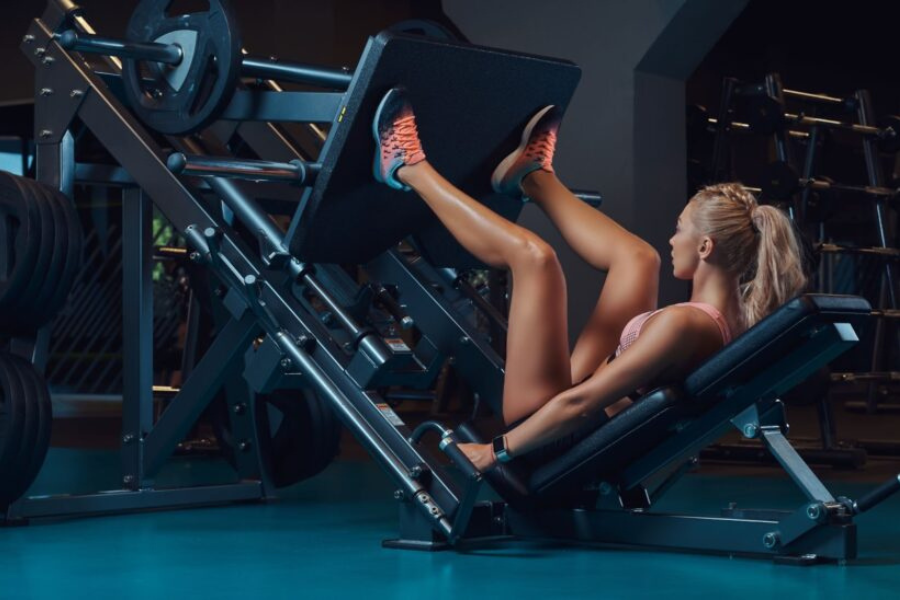
- Leg presses that bring your knees close to your chest without your hips lifting off the pad
- Lunges and split squats where the back knee lowers close to the floor
Your goal is control, not ego lifting. If you have to bounce or lose your form, the weight is too heavy.
Aim for effective sets and smart volume
For muscle growth, most of your working sets should land in the 8 to 12 rep range. This is heavy enough to challenge strength, but high enough to build volume and time under tension.
A practical guideline is:
- At least 2 quad exercises per workout
- Around 3 sets per exercise
- A total of 10 or more hard sets per week for quads
Research summarized by Gymshark suggests that working quads twice a week with a minimum of 10 sets per week is an effective strategy for hypertrophy. Going far beyond 12 to 20 sets can give you diminishing returns if intensity or recovery suffer.
Train close to muscular failure
For your quads to grow, your sets need to be challenging. Finish most working sets with 1 or 2 reps left in the tank, and occasionally take isolation exercises like leg extensions all the way to failure.
Compound lifts like squats and lunges are more demanding on your joints and nervous system, so you can stop those sets slightly further from failure while still progressing.
Master quad focused squat variations
Squats are the backbone of powerful quadricep workouts. Small changes in stance, torso position, and heel elevation can shift more of the load onto your quads and less onto your hips and lower back.
Front squats
Front squats place the bar across the front of your shoulders instead of your back. This naturally keeps your torso more upright and shifts the center of gravity forward, which increases quad involvement.
Form cues:
- Stand with feet about hip to shoulder width
- Keep your chest up and elbows high throughout the movement
- Sit straight down between your hips rather than pushing far back
- Drive your knees in line with your toes as you stand up
Because the bar is in front, you will usually use less weight than on back squats, but your quads will feel more direct tension.
Heels elevated goblet squats
Goblet squats, where you hold a dumbbell or kettlebell at your chest, are one of the most beginner friendly quad exercises. Elevating your heels on a plate or small block lets your knees travel further forward and increases the range of motion.
This variation:
- Targets the vastus medialis, the “teardrop” muscle above your knee
- Helps you stay more upright, which can reduce back strain
- Is especially helpful if you have tight calves that limit squat depth
A starter prescription is 2 sets of 10 reps with about 60 seconds of rest. As you get stronger, you can increase sets or move to barbell variations.
Hack squats and sissy squats
If you have access to a hack squat machine, it is an excellent tool for quad focused squats because the guided track and back support reduce the demand on your stabilizing muscles. You can take sets close to failure safely.
Bodyweight or assisted sissy squats emphasize extreme knee flexion and quad stretch. These are advanced and put significant stress on the knees, so use them carefully and avoid them if you have knee pain.
Use unilateral quad exercises for balance
Training one leg at a time challenges your quads, hips, and core in a different way than bilateral squats. It also helps correct strength imbalances so both legs develop evenly.
Split squats
Split squats look like a static lunge. From a staggered stance, you lower straight down and back without letting the front knee slam into the floor.
To emphasize your quads:
- Take a slightly shorter stance so your front knee travels more over the toes
- Keep your torso relatively upright
- Push through the ball and heel of your front foot
A simple prescription is 2 sets of 10 reps per side with about 30 seconds of rest. Once you master the bodyweight version, add dumbbells at your sides.
Bulgarian split squats
Bulgarian split squats are a more intense variation where your back foot rests on a bench or box. This setup isolates the front leg and gives your quads a deep stretch.
For a quad emphasis:
- Use a shorter stance than you might expect
- Keep your chest up and torso upright
- Allow your front knee to travel forward in line with your toes
Because these are demanding, start with bodyweight and aim for 2 sets of 10 reps per leg with 30 seconds of rest. Over time, you can hold dumbbells or a barbell to progress.
Front foot elevated lunges
Elevating your front foot on a small step or plate increases the range of motion and quad activation. As you step back or forward into the lunge, your front knee flexes more deeply, which places greater tension on the quadriceps.
This is a useful option if regular lunges feel too easy or you want to increase quad workload without dramatically raising the weight.
Isolate your quads with leg extensions
Compound lifts are the foundation, but isolation exercises let you directly target the quads with less systemic fatigue.
The leg extension machine is one of the most effective isolation movements for quad growth. It lets you:
- Focus solely on knee extension
- Use higher reps for a strong muscle pump
- Work one leg at a time to address imbalances
- Add pauses at the top for isometric holds
Because your back and hips are supported, you can safely push these sets closer to failure. Try finishing a quad workout with 3 sets of 12 to 15 reps, pausing for a second at the top of each rep.
Build a sample quadricep workout plan
To see how these pieces fit together, here is an example of a quad focused session you can adapt to your own training. Adjust loads so the last reps of each set feel challenging while maintaining good form.
- Heels elevated goblet squats, 3 sets of 8 to 12
- Bulgarian split squats, 3 sets of 8 to 10 per leg
- Front foot elevated reverse lunges, 3 sets of 10 to 12 per leg
- Leg extensions, 3 sets of 12 to 15, optional single leg on last set
If you want an advanced challenge, some coaches recommend a “mechanical dropset” sequence, such as:
10 reps of dumbbell front squats, then 20 reps of front foot elevated reverse lunges, then 30 reps of heels elevated goblet squats, rest 2 minutes and repeat for 5 rounds.
Use this kind of workout sparingly because it is very demanding. Always prioritize form over chasing rep targets.
Aim to train your quads twice per week, with at least 48 hours of rest between heavy sessions, to let them recover and grow.
At home quadricep workouts without equipment
You can still build strong quads if you train at home with little or no equipment. Many effective quadriceps exercises only use bodyweight.
Good options include:
- Bodyweight squats and heels elevated squats using a book or small board
- Walking lunges in your hallway or yard
- Step ups on a sturdy chair or stair
- Bulgarian split squats using a couch or low table
- Wall sits for static strength
Beginners can start with 2 sets of 10 to 12 reps per exercise, or 2 sets of 20 to 30 seconds for holds like wall sits. As you get stronger, add a third set, increase reps, or slow down the tempo to make each rep more challenging.
Support recovery with mobility and foam rolling
Powerful quadricep workouts only pay off if you give your muscles time and tools to recover.
Warm up before you train
Spend 5 to 10 minutes warming up with:
- Light cardio such as brisk walking or cycling
- Dynamic leg swings and hip circles
- A few easy sets of bodyweight squats or lunges
This increases blood flow and prepares your joints for heavier work.
Foam rolling and static holds
Foam rolling your quads can help reduce muscle tension and improve tissue quality after training. A simple approach is 2 sets of about 20 seconds per leg, with 30 seconds of rest between passes.
Wall sits, where you hold a seated position with your back against a wall and knees at about 90 degrees, challenge your quads through a static contraction. Aim for 2 sets of 30 seconds or as long as you can manage, resting 30 seconds between sets.
Putting it all together
Effective quadricep workouts are less about secret exercises and more about consistent, high quality reps. When you:
- Train through a full range of motion
- Emphasize quad focused squats and unilateral work
- Add isolation with leg extensions or bodyweight variations
- Hit at least 10 hard sets per week and recover well
your legs respond with more strength, better knee stability, and visible growth.
Start by picking two or three of the exercises above for your next leg day. Focus on form, keep the 8 to 12 rep range in mind, and give yourself 6 to 8 weeks of steady training. Your quads will show you what consistent effort can do.
About the Author