A strong calf routine does more than help you fill out leggings. The best calf exercises build strength for walking, running, and jumping, and they support your ankles and knees so you feel more stable in everyday movement. With a mix of bodyweight and dumbbell moves, you can sculpt and tone your legs at home or in the gym without a complicated program.
Below, you will learn how your calf muscles work, the best calf exercises for each area, and how to put them together into simple routines you can actually stick with.
Understand your calf muscles
Before you load up on reps, it helps to know what you are training. Your calves are mainly two muscles that work together every time you rise onto your toes.
The gastrocnemius is the larger, more visible muscle that gives your calves their rounded shape. It is most active when your knee is straight, which is why standing calf raises are so effective for it. The soleus sits underneath the gastrocnemius and works hard whenever your knee is bent, like when you walk up stairs or sit down and lift your heels.
Both muscles are involved in plantar flexion, which is the movement of pointing your toes away from your body. This motion is essential for walking, running, and jumping, since it helps you push off the ground with each step. Strengthening both the gastrocnemius and the soleus improves ankle stability, helps protect your Achilles tendon, and supports better performance in speed and power activities.
Because your calves have a lot of slow twitch muscle fibers, they usually respond well to higher repetition training with controlled movements and focused effort rather than only very heavy, low rep sets. You will see this reflected in the exercise guidelines later in the article.
Standing calf exercises for definition
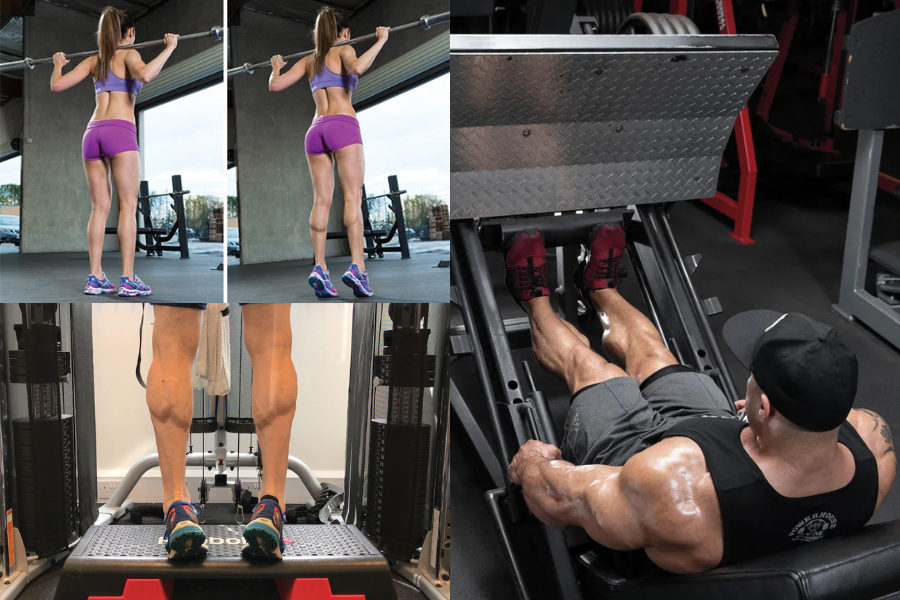
Standing calf exercises are usually your go to when you think about the best calf exercises. When you stand with your knees straight, you put more emphasis on the gastrocnemius, which is the muscle that creates that well defined, rounded look.
Basic standing calf raise
You can start with bodyweight and then add dumbbells as you get stronger. According to guidance from Mayo Clinic, holding a dumbbell in each hand and rising smoothly onto your toes is an effective way to strengthen the calf muscles and protect the Achilles tendon by creating controlled tension in the back of the lower leg.
To perform a classic standing calf raise:
- Stand tall with your feet about hip to shoulder width apart.
- Hold a dumbbell in each hand if you are adding resistance. Let your arms hang naturally at your sides.
- Brace your core and keep your back straight.
- Press through the balls of your feet to rise up onto your toes as high as you comfortably can.
- Pause at the top for a moment and squeeze your calves.
- Slowly lower your heels back down until they are just above or slightly below the level of your toes if you are on a step.
Aim for 1 set of 12 to 15 repetitions at first, as suggested for most people by Mayo Clinic trainers, then build up to 3 or 4 sets as you adapt. Focus on smooth, controlled movement rather than bouncing, and keep your knees straight throughout the exercise to maximize gastrocnemius activation.
Single leg standing calf raise
Once standard raises feel easy, progressing to single leg calf raises makes each side work independently. This helps correct strength imbalances and increases the challenge without needing a lot of extra weight.
To try it:
- Stand next to a wall or sturdy chair for balance.
- Shift your weight onto one leg and lift the other foot slightly off the floor.
- Keeping the working knee straight, rise onto the ball of that foot as high as possible.
- Pause, then lower your heel slowly and with control.
You can add a dumbbell in the same side hand to increase the difficulty. A common guideline is 2 sets of 15 repetitions per leg to start, with 30 seconds of rest between sets, and you can gradually add more sets or weight from there.
Seated calf exercises for balanced strength
If you only perform standing movements, you will likely neglect the soleus. The best calf exercises program targets both major muscles, and that means including seated work.
Seated calf raise
The seated calf raise is a classic bodybuilding move because it isolates the soleus so effectively. When your knees are bent about 90 degrees, the soleus takes on more of the effort, which builds thickness and overall strength in the lower leg.
To perform a seated calf raise at home with dumbbells:
- Sit on a sturdy bench or chair with your knees bent at roughly a right angle and feet flat on the floor.
- Place a dumbbell or heavy object across your thighs, close to your knees. Hold it in place with your hands.
- Keep your back straight and your core lightly engaged.
- Raise your heels off the floor by pushing through the balls of your feet as high as you can.
- Pause at the top and actively squeeze your calves.
- Lower your heels slowly back down to the floor.
A focused tempo, with a slow lowering phase and a brief squeeze at peak extension, helps you get more from each rep. A simple starting structure is 2 sets of about 10 repetitions per side or both legs together, with around 30 seconds of rest between sets. As you progress, you can increase the sets, reps, or weight.
Extended seated calf variation
You can also tweak your seated position to change which muscle is working the hardest. An extended seated calf raise where your knees are not fully bent places more emphasis back on the gastrocnemius, which means you are training the upper calf even though you are still sitting.
This is useful if you prefer the stability of a seated position but want to hit the larger muscle. In practice, this simply means sitting on a higher surface, extending your knees more, and following the same movement pattern of rising onto your toes and lowering slowly.
Foot positions to shape your calves
Small changes in how you point your feet help target different areas of your calves. This can be an easy way to cover more muscle fibers without learning new exercises.
During both standing and seated calf raises, you can experiment with three main foot positions:
- Toes forward so your feet point straight ahead. This generally hits both heads of the gastrocnemius evenly and is a good default.
- Toes turned slightly out. This angle tends to place more stress on the inner or medial head of the gastrocnemius.
- Toes turned slightly in. This position focuses more on the outer or lateral head.
You do not need to overcomplicate your routine. One practical approach is to perform 4 sets of calf raises and change your foot angle each set. For example, start with toes forward, then outward, then inward, then back to forward. As always, keep the movements controlled and limit the amount of rotation to what feels natural for your ankles.
Dynamic and functional calf exercises
Traditional raises are important, but they are not the only way to build stronger, more sculpted calves. Dynamic and functional exercises train your lower legs to handle real movement, which can support running, jumping, and quick changes of direction.
Eccentric calf raise on a step
Eccentric strength is your muscle’s ability to control lengthening under load, and it is especially important for injury prevention. A simple way to build it is to stand on a step so your heels can drop below your toes.
- Stand with the balls of your feet on the edge of a step and your heels hovering off.
- Rise up onto your toes with both feet.
- Shift your weight to one foot at the top.
- Slowly lower that heel down below the level of the step for a count of three or four.
- Use both feet to come back up and repeat on the same side.
This style of training strengthens the muscles and tendons through the full range of motion and can reduce the risk of strains when you stop or change direction quickly, as physical therapists such as Dr. Kate Panawash explain in discussions of calf strength and conditioning.
Tiptoe farmer’s walk
Walking on your toes while carrying weight is a simple way to challenge your calves, balance, and grip at the same time.
Hold a pair of dumbbells at your sides, rise onto your toes, and take small, controlled steps for a set distance or time. Keep your core engaged and avoid letting your ankles roll outward. This teaches your calves to work continuously instead of in short bursts.
Plyometric options
If your joints tolerate impact and you already have some base strength, adding light plyometrics can help you build power in your calves.
Moves like jump squats, lunge jumps, or quick one leg hops over a line train both strength and quickness. For example, the One Leg Over the Line drill, where you hop back and forth over an imaginary or real line on one foot for about 10 repetitions per side, improves lower leg stability and reactivity. Keep the volume modest at first, such as 2 sets per leg, and focus on soft landings.
Simple at home calf workout
You do not need a dedicated machine or a full gym to train your calves effectively. Here is a sample routine that uses the best calf exercises you have learned, with bodyweight or dumbbells.
Try this 15 to 20 minute routine two to three times per week. Rest 30 to 45 seconds between sets. If a movement causes pain instead of normal muscle fatigue, stop and adjust.
- Warm up, 3 to 5 minutes
- March in place, perform leg swings, walk on your toes and heels, or do a few sets of bodyweight squats with a focus on ankle movement. Dynamic warm ups such as leg swings and walking lunges help activate your calves and hamstrings before harder work.
- Standing dumbbell calf raises, 3 sets of 12 to 15 reps
- Use toes forward on set one, turned out on set two, and turned in on set three.
- Seated calf raises, 3 sets of 10 to 15 reps
- Place a dumbbell on your thighs. Move slowly and squeeze at the top.
- Single leg calf raises on a step, 2 sets of 12 reps per leg
- Lower your heel below step level for a full range of motion and an eccentric focus.
- Tiptoe farmer’s walk, 2 rounds
- Walk 20 to 30 seconds on your toes with dumbbells at your sides.
Finish with gentle calf stretches against a wall or with a foam roller to ease tightness and support recovery. Regular stretching increases blood flow and reduces stiffness, which makes it easier to come back strong for your next workout.
Form tips to protect your calves
Good form keeps your calves working hard while your joints stay safe. A few key points apply to almost every calf move you do.
Keep your posture tall, with a straight back and your core slightly braced. This prevents you from leaning too far forward, which can shift strain into your lower back. During standing raises, avoid locking your knees completely, but keep them mostly straight so the gastrocnemius stays engaged.
Move in a slow and controlled manner, especially on the way down. Quick bounces or half reps do not give your muscles time under tension and can irritate your Achilles tendon. Using a chair or wall for balance is smart, especially when you first try single leg variations.
Pay attention to how your calves feel from day to day. Training them two to three times per week with some rest in between sessions is usually enough. If you notice lingering soreness, sharp pain, or a feeling of tightness that does not ease with movement, ease back on volume and let your muscles recover.
Putting it all together
Well defined, strong calves come from consistency, not a single magic move. The best calf exercises combine standing and seated variations, take advantage of different foot positions, and blend in functional work like step lowers and tiptoe walks.
Start with one or two of the exercises that feel most approachable, such as basic standing raises and seated raises, and add more variety as your strength improves. Over time, your calves will not only look more sculpted, they will support you better in everything from daily errands to your favorite sports.
About the Author